
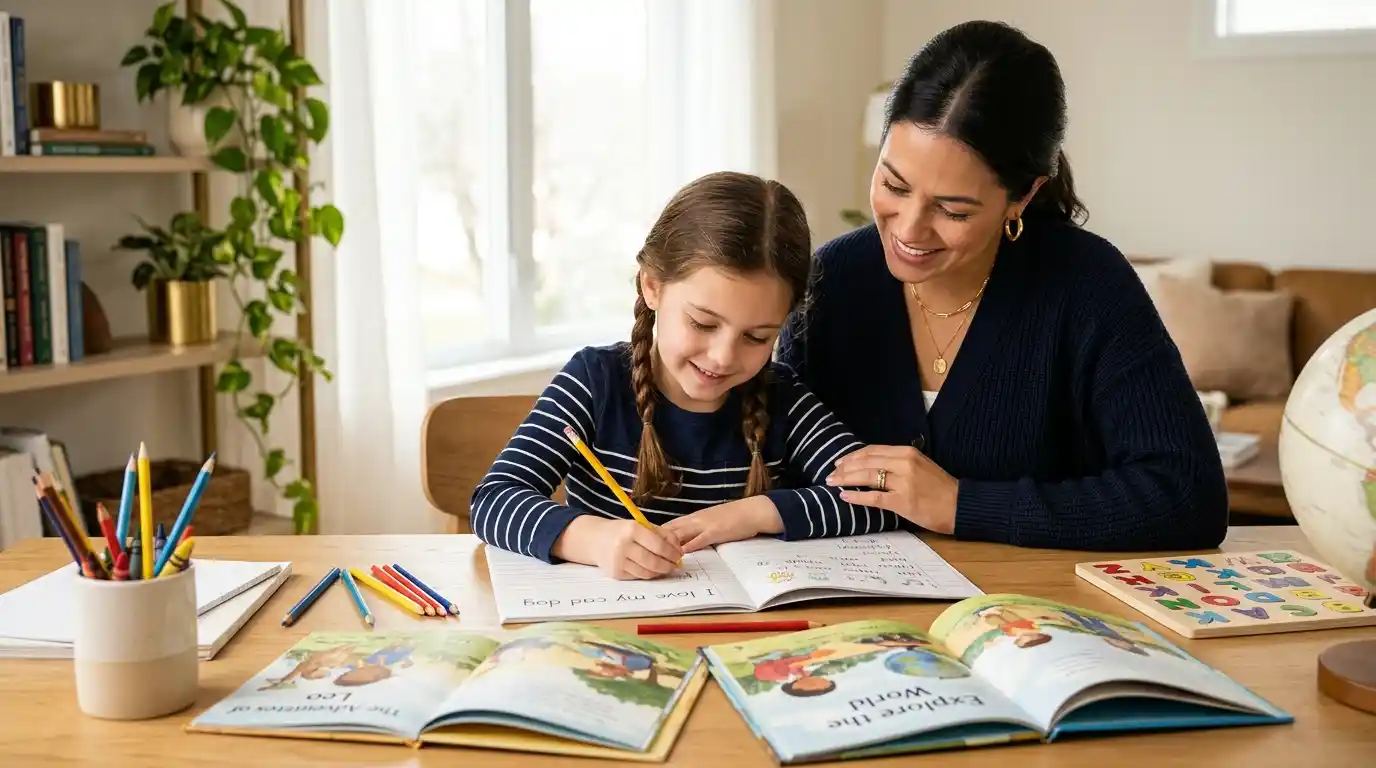
Some children love writing stories, filling notebooks with their thoughts, and creating little adventures on paper. Others find it difficult to write even a few sentences. They may struggle to form letters, spell familiar words, organise their thoughts, or decide what to write next.
If your child often says, "I don't know what to write," takes a long time to finish written homework, or avoids writing activities altogether, you are certainly not alone.
Writing is a skill that develops gradually. It involves much more than holding a pencil and putting words on paper. Children need to think about ideas, choose suitable vocabulary, construct sentences, use correct spelling, and organise their thoughts in a way that makes sense to the reader.
The good news is that parents can play an important role in this journey. Learning how to improve a child's writing skills at home does not require expensive materials or complicated teaching methods. Everyday conversations, reading together, creative games, and short writing exercises can make a meaningful difference.
The secret is to make writing a natural part of everyday life rather than something children only do when homework is assigned.
Why Are Writing Skills Important for Children?
Writing is one of the most important skills children develop during their school years. It allows them to communicate ideas, explain what they have learned, express emotions, and demonstrate their understanding of different subjects.
From writing a simple sentence in the early grades to preparing essays, stories, reports, and examination answers in higher classes, children depend on writing throughout their education.
Strong writing skills also support several areas of development.
1. Better Communication
Writing teaches children how to express their thoughts clearly. They learn to choose words, organise information, and communicate messages in a way that other people can understand.
2. Improved Vocabulary
Reading and writing introduce children to new words and different ways of using language. As their vocabulary grows, they become better at describing experiences and explaining their ideas.
3. Stronger Creative Thinking
Storytelling, journaling, and imaginative writing encourage children to think beyond familiar situations. They learn to create characters, explore possibilities, and develop their own ideas.
4. Better Academic Performance
Writing is used across almost every school subject. Children need it to explain scientific concepts, answer questions, describe historical events, solve word problems, and complete examinations.
5. Confidence and Independence
Being able to communicate through writing gives children another way to share their opinions and express themselves. As their skills improve, they often become more comfortable completing written tasks independently.
Writing involves several connected skills
A child's writing development includes handwriting, spelling, vocabulary, grammar, sentence construction, punctuation, idea development, and organising information. These abilities develop at different rates, so it is helpful to understand which particular skill needs attention.
How to Improve a Child's Writing Skills at Home: 15 Practical Tips
You do not need to turn your home into a classroom to help your child become a better writer. A few simple activities, repeated regularly, can give children the opportunity to practise different writing skills in a relaxed environment.
Here are 15 practical ways parents can make writing more enjoyable and productive.
1. Encourage Your Child to Read Every Day
One of the easiest ways to support writing development is to make reading a regular habit.
Books introduce children to sentence structures, vocabulary, punctuation, spelling patterns, and different writing styles. They also help children understand how stories and ideas are organised.
Younger children can enjoy picture books and short stories, while older children may prefer adventure books, biographies, informative articles, or age-appropriate novels.
After reading together, ask a few simple questions:
- What was your favourite part of the story?
- Which character did you like the most?
- What would you have done differently?
- What do you think might happen next?
These conversations help children develop ideas that they can later turn into written sentences.
2. Start With Short and Simple Writing Tasks
Expecting a child to write a full page when they are still learning to construct sentences can quickly become frustrating.
Begin with small tasks that feel achievable. For example, ask your child to write three sentences about their favourite game, five things they enjoy eating, or a few lines about something interesting that happened during the day.
Other simple ideas include:
- Writing a short birthday message.
- Describing a favourite toy.
- Making a list of favourite animals.
- Writing a note to a family member.
- Describing what they did during the weekend.
As children become more comfortable, gradually increase the length and complexity of their writing.
3. Make Writing Part of Everyday Life
Children sometimes associate writing only with homework, tests, and school assignments. Parents can change this by showing them how useful writing is in everyday situations.
Give your child small responsibilities that involve writing.
- Shopping lists: Ask them to write down five items needed from the market.
- Family menus: Let them prepare a menu for a pretend restaurant.
- Thank-you notes: Encourage them to write a message after receiving a gift.
- Room labels: Ask them to label drawers, books, or storage boxes.
- Instructions: Let them explain how to play their favourite game.
These activities give children a real reason to write and help them understand that written communication is useful beyond the classroom.
4. Practise Handwriting in Fun Ways
Handwriting is an important part of early writing development. Children need opportunities to learn how to form letters, control pencil movements, maintain consistent letter sizes, and leave appropriate spaces between words.
However, repeatedly copying the same letters can become boring. Try changing the materials and activities.
- Write letters on a small whiteboard.
- Use chalk to practise words outdoors.
- Form letters in a tray of sand.
- Trace large letters using a finger.
- Practise writing names and familiar words.
- Use age-appropriate handwriting worksheets.
Check that your child is sitting comfortably, holding the pencil comfortably, and using the handwriting style taught at school.
Remember that handwriting and creative writing are separate skills. A child may have wonderful ideas but still need support with pencil control and letter formation.
5. Build Your Child's Vocabulary Through Conversation
Children need words before they can use those words confidently in writing.
Instead of asking them to memorise long vocabulary lists, introduce new words through everyday conversations, reading, and observation.
For example, if your child says, "The garden is nice," encourage them to describe what makes it interesting.
Ask questions such as:
- What colours can you see?
- What flowers are growing there?
- How does the garden smell?
- Does it feel peaceful or exciting?
The child might then write: "The colourful garden is filled with beautiful flowers. The fresh air makes it feel peaceful."
This simple exercise teaches children how descriptive words can make sentences more interesting.
6. Use Pictures as Writing Prompts
Sometimes children struggle with writing because they cannot think of an idea. Pictures can make getting started much easier.
Show your child a photograph, illustration, or picture from a storybook and ask them to describe what they see.
For younger children, begin with questions:
- Who is in the picture?
- Where are they?
- What are they doing?
- What might happen next?
Older children can use the same picture to create an imaginative story with a beginning, middle, and ending.
For example, a picture of an old wooden door could inspire a story about a secret room, a hidden treasure, or an unexpected adventure.
7. Create a Simple Writing Journal
A journal gives children a personal space to write about their experiences, thoughts, and interests.
Choose a notebook that your child likes and encourage them to write a few lines regularly.
Possible journal topics include:
- Something interesting that happened today.
- My favourite memory from this week.
- A person who inspires me.
- What I would do if I could travel anywhere.
- Something new I learned.
- My plans for the weekend.
Do not insist on correcting every spelling or grammar mistake. The first goal is to help children become comfortable expressing their thoughts on paper.
8. Play Word and Spelling Games
Spelling practice does not always have to involve writing words repeatedly in a notebook. Games can make the process more enjoyable while helping children recognise letter patterns and remember vocabulary.
Try these activities:
- Word building: Give your child a group of letters and ask them to create as many words as possible.
- Word of the day: Introduce one new word and ask your child to use it in a sentence.
- Missing letters: Write a familiar word with one or two letters missing.
- Rhyming words: Ask them to find words that rhyme with a given word.
- Word categories: Choose a topic such as animals, fruits, or places and create a list.
These games support spelling, vocabulary, and language development.
9. Teach Children How to Build Better Sentences
A child may know several words but still struggle to put them together into a complete sentence.
Start with simple sentence structures and gradually encourage them to add more information.
Example:
Basic sentence: "The boy is playing."
Improved sentence: "The little boy is playing football in the garden."
Ask questions that help children expand their ideas:
- Who is doing the action?
- What are they doing?
- Where is it happening?
- When is it happening?
- How does the person feel?
This method helps children move from short sentences towards more detailed and descriptive writing.
10. Encourage Storytelling and Creative Writing
Children often have wonderful imaginations. Give them opportunities to turn their ideas into stories.
You can begin with simple story starters such as:
- One morning, I discovered a mysterious box outside my door...
- If I could spend one day with any animal...
- When I opened the book, something unexpected happened...
- My dream school would have...
- If I became a superhero for one day...
Allow your child to develop the story in their own way. Do not worry too much about perfect spelling or grammar during the first draft.
The aim is to help them enjoy creating ideas and expressing them through writing.
11. Introduce Simple Grammar and Punctuation
Grammar and punctuation help children communicate their ideas clearly. Rather than teaching every rule at once, introduce concepts gradually through examples.
Begin with:
- Capital letters at the beginning of sentences.
- Full stops at the end of statements.
- Question marks for questions.
- Commas in appropriate lists.
- Correct use of nouns, verbs, and adjectives.
- Basic present, past, and future tense.
For example, ask your child to improve this sentence:
"my sister likes reading books"
Together, change it to:
"My sister likes reading books."
Small corrections and clear examples help children understand how written language works.
12. Help Your Child Plan Before Writing
Sometimes the biggest challenge is not spelling or handwriting. It is deciding what to write and in which order.
Teach your child to organise their thoughts before starting a longer writing task.
For a simple story, use this structure:
- Beginning: Introduce the characters and setting.
- Middle: Explain what happens and describe the main event.
- Ending: Tell the reader how the story finishes.
For older children, simple mind maps, bullet-point outlines, and short notes can help organise paragraphs before writing an essay.
13. Encourage Your Child to Edit and Improve Their Work
Good writing often takes more than one attempt. Children should learn that reviewing and improving a first draft is a normal part of writing.
After your child finishes a short piece, read it together and ask:
- Does the writing make sense?
- Are any important details missing?
- Does every sentence begin with a capital letter?
- Have full stops and question marks been used correctly?
- Are there words that could make the description more interesting?
Choose one or two areas to improve at a time. Too many corrections can make children lose interest.
14. Introduce Age-Appropriate Digital Writing
As children grow older, keyboard skills and digital writing become increasingly useful.
With suitable supervision, older children can practise by:
- Typing short stories.
- Creating a digital journal.
- Writing simple emails to family members.
- Preparing short presentations.
- Creating a simple family newsletter.
Digital writing provides another way to express ideas, but it should complement rather than automatically replace handwriting practice.
15. Make Writing a Positive Family Activity
Children often learn by observing the people around them. If they see parents writing shopping lists, making notes, preparing messages, or reading books, they begin to understand that writing is part of everyday life.
Try creating a small family writing activity once a week.
Everyone can write a short story, share a favourite memory, prepare a thank-you note, or describe something interesting that happened.
Share the writing with each other and appreciate everyone's effort. This helps children see writing as a way to communicate rather than just another school responsibility.
How to Improve Your Child's Handwriting at Home
Handwriting deserves special attention because it is one of the physical skills children use when producing written work.
If your child's letters are difficult to read, words run together, or writing appears uneven, first identify the particular difficulty instead of simply asking them to write more neatly.
Focus on Letter Formation
Help your child practise how individual letters are formed. Use the same letter style taught by their school so that they receive consistent guidance.
Work on Letter Size and Spacing
Show children how to keep letters a reasonably consistent size and leave spaces between words. Lined paper can be useful for practising letter placement.
Encourage Comfortable Pencil Control
Check that the child can hold and move the pencil comfortably. Avoid forcing an uncomfortable grip. If writing causes pain or excessive fatigue, seek advice from the teacher or an appropriate professional.
Include Fine Motor Activities
Drawing, colouring, puzzles, building blocks, and playing with modelling clay provide opportunities to develop hand coordination and control.
Keep handwriting sessions short and focused. Regular practice of a particular difficulty is generally more useful than repeatedly copying long paragraphs.
Easy Writing Activities for Kids at Home
Not sure what your child should write about? Here are some activities that can be adapted for different ages and school levels.
| Writing Activity | Skill Developed | Suggested Task |
|---|---|---|
| Daily journal | Sentence construction | Write three lines about the day. |
| Picture description | Vocabulary | Describe a favourite picture. |
| Story starters | Creative writing | Complete an imaginative story. |
| Shopping list | Practical writing | Write five household items. |
| Greeting cards | Communication | Write a birthday message. |
| Word games | Spelling and vocabulary | Build words from given letters. |
| Comic strips | Dialogue and sequencing | Create a short illustrated story. |
| Book reviews | Reading comprehension | Describe a favourite book. |
| Instructions | Organising information | Explain how to play a game. |
| Family newspaper | Research and composition | Write about family activities. |
Choose activities according to your child's age, interests, and current writing ability. A younger child may begin by labelling pictures, while an older student can create a short article or book review.
How to Create a Daily Writing Routine for Children
A common mistake is to make writing practice too long. Children do not necessarily need to spend an hour writing every day to develop their skills.
A short and consistent routine can be easier to maintain, especially when it includes different activities.
A Simple 15-Minute Writing Routine
| Time | Activity | Purpose |
|---|---|---|
| Minutes 1–3 | Discuss an interesting topic. | Develop ideas. |
| Minutes 4–6 | Plan what to write. | Organise thoughts. |
| Minutes 7–12 | Write independently. | Practise writing. |
| Minutes 13–15 | Review one or two things. | Learn from feedback. |
Sample Weekly Writing Schedule
| Day | Writing Activity |
|---|---|
| Monday | Describe a picture. |
| Tuesday | Write a short journal entry. |
| Wednesday | Create an imaginative story. |
| Thursday | Write a letter or greeting card. |
| Friday | Play a vocabulary or spelling game. |
| Saturday | Write about a family activity. |
| Sunday | Read and review the week's writing. |
The routine can be adjusted according to the child's school schedule and energy levels. Some days may involve handwriting practice, while others focus on storytelling or vocabulary.
How Can Parents Improve Writing Skills According to a Child's Age?
Writing development looks different at every stage. A five-year-old who is learning to form letters should not be given the same writing expectations as a student preparing longer essays.
Early Years and Kindergarten
Focus on pre-writing activities, drawing, recognising letters, tracing, writing names, and developing pencil control.
Encourage children to describe their drawings and tell simple stories, even if they are not yet able to write every word independently.
Grades 1–3
Introduce short sentences, familiar vocabulary, simple punctuation, spelling patterns, and basic handwriting practice.
Children can begin writing about pictures, favourite activities, family members, and short stories.
Grades 4–5
Encourage paragraph writing, descriptive language, story structure, basic grammar, and organising ideas into a logical sequence.
Book reviews, journal entries, letters, and short reports can provide useful practice.
Grades 6–8
Older students can practise longer compositions, essays, summaries, research-based writing, and persuasive arguments.
Help them understand how to create introductions, develop supporting points, organise paragraphs, and write meaningful conclusions.
Grades 9 and Above
Students can focus on analytical writing, structured essays, formal communication, reports, critical thinking, and editing their own work.
Encourage them to support their arguments with relevant information and communicate ideas clearly.
Remember: These are general activity suggestions, not strict developmental deadlines. Children progress at different rates, and their individual learning needs should guide the amount and type of practice.
What If Your Child Struggles With Writing?
Not every writing difficulty has the same cause. One child may have difficulty forming letters, while another may have excellent handwriting but struggle to organise ideas into paragraphs.
Before choosing an activity, try to identify what is actually making writing difficult.
Difficulty With Handwriting
If letters are inconsistent, difficult to recognise, or uncomfortable to write, focus on letter formation, pencil control, spacing, and comfortable positioning.
Difficulty With Spelling
Use age-appropriate word games, spelling patterns, reading activities, and short practice exercises. Connect unfamiliar words with examples and sentences.
Difficulty Finding Ideas
Discuss the topic before asking the child to write. Pictures, mind maps, storytelling, and question prompts can help them organise their thoughts.
Difficulty Constructing Sentences
Begin with simple sentence patterns and gradually introduce descriptive details, connecting words, and more complex structures.
Difficulty Organising Paragraphs
Teach children to use a beginning, supporting details, and a concluding sentence. Planning notes before writing can make longer tasks easier.
Difficulty Staying Focused
Break larger tasks into smaller sections. Provide a comfortable workspace, remove unnecessary distractions, and allow short breaks when needed.
If writing difficulties persist despite appropriate support, speak with the child's teacher. A qualified educational or developmental professional can help identify whether additional assessment or targeted support is needed.
Messy handwriting or spelling mistakes alone do not establish a learning disorder. It is important to look at the child's wider learning pattern rather than relying on a single sign.
Common Mistakes Parents Should Avoid During Writing Practice
Parents naturally want to see their children improve, but the way feedback is given can influence how children feel about writing.
Here are some habits worth avoiding:
- Correcting every mistake: Too many corrections can interrupt a child's ideas and make writing feel stressful.
- Comparing children: Every child has a different pace of development. Focus on individual progress.
- Forcing long writing sessions: Long exercises may cause tiredness and frustration, especially for younger children.
- Focusing only on handwriting: Good writing also involves vocabulary, ideas, organisation, and sentence construction.
- Choosing activities that are too difficult: Tasks should provide a manageable challenge rather than constant frustration.
- Ignoring creative ideas: Encourage imagination before focusing on every spelling and grammar detail.
- Making writing feel like punishment: Keep practice positive and give children opportunities to write about topics they enjoy.
The aim is to build a lasting interest in writing, not simply to complete another worksheet.
How Can Reading and Writing Work Together?
Reading and writing support each other. When children read regularly, they become familiar with how words, sentences, and paragraphs work.
They also discover different writing styles, learn new vocabulary, and develop an understanding of how information and stories are presented.
Parents can connect both activities in simple ways.
- After reading a story, ask your child to write a different ending.
- Ask them to describe their favourite character.
- Let them write a short summary of a book.
- Encourage them to create a new story using words they discovered while reading.
- Ask them to write three questions about a story.
These activities help children understand what they read and use that understanding to develop their own written expression.
How Can School and Parents Work Together to Improve Writing Skills?
Children benefit when the writing support they receive at home complements what they learn at school.
Teachers understand the curriculum, the writing expectations for each grade, and the areas where students may need additional practice. Parents can reinforce these skills through everyday activities at home.
A helpful partnership can include:
- Discussing the child's current writing strengths and difficulties with teachers.
- Understanding the handwriting and spelling methods used in the classroom.
- Practising relevant skills at home without overwhelming the child.
- Encouraging reading and creative writing outside school hours.
- Sharing progress and discussing areas that need additional support.
When parents and teachers communicate regularly, children receive more consistent guidance and can build confidence in their writing abilities.
How School of Scholars Supports Children's Learning and Development
At School of Scholars, education is about developing the knowledge, abilities, and confidence children need throughout their learning journey.
Writing is an important part of this development because it helps students communicate ideas, demonstrate understanding, develop creativity, and express themselves clearly.
A positive learning experience should encourage children to ask questions, explore new ideas, read regularly, participate in classroom activities, and develop their individual strengths.
Parents also play an important role. Reading together, encouraging creative expression, and providing opportunities for everyday writing can reinforce the learning children experience at school.
The goal is not simply to produce neat handwriting or longer essays. It is to help children become thoughtful, confident, and independent communicators.
Parents can explore more educational guidance and learning resources through the School of Scholars website.
Final Thoughts: Small Writing Habits Can Make a Big Difference
Helping a child become a better writer does not require complicated lessons or hours of daily practice. It begins with simple opportunities to read, think, talk, and express ideas.
A shopping list, a few lines in a journal, a handmade birthday card, or a short story about an imaginary adventure can all become valuable learning experiences.
Be patient when your child makes mistakes. Celebrate their ideas, encourage independent thinking, and give them enough time to develop their skills.
Remember, the goal is not to make children perfect writers overnight. It is to help them enjoy expressing their thoughts and become more confident with every writing experience.
With regular practice, supportive guidance, and activities suited to their age and interests, children can gradually strengthen their handwriting, spelling, vocabulary, sentence construction, and creative writing abilities.
Explore School of ScholarsFrequently Asked Questions About Improving Children's Writing Skills
1. How can I improve my child's writing skills at home?
Encourage daily reading, short writing exercises, journaling, storytelling, vocabulary games, and picture descriptions. Give positive feedback and gradually introduce more challenging tasks.
2. How can I make writing fun for my child?
Use creative stories, comic strips, picture prompts, word games, greeting cards, journals, and everyday activities such as writing shopping lists.
3. How often should children practise writing?
Short and regular practice is a useful starting point. The appropriate amount depends on the child's age, writing ability, schoolwork, and individual learning needs.
4. Does reading help improve children's writing skills?
Yes. Reading introduces children to new vocabulary, spelling patterns, sentence structures, and different writing styles that they can use in their own work.
5. How can I improve my child's handwriting at home?
Practise letter formation, spacing, consistent letter size, and comfortable pencil control. Drawing, colouring, and short handwriting exercises can also support development.
6. What should I do if my child does not enjoy writing?
Start with short activities about topics your child enjoys. Use pictures, games, stories, and everyday writing tasks instead of forcing long assignments.
7. How can I help my child write better sentences?
Start with simple sentences and encourage children to add details about who, what, where, when, and how. Gradually introduce descriptive words and connecting phrases.
8. Should parents correct every spelling and grammar mistake?
No. Focus on one or two important improvements at a time. Praise good ideas and effort so children remain motivated to write.
9. What are the best writing activities for kids at home?
Useful activities include daily journals, picture descriptions, short stories, comic strips, shopping lists, greeting cards, book reviews, and spelling games.
10. When should I seek help if my child struggles with writing?
Speak with your child's teacher if writing difficulties persist, cause significant frustration, or affect schoolwork. A suitable educational assessment may help identify the support needed.
Further Reading and Educational Resources
Parents who want to explore children's writing development in more detail can refer to these educational resources:


Comments are closed