By 2030, school will probably still have teachers, classrooms, and homework but a lot of what happens inside them will change. Expect AI tutors that adapt to each child in real time, more project-based learning instead of pure memorization, teachers shifting into more of a mentor role, and a much bigger focus on critical thinking, creativity, and AI literacy. AI won’t replace school. It’ll change what school is actually for.
Let’s walk through what this could realistically look like.
Picture This: A School Morning in 2030
A child walks into class. The lesson isn’t identical for every student in the room anymore. An AI learning assistant already knows which math concepts this particular kid has nailed, where they’re stuck, and what kind of practice would actually help.
Instead of just memorizing facts, students spend more time solving real problems, building projects, working with classmates, experimenting with new tools, and importantly learning how to use AI responsibly instead of blindly.
This isn’t science fiction. It’s already starting. AI is already being used to personalize learning, cut down teachers’ admin workload, support accessibility, and open up new ways of teaching. The World Economic Forum has described AI as something that can personalize learning while supporting teachers not replacing them.
So what will school life actually look like for kids growing up in this shift? Nobody has a crystal ball, but several changes are already showing up.
1. AI Tutors Could Become a Normal Part of Learning
Right now, if a kid doesn’t understand something in class, they usually have to wait until the next lesson or ask a parent who may not remember how fractions work either. An AI tutor changes that. It can explain things instantly, generate practice questions, and give feedback the moment a student needs it.
Say a child is stuck on fractions. Instead of just marking the answer wrong, an AI tutor could notice the actual mistake maybe they’re confused about denominators and offer a simpler explanation before trying another question. The point isn’t to hand over answers. It’s to act like a patient study buddy that helps the child understand why something is right, not just that it’s right.
UNESCO has pointed out that intelligent tutoring systems are already in use for subjects like math, languages, geography, and chemistry though it stresses these tools need to stay human-centered, not just automated.
By 2030, students may realistically have access to:
- AI-powered tutoring available outside class hours
- Personalized practice questions
- Instant feedback instead of waiting for grading
- Adaptive learning activities that adjust in real time
- Voice-based learning assistants
- AI-generated explanations tailored to how they learn
2. Learning Could Get Genuinely Personalized
Here’s the problem with a traditional classroom: 30 kids get the exact same lesson at the exact same pace, even though they don’t all learn the same way. Some pick up multiplication instantly. Others need more reps. Some learn best from reading, others from visuals or hands-on experiments.
AI could help schools build more personalized learning paths giving advanced students harder problems while giving struggling students simpler explanations and extra practice, all without singling anyone out. The World Economic Forum lists personalized learning as one of AI’s biggest opportunities in education.
A possible 2030 learning flow:
Assessment → AI spots learning gaps → Personalized activities →
Student practices → AI gives feedback → Teacher reviews progress
This makes learning more flexible — without cutting the teacher out of the loop.
3. Teachers Won’t Disappear They Might Matter Even More
One of the biggest myths floating around is that robots are coming for teaching jobs. The more realistic picture: AI takes over repetitive tasks, freeing teachers to actually focus on the kids.
Right now, teachers spend a huge chunk of their time prepping materials, grading, organizing records, and handling admin work. If AI can absorb some of that load, teachers get more time for mentoring, discussion, creative activities, relationship-building, and one-on-one support. The World Economic Forum has specifically pointed to AI’s potential to handle administrative work so educators can focus more on actual teaching and student connection.
In a 2030 classroom, a teacher looks less like someone reciting facts, and more like a:
- Mentor
- Coach
- Project leader
- Emotional support figure
- Critical-thinking guide
- Learning strategist
AI can hand over information. Only a human teacher can give context, judgment, and genuine connection.
4. Classrooms Could Get a Lot More Interactive
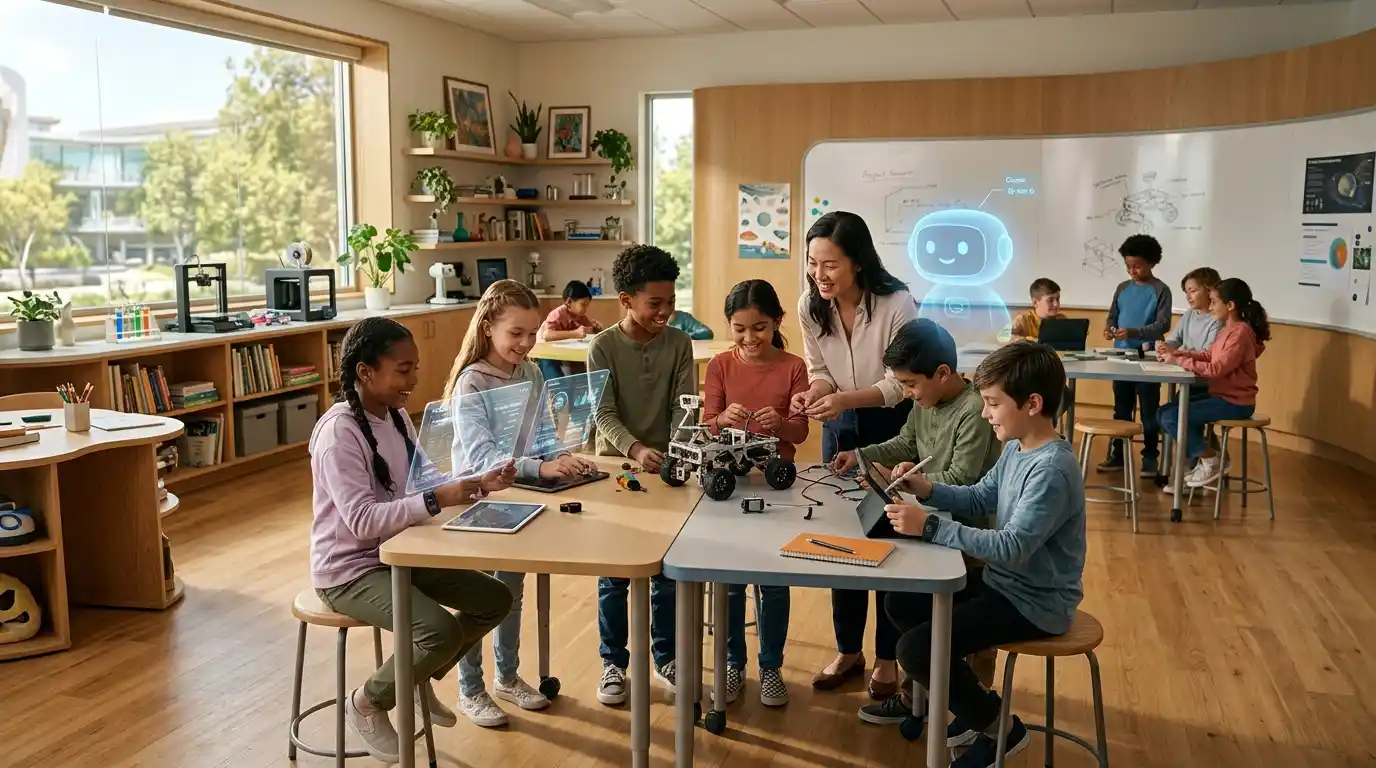
The classroom of 2030 probably won’t look like rows of desks and a chalkboard. It could mix AI, interactive screens, virtual simulations, augmented reality, robotics, digital labs, and hands-on group projects.
Imagine learning about ancient Rome by exploring a virtual reconstruction of the actual city. Or understanding space by stepping into an immersive simulation of the solar system. Or studying the human body through an interactive 3D model instead of a flat diagram in a textbook.
Technology like this can make abstract ideas click faster but it should genuinely deepen learning, not just make lessons flashier for the sake of it.
5. Memorizing Facts Could Matter Less Than Understanding Them
If AI can pull up any fact instantly, kids may not need to memorize as much raw information they’ll need to know what to do with it.
That doesn’t mean basics stop mattering. Reading, writing, math, and general knowledge are still the foundation everything else builds on. But education is likely to shift toward questions like:
- Can you explain this in your own words?
- Can you apply it to a new situation?
- Can you spot the actual problem?
- Can you judge whether information is trustworthy?
- Can you build something new from it?
- Can you defend your reasoning?
This matters more than ever because AI can generate answers fast but it can’t tell a student whether that answer is accurate, fair, or biased. That judgment call still needs a human brain behind it.
6. Critical Thinking Becomes a Core Life Skill, Not a Bonus
Kids growing up now will be surrounded by AI-generated content constantly AI-written articles, AI-made images, synthetic videos, chatbots, and endless auto-generated social media posts.
That creates a genuinely new challenge: teaching kids to stop and ask real questions before believing what they see.
- Is this actually true?
- Where did this come from?
- Is there a hidden assumption baked into this?
- Could this be biased?
- What actual evidence backs this up?
UNESCO has stressed that both students and teachers need to understand AI’s potential and its risks, with an approach that stays inclusive and human-centered rather than purely technical.
By 2030, knowing how to critically evaluate AI output might be just as basic a skill as knowing how to search Google is today.
7. Kids May Learn How AI Actually Works Not Just How to Use It
AI won’t just be something children passively use. Many will start learning the mechanics behind it too.
Schools could introduce age-appropriate lessons on:
- What artificial intelligence actually is
- How machine learning works at a basic level
- How algorithms make predictions
- What “data” really means
- AI bias and where it comes from
- Digital privacy
- Responsible AI use
- Generative AI
- Online safety
- AI ethics
Younger kids might pick this up through games and simple hands-on experiments. Older students could go deeper into coding, data, robotics, and machine learning basics.
The goal isn’t to turn every child into a future AI engineer. It’s to make sure they grow up as informed users and thinkers, not just passive consumers of whatever an algorithm serves them.
8. Creativity Might Become More Valuable, Not Less
If AI can already generate text, images, music, and presentations in seconds, you might assume creativity becomes less important. It’s actually the opposite.
When machines can churn out content instantly, what stands out is a child’s ability to come up with original ideas, mix concepts in unexpected ways, and communicate a genuinely unique perspective.
A student might use AI to brainstorm ideas for a story but they still have to decide what the story actually means, who the characters are, what emotions it should stir, and how the final piece should come together.
AI becomes the tool. The child stays the creator.
That’s exactly why future education can’t just focus on technical skills. Creativity, imagination, and communication aren’t going anywhere.
9. Projects Could Replace a Lot of Traditional Assignments
Instead of “answer these 20 questions,” schools may lean much harder into project-based learning.
For example, a class might get a challenge like: “Design a sustainable city for 2040.”
Students would research population growth, transportation, energy, housing, and environmental factors. They might use AI to gather information, sketch out visual concepts, or analyze data but they’d still have to collaborate, make real decisions, and explain their reasoning out loud.
The final project would combine research, teamwork, creativity, presentation skills, and genuine problem-solving preparing kids for a world where there usually isn’t one single “correct” answer.
10. Soft Skills Could Become Core Curriculum, Not an Afterthought
No matter how fast technology moves, human skills stay relevant. Kids growing up in the AI era will still need to work well with other people arguably more than ever.
Schools may put much more weight on:
- Communication
- Leadership
- Teamwork
- Empathy
- Adaptability
- Problem-solving
- Emotional intelligence
- Creativity
- Decision-making
- Resilience
The World Economic Forum has argued that future education needs to blend technical skills with these human, adaptable ones. A kid who’s great at prompting AI but can’t communicate, collaborate, or think independently is still going to struggle.
11. Homework Could Look Completely Different
Picture homework in 2030. Instead of:
“Read Chapter 5 and answer questions 1–10.”
It might look more like:
“Use what you learned about ecosystems to design a sustainable mini-city.”
The student researches, experiments, builds something, presents it, and gets feedback. AI could help them practice concepts at home too.
But here’s the catch schools will need clear rules around this. If AI just does the entire assignment for the student, nothing actually gets learned. The goal has to be AI-assisted learning, not AI-replaced learning.
12. Assessments and Exams May Need a Serious Rethink
Traditional exams mostly test what a student can remember and reproduce on demand. The problem: AI can already generate convincing written answers to most of those questions.
That means schools will likely need to shift how they assess learning. By 2030, expect more:
- Oral presentations
- Practical, hands-on projects
- Group challenges
- Real problem-solving tasks
- Portfolio-based assessment
- Classroom discussions
- Real-world simulations
- Personal reflections
Teachers may increasingly ask students to explain their thinking rather than just deliver a final answer shifting the focus toward genuine understanding and application.
13. AI Could Make Education More Accessible
This is one of the more hopeful shifts. AI-powered tools could help kids with different learning needs through:
- Text-to-speech
- Speech-to-text
- Real-time language translation
- Adjustable reading levels
- Visual explanations for complex ideas
- Personalized interfaces
- Alternative formats for different learning styles
The World Economic Forum has pointed to AI-enabled digital tools as a real opportunity to widen access to quality education for diverse learners. The open question is whether this access will actually be equitable or whether it’ll mostly benefit kids who already have resources.
14. Screen Time Will Still Be a Real Concern
More tech doesn’t automatically mean better learning and this might be one of the biggest challenges schools face by 2030.
Kids still need physical activity, real face-to-face conversations, time outdoors, creative play, actual books, enough sleep, and time away from screens entirely. Recent international education findings have already raised concerns about digital distraction hurting students’ reading skills and overall focus.
The future classroom shouldn’t mean “all technology, all the time.” It should mean the right technology, used at the right moments not as a substitute for everything else kids need to grow.
15. AI Ethics Could Become Part of Everyday School Life
Kids will need to understand early on that technology comes with real responsibility attached. Schools might start tackling questions like:
- Should AI be allowed to make decisions that affect people?
- How should personal data actually be protected?
- What happens when an AI system turns out to be biased?
- Is it okay to use AI to help with an assignment — and where’s the line?
- Who actually owns something AI generates?
- Can AI-generated information always be trusted?
These aren’t just tech questions they’re questions about fairness, responsibility, and human values. UNESCO has specifically pushed for human-centered AI in education, with a strong focus on inclusion, equity, and preventing AI from widening existing educational gaps rather than closing them.
What Might an Actual School Day Look Like in 2030?
Here’s one realistic possibility:
8:00 AM — Personalized Learning Students start with a short activity. An AI system checks previous progress and recommends exercises suited to each kid.
9:00 AM — Teacher-Led Lesson The teacher introduces a new concept and runs a discussion. AI supports the lesson in the background but doesn’t take over.
10:00 AM — Collaborative Project Students team up to tackle a real-world challenge, using digital tools to research and build solutions together.
11:30 AM — Creative Learning Time for art, storytelling, design, music, or media projects with AI available as a creative tool, not a replacement for imagination.
1:00 PM — Practical Learning Hands-on experiments, robotics, science activities, or outdoor learning.
2:00 PM — Reflection Students talk through what they learned, where they got stuck, and what they’d do differently next time.
2:30 PM — Personalized Practice Individual activities matched to each student’s specific learning needs.
This is just one version of how it could look but the underlying idea holds up: the school of 2030 probably won’t replace traditional education. It’ll blend human teaching with smart technology.
What Skills Will Kids Actually Need for 2030?
Nobody can predict exactly which jobs will exist in ten years. What matters more is raising kids who can adapt to whatever comes.
| Skill | Why It Matters |
|---|---|
| Critical Thinking | Helps kids judge whether AI-generated information is actually trustworthy |
| Creativity | Lets students generate genuinely original ideas |
| Communication | Essential for teamwork and leadership |
| Problem-Solving | Prepares kids to handle unfamiliar situations |
| AI Literacy | Teaches responsible, informed AI use |
| Digital Literacy | Supports safe and effective tech use overall |
| Collaboration | Helps kids work well with both people and technology |
| Adaptability | Prepares them for careers that don’t even exist yet |
| Emotional Intelligence | Strengthens relationships and decision-making |
| Curiosity | Fuels lifelong learning, long after school ends |
The real goal isn’t teaching kids how to use AI. It’s teaching them how to think in a world where AI is just… always there.
Will AI Actually Replace Schools?
Short answer: probably not at least not the way movies make it look.
School gives kids far more than academic content. It gives them a place to make friends, practice teamwork, build confidence, learn social skills, join activities, form relationships with mentors, and gradually build independence.
AI can hand over information and assistance. It can’t recreate the experience of actually growing up alongside other kids in a shared community. The more realistic future is AI-enhanced education, not AI-run schools. The World Economic Forum backs this same view — that AI should enhance teaching and support teachers, not replace them outright.
The Real Challenge: Getting the Balance Right
The question was never whether kids will use AI. They almost certainly will, whether schools plan for it or not.
The real question is: how do we teach them to use it well?
- Too little tech, and kids show up unprepared for a world that runs on it.
- Too much tech, and kids lose independent thinking, human connection, and genuinely meaningful learning.
The likely answer is balance. Kids need to know how to use AI but also how to think and learn without it. They need digital skills but also solid communication skills. They need technology but they also need actual play. They need information but more than that, they need judgment.
The AI Generation Needs More Than Just AI
Kids entering school in the coming years will grow up in a world where artificial intelligence is completely normal not a novelty, just part of the background. They’ll use it to study math, translate languages, explore science, write stories, and solve problems.
But here’s the thing: the most successful kids probably won’t be the ones using the most technology. They’ll be the ones who know exactly when to use it, when to question it, and when to just think for themselves.
The school of 2030 could genuinely become a place where humans and technology work side by side teachers as mentors, AI as a learning assistant, classrooms built around personalization, and assignments built around real projects. Skills like creativity, curiosity, critical thinking, and empathy could end up mattering just as much as traditional academic knowledge.
The future of education was never really about raising kids who can compete with AI. It’s about preparing kids to live, learn, and create in a world that AI has already reshaped.
Frequently Asked Questions
What will school life look like in 2030? Expect AI-powered learning assistants, more personalized lessons, interactive technology, project-based assignments, and a much stronger focus on critical thinking, creativity, and digital literacy with teachers still very much at the center of it all.
Will AI replace teachers by 2030? Unlikely. AI is far more likely to assist teachers than replace them handling personalized learning support, instant feedback, and admin tasks — while teachers focus on mentorship, emotional support, and classroom leadership.
How will AI change education for kids specifically? AI can personalize learning by adapting materials to each student, give instant feedback, offer tutoring support, improve accessibility, and open up new, more interactive ways to explore subjects.
What skills will children actually need for 2030? A mix of digital and human skills: AI literacy, critical thinking, creativity, communication, collaboration, problem-solving, adaptability, and emotional intelligence.
Will kids still use textbooks in 2030? Probably, alongside digital resources — expect a blend of traditional textbooks with interactive tools, simulations, and AI-powered learning apps rather than a complete replacement.
Will homework disappear because of AI? Not likely. It’ll probably shift shape instead moving toward projects, hands-on activities, reflection, and problem-solving rather than pure memorization drills.
Why does AI literacy matter for children? It helps them understand how AI actually works, recognize its limitations, spot biased or inaccurate information, and use it responsibly instead of blindly trusting whatever it outputs.
Can AI genuinely make education more accessible? Yes tools like translation, speech-to-text, text-to-speech, and personalized formats can help a lot. The real challenge is making sure that access is fair and doesn’t just benefit kids who already have more resources.
Will kids still need to learn basic reading and math? Absolutely these remain the foundation everything else is built on. AI can support learning, but kids still need core knowledge and reasoning skills to actually use and evaluate information well.
What’s the biggest overall challenge with AI in education? Finding the right balance between technology and human learning while also addressing privacy, bias, unequal access, academic honesty, screen time, and the risk of kids becoming overly dependent on AI instead of thinking for themselves.