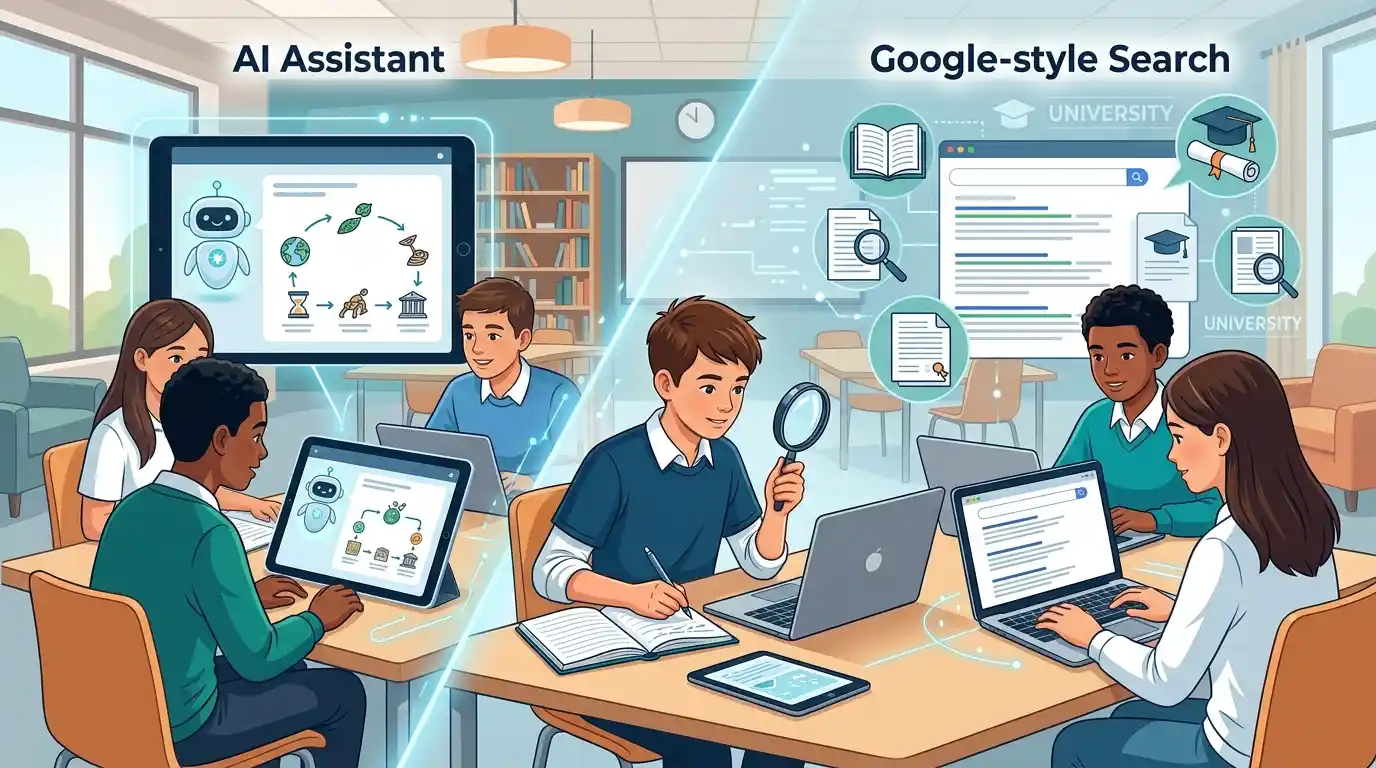
Neither one wins on its own. Google is best for finding real sources websites, research papers, official pages. AI is best for understanding what those sources actually mean. The smartest students use both together, not one instead of the other.
Students today have more ways to find answers than any generation before them. A question that used to mean flipping through a textbook or waiting to ask a teacher can now be answered in seconds through Google, or through an AI tool.
That raises an obvious question: should students be using AI or Google?
The honest answer is: it depends what you’re trying to do. Google is great at finding things websites, videos, papers, official resources. AI is great at explaining things breaking down a hard concept, walking through an example, answering follow-up questions in plain language. Used together, they cover each other’s gaps.
What’s the Real Difference Between AI and Google?
Google shows you where information lives it points you to websites and sources. AI generates an answer directly, based on patterns it learned during training (and, depending on the tool, current web results too).
Say a student searches: “What is photosynthesis?”
Google hands back links educational sites, videos, science resources, articles. An AI tool explains photosynthesis in simple words, tailored to whatever level the student needs.
Quick comparison:
| What you need | AI Tools | Google Search |
|---|---|---|
| A quick explanation | Excellent | Good |
| Finding original sources | Limited | Excellent |
| Locating research papers | Can summarize them | Excellent |
| Simple, plain-language answers | Excellent | Good |
| The latest information | Depends on the tool | Excellent |
| Multiple points of view | Good | Excellent |
| Learning at your own pace | Excellent | Limited |
| Confirming a fact is true | Needs double-checking | Easier — compare sources |
| Brainstorming ideas | Excellent | Good |
| Homework help | Excellent | Good |
| Finding official websites | Good | Excellent |
When Should Students Use Google?
Reach for Google when you need real sources, not just an answer.
Working on a school project. Google helps you find educational websites, government pages, university sources, research papers, books, news articles, videos, and statistics so you can compare several sources instead of trusting just one.
Checking anything time-sensitive. Current events, new discoveries, tech updates, sports stats, government policy, today’s prices anything that changes often needs a live, authoritative source, not a static AI answer.
Verifying a claim. Always ask, “Where did this actually come from?” Google makes it easy to trace a claim back to its source and check it against other sites.
Finding the original source, not a summary. If you’re doing real academic work, don’t stop at an AI’s summary of a study. Use Google to find the actual paper and check the authors, publication date, method, findings, and references yourself.
When Should Students Use AI?
Reach for AI when the goal is understanding, not just finding.
A topic just isn’t clicking. If a textbook explanation of gravity goes over your head, ask an AI: “Explain gravity like I’m 10 years old.” Then keep asking follow-ups until it makes sense. That back-and-forth is what makes AI useful as a study partner.
You need examples, not just definitions. Know what a metaphor is but can’t spot one in the wild? Ask AI for examples easy ones, harder ones, real-life ones plus practice questions or a mini quiz. That kind of active practice sticks better than reading a definition twice.
You need to brainstorm. AI is genuinely good for generating starting ideas for science projects, essays, presentations, creative writing, debate topics, or coding projects. Just remember: these are starting points, not finished homework you hand in as your own.
You want the same idea explained a different way. Ask AI to explain something with a real-life example, a simple analogy, step-by-step, or as a short version followed by a detailed one. Being able to re-ask for a different angle is one of AI’s biggest advantages over a static textbook page.
Is AI More Accurate Than Google?
No and it’s important not to assume that. AI can get things wrong, misread your question, or state something incorrect with total confidence. Google isn’t automatically accurate either search results can include unreliable sites just as easily as good ones.
So the real question isn’t “AI or Google?” It’s “how good is this specific source?”
A simple rule to remember: AI helps you understand an answer. Google helps you investigate it.
For anything that matters academically, check claims against real, trustworthy sources universities, government sites, published research, textbooks, and reputable educational organizations.
The Best Strategy: Use Both, Together
Instead of picking a side, learn when to reach for which tool. Here’s a simple workflow that works well:
- Ask AI for a basic explanation. “Explain climate change in simple terms.” This gets you oriented.
- Ask AI what to look into next. “What are the most important things I should research about climate change?” Turn the answer into a research checklist.
- Search Google for real sources. University pages, government publications, scientific organizations, research papers, reputable education sites.
- Compare what different sources say. If several trustworthy sources agree, you can trust the answer more.
- Use AI to decode anything confusing. If a research paper is dense, ask AI to explain the terminology but still go back to the original source.
- Form your own answer. This last step matters most.
In short: Research → Understand → Verify → Think → Write.
Not: Ask AI → Copy → Submit.
Why Students Shouldn’t Rely on AI for Everything
AI saves time, but leaning on it too much has a real cost. If every question gets outsourced to AI without any thinking involved, students lose chances to build critical thinking, problem-solving, research skills, writing ability, creativity, and independent judgment.
School was never really about just getting answers. It’s about learning how to find, understand, question, and use information skills that don’t build themselves if AI always does the heavy lifting.
Can Students Use AI for Homework?
Yes the key is how you use it, not whether you use it.
Good uses of AI for homework include explaining tough concepts, generating practice questions, checking your own understanding, brainstorming ideas, building a study plan, practicing a language, spotting gaps in your knowledge, getting feedback on a draft, and creating examples.
Just follow your school’s actual AI policy, and never submit AI-written work as your own where that isn’t allowed.
A Simple 3-Question Check for Any AI Answer
Before trusting an AI’s answer, run it through this quick check:
- Is this time-sensitive information? If yes, confirm it with a current source.
- Is there a real source behind this? Look for backing from credible institutions, books, or research — not just AI’s word for it.
- Can I confirm this elsewhere? Search the key claim on Google and see if trustworthy sources agree.
This one habit alone will noticeably improve how well you research.
Which One Should You Use for Which Task?
| Task | Better first choice |
|---|---|
| Understanding a hard concept | AI |
| Finding research papers | |
| Checking current events | |
| Brainstorming ideas | AI |
| Finding official information | |
| Getting practice questions | AI |
| Comparing multiple viewpoints | |
| Building a study plan | AI |
| Verifying an important fact | Google + trusted sources |
| Understanding a research paper | AI + the original source |
| Learning through follow-up questions | AI |
| Serious academic research | Google + authoritative sources |
There’s no single winner here just the right tool for the moment.
How Parents and Teachers Can Help
The most useful question any parent or teacher can teach a student to ask is: “How do you know this is true?”
Beyond just teaching kids how to use AI, it’s worth teaching them how to evaluate sources, spot outdated or unreliable information, compare multiple sources, catch AI mistakes, cite properly, and think for themselves. Those skills only get more important as AI becomes a bigger part of school and work.
The Real Future Isn’t “AI vs Google”
The future of student research isn’t a fight between two tools it’s AI, search engines, books, teachers, and databases all working together. Google is excellent at helping students find information. AI is excellent at helping students work through it. Teachers bring context, mentorship, and judgment that neither tool replaces. Books and academic sources still hold established, verified knowledge.
The strongest students won’t be the ones using the most technology they’ll be the ones who know exactly when and how to use each tool well.
Conclusion : AI or Google?
Neither is universally better.
Use AI when you need an explanation, an example, a brainstorm, some practice, or a personalized way to learn something.
Use Google when you need current information, original sources, research papers, official pages, or a range of perspectives.
For anything that actually counts academically: use AI to understand, use Google to research, verify with trusted sources, then think it through yourself. That’s how students get the benefit of modern tools without losing the thinking skills that school is actually there to build.
Frequently Asked Questions
Is AI or Google better for students?
Neither is better across the board. Google is stronger for finding real sources and current information. AI is stronger for explaining concepts and generating examples. Most students benefit from using both.
Is AI more accurate than Google?
No. AI can state wrong information confidently, and Google can surface unreliable websites. Accuracy depends on the specific source, not which tool you used.
Can students use AI to do their homework?
Yes, when used responsibly for explanations, practice questions, brainstorming, and feedback. Students should follow their school’s AI policy and avoid submitting AI-written work as their own if that isn’t allowed.
How can a student check if an AI answer is correct?
Ask three things: Is this time-sensitive? Is there a credible source behind it? Can I confirm it elsewhere? If the answer to the third is yes from a trustworthy source, you can trust it more.
Should students use Google for research papers?
Yes. Google (and academic search tools) are better than AI at locating the actual research paper, its authors, methodology, and references details an AI summary often leaves out.
Is it bad for students to rely too much on AI?
It can be. Overusing AI for every question can reduce opportunities to build critical thinking, research skills, and independent reasoning skills that come from doing the work, not just reading the answer.
What’s the best way to combine AI and Google for research?
Use AI first to understand the topic and build a research checklist, then use Google to find real sources, compare them, and verify key facts before forming your own conclusion.