
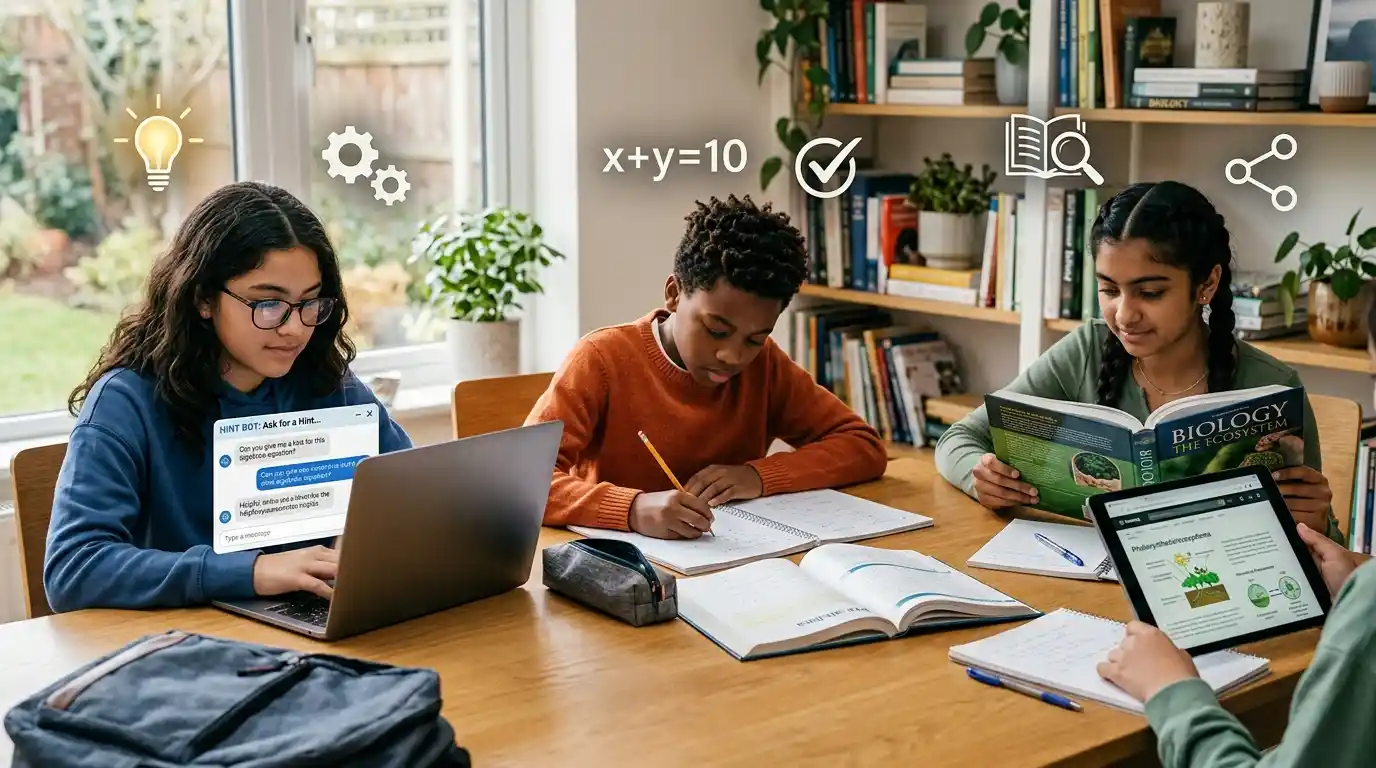
Yes but only if it’s used to help students understand, not just finish faster. AI can explain tricky concepts, generate practice questions, and give feedback. Copying its answers straight into an assignment does the opposite it finishes the homework while skipping the learning.
AI is changing how students study, research, and get through schoolwork. Today’s tools can explain a confusing topic, generate practice questions, help brainstorm, build a study schedule, and give feedback on a draft all through a normal conversation.
But the real question is whether any of that actually makes homework better, not just faster.
The honest answer: it depends entirely on how it’s used. AI can make homework more effective by helping students understand what they’re stuck on and figure out where they need more practice. But if a student just copies whatever AI gives them, the assignment gets done and nothing gets learned. The goal should always be better learning, not just quicker completion.
What Does “Using AI for Homework” Actually Mean?
It doesn’t mean handing the whole assignment to AI and copying the output. Used responsibly, it can mean:
- Explaining a difficult concept
- Giving examples
- Creating practice questions
- Offering hints instead of solutions
- Checking grammar
- Helping organize ideas
- Building a study plan
- Explaining where a mistake happened
- Testing what you actually know
- Giving feedback on a draft
Compare “solve this entire math problem” with “give me a hint about which formula to use, but don’t tell me the final answer.” The second version keeps the thinking in the student’s hands that’s the whole difference.
10 Ways AI Can Genuinely Improve Homework
1. It can explain things a different way. Sometimes a textbook explanation just doesn’t land. Ask AI: “Explain photosynthesis in simple language and give me three real-life examples.” Still confusing? Ask for an analogy instead. That flexibility is what makes AI genuinely useful as a study tool, not just a search shortcut.
2. It can walk through problems step by step. Rather than handing over a finished solution, AI can guide a student through: identify what’s given → figure out what’s being asked → pick the right formula → attempt the calculation → check the result. Working through each step yourself builds the skill; copying the final answer doesn’t.
3. It can generate real practice. Ask: “Create 10 questions about the water cycle. Only give me the answers after I try them.” AI can mix in multiple-choice, short-answer, true/false, and scenario-based questions turning a passive homework sheet into actual practice.
4. It can help find where you went wrong. Instead of asking AI to solve something from scratch, share your own attempt and ask: “Check my solution and tell me where my reasoning went wrong don’t solve the whole thing.” Mistakes are part of learning, and this keeps that part intact.
5. It can help you brainstorm a starting point. Staring at a blank page is often the hardest part of any assignment. Ask: “Give me five arguments for and against using renewable energy.” Then go research and build your own position from there.
6. It can improve your writing without replacing it. Skip “rewrite my essay.” Ask instead: “Identify grammar mistakes and explain how I can fix them.” AI can flag issues with clarity, structure, grammar, vocabulary, and transitions but the final piece should still be yours.
7. It can build a study plan around your actual weak spots. Try: “Create a 7-day revision plan for math, 30 minutes a day, with extra time on algebra since I struggle with it.” Then fit it around your real schedule.
8. It can turn homework into a back-and-forth instead of a one-way task. Regular homework often goes: read → answer → submit. With AI, it can become: ask → learn → question → practice → get feedback → try again. That loop invites more curiosity than a worksheet ever does.
9. It can help with test prep, not just tonight’s assignment. After finishing homework, ask: “Quiz me with 10 questions on this topic,” or “Give me five questions a bit harder than my homework.” This pushes past just completing the assignment toward actually mastering the material.
10. It can help build independence, not dependence. Used well, AI encourages more questions, not fewer why something works, how two ideas connect, what happens if a condition changes, why an answer was wrong. The key is staying an active participant, not a passive copier.
When AI Makes Homework Worse
AI isn’t automatically helpful. A few ways it backfires:
Copying full answers. The assignment gets submitted, but nothing sinks in.
Skipping the struggle. Getting stuck on a hard question is often where real learning happens. Jumping straight to AI for the answer removes that entirely.
Trusting it without checking. AI can be confidently wrong. Anything important should be verified against a real source.
Losing your own voice. If AI writes every essay, a student never really develops their own writing style.
Becoming unable to work without it. The goal is to make students more capable not incapable without a chatbot open in another tab.
How Parents Can Encourage Responsible Use
Parents don’t need to ban AI outright clear expectations work better.
- Ask “what did you learn?” not just “did you use AI?” Have your child explain the concept back in their own words.
- Encourage verification. Ask “how do you know this is correct?” so checking becomes a habit, not an afterthought.
- Set simple ground rules: try the homework first, use AI for explanations and hints, verify anything important, never submit AI work as your own if the school doesn’t allow it, don’t share private information, and follow any disclosure rules the school sets.
- Value understanding over speed. An assignment that takes 30 minutes and actually teaches something beats one finished in five minutes with zero understanding.
How Teachers Can Guide AI Use in Class
Rather than only trying to block AI, teachers can build assignments that actually use it as a thinking tool asking students to explain their reasoning, show their work, compare an AI answer with their own, spot mistakes in an AI response, verify AI claims against real sources, and reflect on how AI actually helped them learn. That turns AI itself into a lesson in critical thinking.
Homework Prompts Worth Trying
| Goal | Prompt |
|---|---|
| Understand a topic | “Explain this topic in simple language.” |
| Get unstuck | “Give me one hint without giving me the answer.” |
| Practice | “Create 10 practice questions about this topic.” |
| Check your work | “Review my answer and tell me where my reasoning might be wrong.” |
| Test yourself | “Quiz me one question at a time.” |
| Brainstorm | “Give me five ideas for this project.” |
| Fix writing | “Find grammar problems and explain how to fix them.” |
| Plan revision | “Create a study plan for this chapter.” |
| Practice arguing | “Give me arguments for and against this idea.” |
| Go deeper | “Ask me questions that test whether I really understand this.” |
The Best Method: Try → Ask → Understand → Verify → Create
- Try it yourself first. Spend real time attempting the assignment before reaching for AI.
- Ask for help if you’re stuck. Request an explanation or a hint — not a finished answer.
- Actually think about the response. Read it properly instead of copying it straight away.
- Verify anything that matters. Check facts, numbers, or quotes against a reliable source.
- Finish the work yourself. Apply what you now understand, following your teacher’s AI rules.
AI vs a Teacher vs a Search Engine
| Homework need | AI | Teacher | Search/Books |
|---|---|---|---|
| Explain a hard concept | Excellent | Excellent | Good |
| Personalized follow-up questions | Excellent | Excellent | Limited |
| Finding original sources | Limited | Good | Excellent |
| Instant feedback | Excellent | Depends on availability | Limited |
| Practice questions | Excellent | Excellent | Good |
| Emotional encouragement | Limited | Excellent | Limited |
| Current information | Needs checking | Good | Depends on source |
| Overall academic guidance | Helpful | Excellent | Good |
| Building independent thinking | Depends on how it’s used | Excellent | Excellent |
AI is best thought of as one part of a student’s learning toolkit not a replacement for teachers, books, research, or their own thinking.
Three Questions to Ask Before Using AI for Homework
- Am I trying to learn this, or just finish it? If the only goal is speed, that’s worth reconsidering.
- Could I explain this answer myself, without AI? If not, you probably need to spend more time with the concept.
- Did I check anything that actually matters? For real facts, figures, or quotes, verify them against a trustworthy source.
Can AI Replace Teachers?
No. AI can explain things and generate practice, but teachers bring something AI can’t they track a student’s actual progress, understand classroom context, know individual challenges, follow curriculum goals, and support emotional and social growth. AI can support that work. It doesn’t replace it.
What Parents Should Keep in Mind
AI isn’t just a shortcut for finishing homework faster it’s a technology students will keep running into throughout school and eventually at work. The useful lesson isn’t “never use AI.” It’s “learn to use AI responsibly.” Kids still need to own their thinking, their decisions, and their work AI is a tool in that process, not a replacement for it.
Conclusion
Can AI make homework better? Yes but only when it strengthens learning instead of standing in for it. Use it to understand hard topics, get real practice, receive feedback, brainstorm, and prep for tests, while still holding onto independent thinking, research skills, creativity, problem-solving, and your own writing voice.
Don’t use AI to avoid learning. Use AI to learn better.
Frequently Asked Questions
Does using AI for homework actually help students learn?
It can, if it’s used for explanations, hints, and practice rather than finished answers. Copying AI output straight into an assignment skips the learning entirely.
Is it cheating to use AI for homework?
It depends on the task and the school’s rules. Using AI to understand a concept or practice is generally fine; submitting AI-generated work as your own without permission usually isn’t.
How can students avoid becoming dependent on AI?
Try the problem first, ask for hints instead of full answers, and always check whether you can explain the concept yourself afterward.
Can AI replace a teacher for homework help?
No. AI can explain concepts and generate practice, but teachers track real progress, understand context, and provide guidance and support AI can’t replicate.
What’s a good way for parents to check if AI use is actually helping?
Ask “what did you learn from that?” instead of just “did you use AI?” it shifts the focus from permission to actual understanding.
Should students verify information they get from AI?
Yes, especially for anything factual, numerical, or important to a grade. AI can state incorrect information confidently, so check it against a reliable source.
What’s the best way to use AI for exam preparation?
Ask it to quiz you on the topic, generate slightly harder practice questions, and highlight areas where you’re weak then focus your study time there.