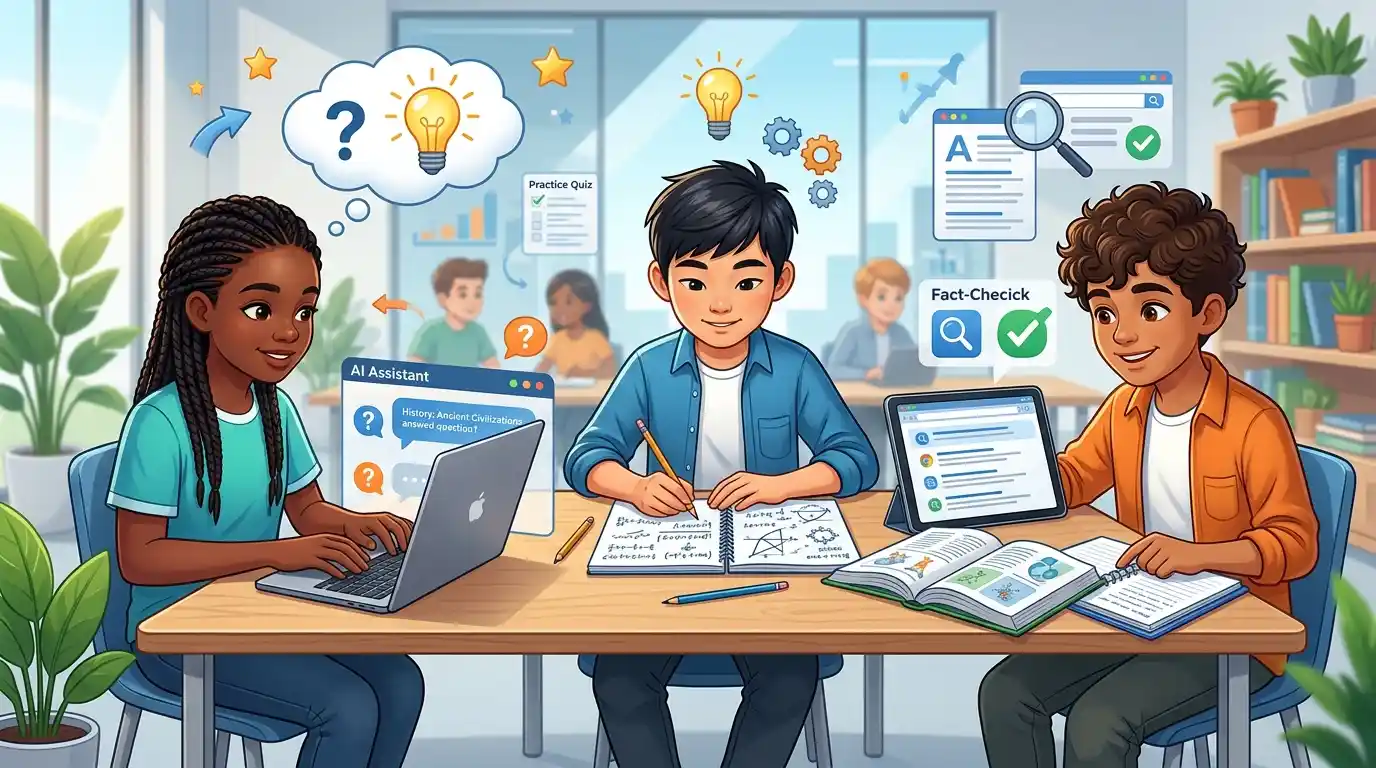
ChatGPT is genuinely useful for students but only if it’s used to help you understand a topic, not to hand you a finished answer. Ask it to explain, quiz, and hint instead of asking it to solve. That single shift changes ChatGPT from a shortcut into an actual tutor.
AI has changed how students search, study, practice, and solve problems. ChatGPT stands out from a plain search engine because it’s conversational you can ask a question, get an explanation, push back with a follow-up, and keep going until something actually clicks.
But there’s a real difference between using ChatGPT to learn and using ChatGPT instead of learning. If a student pastes in a homework question, copies the answer, and submits it, the assignment gets finished but nothing gets learned.
The better approach isn’t “give me the answer.” It’s “help me understand how to get there myself.”
What Is ChatGPT for Students, Exactly?
It’s an AI tool students can talk to in plain language to work through schoolwork. That includes explaining hard topics, generating practice questions, brainstorming ideas, building study plans, summarizing text, practicing a language, working through problems step by step, improving a draft, exploring different viewpoints, and prepping for tests.
The conversational part is what sets it apart from searching. Instead of googling five different explanations of photosynthesis and hoping one clicks, a student can ask ChatGPT to explain it simply, then keep asking “wait, what about this part?” until it makes sense.
Is ChatGPT Actually Good for Students?
Yes as long as it’s used as a learning tool, not a shortcut.
ChatGPT can make learning more interactive, but students still need to think critically about what it says. AI answers can be wrong, incomplete, outdated, or built on a bad assumption confidently stated either way. The habit worth building is simple: use AI to support your thinking, not replace it.
10 Smart Ways to Actually Use ChatGPT for Learning
1. Ask it to explain, not just answer. Skip “give me the answer to this question.” Try “explain this step by step and give me a simple example” for instance, “explain Newton’s laws of motion using everyday examples.” That forces the focus onto understanding the idea, not just getting a number at the end.
2. Ask for the explanation at different levels. If the textbook version is too advanced, ask for it simplified, for a beginner, at university level, through an analogy, or with a real-life example. One of these will usually land better than the others.
3. Turn it into a quiz generator. Instead of asking ChatGPT to do your homework, ask it to test you: “Create 10 multiple-choice questions about the water cycle. Don’t show the answers until I respond.” Attempt them yourself, then ask ChatGPT to explain which ones you got right or wrong, and why. That turns it from an answer machine into a practice partner.
4. Ask for hints, not solutions. This one habit alone can stop AI dependency before it starts. Say: “Don’t give me the answer just one hint at a time.” Works especially well for math, coding, science, and logic problems.
The goal is:
Question → Hint → Attempt → Feedback → Solution. Not: Question → Copy Answer.
5. Use it to brainstorm, not to finish. When you know the topic but not where to start, ask for ideas: “Give me 10 possible topics for a school presentation about climate change, suitable for teenagers.” Pick one, then build it out yourself.
6. Ask it to argue against you. This is a genuinely great critical-thinking exercise. Try: “I think social media is good for students because it helps them communicate. Give me three arguments against that.” You get exposed to angles you hadn’t considered then you decide if your original view still holds up.
7. Get help building a study plan. Juggling five subjects before exams gets overwhelming fast. Ask: “I have five subjects to prepare for help me build a two-week study schedule with revision, practice questions, and breaks.” Then adjust it to fit your real timetable and pace.
8. Use it to improve writing without letting it rewrite everything. Instead of “rewrite this for me,” try “check this paragraph for grammar mistakes and explain what I should fix don’t rewrite it.” You learn from the correction instead of just swapping in AI’s version.
9. Practice a language through conversation. Try: “Let’s have a beginner-level conversation in English. Correct my grammar after each response.” Great for vocabulary, sentence structure, and general conversational confidence.
10. Ask it to find your gaps. Try: “Ask me 10 questions about photosynthesis, one at a time. Don’t give me answers unless I get one wrong.” This builds a clean loop:
Learn → Practice → Find gaps → Review → Practice again.
Prompts You Can Actually Copy and Use
| Goal | Try this prompt |
|---|---|
| Understand a topic | “Explain this concept in simple language.” |
| Practice | “Create 10 practice questions about this topic.” |
| Get unstuck | “Give me one hint without giving me the answer.” |
| Review before a test | “Quiz me on this topic, one question at a time.” |
| Brainstorm | “Give me five ideas for a school project about…” |
| Improve writing | “Find grammar mistakes and explain them — don’t rewrite it.” |
| Practice arguing | “Give me arguments for and against this idea.” |
| Plan study time | “Create a revision plan for this topic.” |
| Learn vocabulary | “Test me on these 20 words.” |
| Understand a hard text | “Explain the main ideas in this passage simply.” |
What Students Should Avoid Doing With ChatGPT
Copying full answers and submitting them. This defeats the point of the assignment and can break academic rules.
Trusting every response blindly. AI makes mistakes. Anything important should be checked against a real, trustworthy source.
Moving on without actually understanding the answer. If you can’t explain it back in your own words, you probably haven’t learned it yet — you’ve just read it.
Letting AI replace real research. For serious academic work, you still need to know how to find and judge books, papers, and official sources yourself.
Typing in private or sensitive information. Be careful about what personal details you share with any AI tool.
The “Don’t Copy, Understand” Method
A simple five-step habit to build every time you open ChatGPT:
- Ask — put the concept or problem to ChatGPT.
- Understand — actually read the explanation, don’t skim it.
- Question — follow up on whatever’s still unclear.
- Practice — try a similar problem on your own, without AI.
- Explain — say the concept back in your own words.
If you can explain it yourself, you’ve actually learned it. If you can’t, that’s your cue to go back to step 1.
ChatGPT vs a Regular Search Engine
| Need | ChatGPT | Search engines |
|---|---|---|
| Simple explanation | Excellent | Good |
| Follow-up questions | Excellent | Limited |
| Finding actual websites | Good | Excellent |
| Finding original sources | Needs verification | Excellent |
| Brainstorming | Excellent | Good |
| Practice questions | Excellent | Limited |
| Current information | Needs checking | Strong |
| Academic research | Helpful support | Essential |
| Personalized pacing | Excellent | Limited |
| Confirming a fact | Needs extra checking | Multiple sources available |
The strongest setup is using both: ChatGPT to understand a topic, search engines to find and confirm real sources.
How Teachers and Parents Can Encourage Better Habits
Students don’t need to be told to avoid AI completely they need help using it well. Teachers can encourage students to explain answers in their own words, show their working, cite sources, verify key facts, compare multiple sources, talk about how they used AI, and complete some work without it entirely.
Parents can shift the question from “Did you use AI?” to “What did you actually learn from using it?” The second question pushes toward reflection instead of just permission-seeking.
One Simple Rule to Remember
Before asking ChatGPT for an answer, pause and ask yourself: “Could I use this to help me learn instead?”
- ❌ “Write my entire essay.” → ✅ “Help me build an outline and give me questions to answer in each section.”
- ❌ “Solve this math problem.” → ✅ “Give me a hint about which formula to use.”
- ❌ “Write my homework answer.” → ✅ “Explain this topic so I can write the answer myself.”
- ❌ “Give me the correct answer.” → ✅ “Quiz me and help me find where my reasoning went wrong.”
Where This Is All Heading
AI is only going to become a bigger part of school life. Students who learn to use it responsibly can pick up real skills creativity, critical thinking, communication, research, problem-solving, and independent learning instead of losing them.
The most valuable skill isn’t knowing how to get an answer out of AI. It’s knowing what to ask, how to judge the response, and how to actually turn it into your own understanding.
Conclusion
ChatGPT works best as a learning assistant, not an answer machine. Use it to understand hard concepts, practice, brainstorm, improve your writing, and prep for exams but the real learning happens when you think, question, practice, verify, and explain things yourself.
Don’t ask AI to do your learning. Ask AI to help you learn better.
Frequently Asked Questions
Is it okay for students to use ChatGPT for homework?
Yes, as long as it’s used to understand the material explanations, practice questions, hints, feedback rather than to generate a finished answer to copy and submit.
Will using ChatGPT make students worse at thinking for themselves?
Only if it’s used as a shortcut. Used for explanations, hints, and practice instead of finished answers, it can actually strengthen critical thinking rather than replace it.
How can students avoid becoming too dependent on ChatGPT?
Ask for hints instead of answers, attempt problems on their own first, and always try to explain the concept back in their own words afterward.
Is ChatGPT accurate enough to trust for schoolwork?
Not automatically. It can get things wrong or state incorrect information confidently. Important facts should always be checked against a trustworthy source.
What’s the best way to use ChatGPT and Google together?
Use ChatGPT to understand a topic and generate a research checklist, then use Google to find and verify real sources papers, official sites, textbooks before drawing conclusions.
Can ChatGPT help with exam preparation?
Yes it can build a study schedule, generate practice questions, run quizzes, and help identify weak spots that need more review.
What should students never do with ChatGPT?
Never submit AI-generated work as their own without permission, never trust an answer without checking it, and never enter private or sensitive personal information into it.