
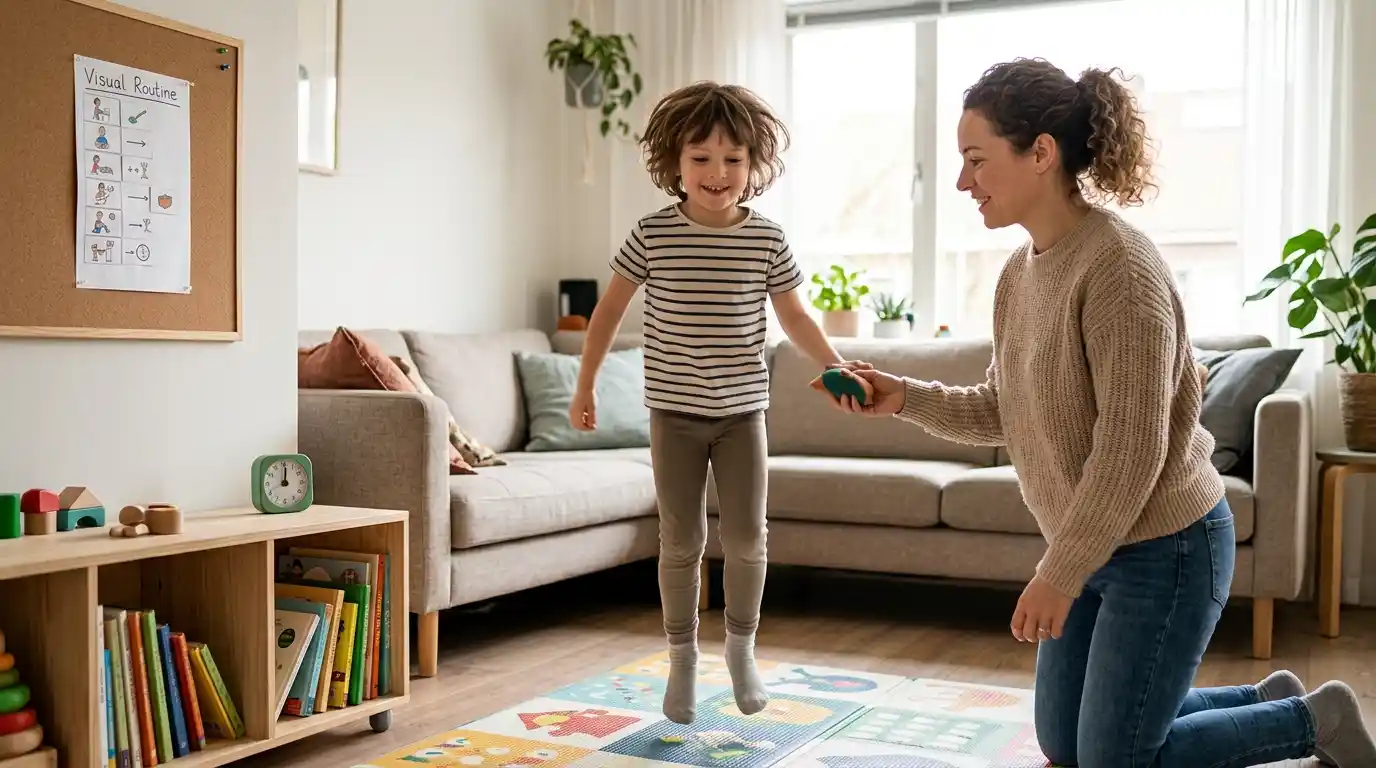
Quick answer: A child who is always on the move is usually just a child with a lot of energy. Movement becomes a concern only when it is persistent, hard for the child to control even when they understand what is expected, shows up in more than one setting, and gets in the way of school, friendships, safety, or family life. Common causes include temperament, too little physical activity, boredom, stress, poor sleep, and sometimes ADHD. Start with movement breaks, short instructions, and steady routines. If the pattern continues, talk to your pediatrician.
Is it normal for children to be this active?
Yes. Children are built to move. Running, climbing, asking endless questions, and getting restless during long activities are all part of growing up. Health guidelines recommend that school-age children get about an hour or more of physical activity every day, and many don’t.
So “Does my child move a lot?” is the wrong test. A better one is:
“Does my child’s activity level regularly get in the way of learning, relationships, routines, or safety?”
If the answer is no, you likely have an energetic child, not a problem to fix.
What is hyperactivity in children?
Hyperactivity is a persistent pattern of excessive movement or difficulty staying still when the situation calls for it. A hyperactive child may:
- Fidget with hands or feet constantly
- Leave their seat when they are expected to stay in it
- Run or climb at the wrong times
- Talk nonstop
- Struggle with quiet activities
- Seem “on the go,” as if driven by a motor
- Have trouble waiting their turn
- Jump from one activity to the next without finishing
- Interrupt conversations or games
Context and age matter. A five-year-old who can’t sit through a long meal is behaving typically. The same behavior in a ten-year-old, happening daily across settings, deserves a closer look.
Why is my child always moving?
There is rarely one reason. Here are the most common ones.
Natural temperament
Some children are simply more energetic, adventurous, and physically expressive. A high-energy child can still sit through a short meal, listen to a good story, and follow instructions when it counts.
Not enough physical activity
Many children spend the school day seated, then come home to homework and screens. Pent-up energy has to go somewhere. Outdoor play, cycling, swimming, sports, dancing, and active family games give it a healthy outlet. Sometimes a child does not need to move less. They need better chances to move.
Boredom
A child who squirms through a worksheet may sit happily through a hands-on science experiment. If restlessness shows up mainly with dull, repetitive, or too-hard tasks, the task may be the issue.
Difficulty with self-control
Self-regulation, meaning controlling impulses, waiting, and shifting between activities, develops gradually. Some children know exactly what is expected and still find it very hard to do. Telling them to “stop moving” doesn’t teach them how.
Stress or strong emotions
Children often show worry, frustration, or overwhelm through their bodies rather than their words. If restlessness appears suddenly, ask what has changed: a new school, friendship trouble, bullying, a move, or changes at home.
Poor sleep
Tired children don’t always slow down. Many get more restless, irritable, and impulsive. Consider whether your child:
- Has a regular bedtime
- Gets enough sleep for their age (about 9 to 12 hours for school-age children)
- Takes a long time to fall asleep or wakes often
- Snores loudly or seems to struggle to breathe at night
- Is very tired during the day
Loud snoring and disrupted breathing are worth raising with a doctor, since sleep-related breathing problems can look like hyperactivity.
ADHD
Hyperactivity can be part of ADHD, but ADHD is more than being energetic. It involves a lasting pattern of attention problems, hyperactivity, and/or impulsivity that begins before age 12, lasts at least six months, appears in more than one setting, and interferes with daily life. High energy alone is not enough for a diagnosis, and online checklists can’t make one.
What is the difference between high energy and hyperactivity?
| High energy | Persistent hyperactivity | |
|---|---|---|
| Control | Can settle down when the situation requires it | Struggles to regulate movement even when they understand the rule |
| Settings | Active mostly during play or excitement | Shows up at home, school, and elsewhere |
| Impact | Daily life runs fairly smoothly | Causes ongoing problems with learning, friendships, safety, or routines |
It is not how much a child moves. It is how persistent the movement is, how hard it is to control, and whether it causes real problems.
What does hyperactivity look like at school?
Teachers see your child alongside peers in a structured setting, so they may notice things you don’t. Signs include:
- Leaving their seat often
- Fidgeting through lessons
- Talking when others should be listening
- Interrupting classmates
- Trouble waiting for a turn
- Wandering during independent work
- Needing frequent reminders about class rules
When should parents be concerned?
Consider seeking advice when the activity level is:
- Persistent and hard to manage
- Very different from peers of the same age
- Present in more than one setting
- Affecting schoolwork, friendships, or family routines
- A safety risk, such as running into roads or climbing dangerously
- Paired with significant attention or impulse-control problems
- A sudden change from your child’s usual behavior
The overall pattern matters more than any one incident.
How can parents help a child who is always moving?
The goal is not to eliminate movement. It is to give it structure and outlets.
1. Build movement into the day
Plan it instead of fighting it: homework, short movement break, homework, outdoor play. Planned breaks work better than repeating “sit still.”
2. Keep instructions short
Skip: “Go upstairs, put your clothes away, clean your desk, bring your books down, and start homework.” Try: “First, put your clothes away.” Then give the next step.
3. Use predictable routines
Knowing what comes next lowers stress and resistance. A simple daily rhythm (breakfast, school, snack, play, homework, dinner, bedtime) helps, and younger children do well with picture schedules.
4. Say what you want, not what you don’t
Instead of “Stop moving,” try: “Please stay in your chair until we finish this page. Then you can take a movement break.” The child gets a clear goal and something to look forward to.
5. Catch them getting it right
Children who hear corrections all day begin to feel that everything they do is wrong. Be specific: “You stayed at the table until you finished your first activity. That was great focus.”
6. Reduce distractions
During homework, turn off the TV, silence phone notifications, clear away toys, and keep the desk simple.
7. Use shorter work blocks
A sample plan for a school-age child:
- 10 minutes reading
- 5-minute movement break
- 10 minutes writing
- 5-minute break
- 10 minutes math
Adjust the timing to your child’s age and needs.
How can teachers support a very active child?
Movement is not bad behavior, and classrooms can plan for it. Useful strategies include:
- Clear, consistent routines
- Short instructions and smaller assignment steps
- Planned movement breaks, such as handing out papers or stretching
- Hands-on learning activities
- A seat with fewer distractions
- Positive reinforcement
- Regular communication with parents
Should you punish a child for being hyperactive?
Repeated punishment rarely helps, because the child is often struggling with control, not choosing to misbehave. A stronger approach combines:
- Clear boundaries
- Predictable routines
- Positive reinforcement
- Daily physical activity
- Short instructions
- Fair, consistent consequences when needed
- Emotional support
Firm limits and understanding can go together.
Can a child be hyperactive without having ADHD?
Yes. Temperament, excitement, boredom, stress, poor sleep, and changes in routine can all cause high activity levels, sometimes temporarily. ADHD is only one possible explanation, and diagnosing it requires a broader look at symptoms and daily functioning.
When should you talk to a doctor?
Book an appointment with your pediatrician if your child’s activity level:
- Is persistent and hard to manage
- Interferes with school
- Affects friendships or family life
- Creates repeated safety concerns
- Happens across multiple settings
- Comes with major attention or impulse-control problems
- Marks a big change from their usual behavior
A professional will look at development, environment, sleep, and other possible explanations, not only the behavior itself.
Questions to ask your child’s teacher
Rather than asking, “Is my child hyperactive?”, try these:
- Does my child often leave their seat?
- Can they stay engaged during short activities?
- Does this happen in every subject?
- Are they calmer during hands-on work?
- Do they follow classroom instructions?
- How often do they interrupt others?
- Is it affecting their learning?
- What strategies seem to help?
Comparing home and school observations gives you a fuller picture.
Frequently asked questions
Why is my child always moving?
Common reasons are natural temperament, not enough physical activity, boredom, stress, poor sleep, difficulty with self-control, and sometimes ADHD. Age, behavior across settings, and effect on daily life help point to the cause.
Is it normal for a child to be very active?
Yes. Many children have high energy and need lots of chances to move. It is not automatically a sign of a developmental or behavioral condition.
What is the difference between high energy and hyperactivity?
A high-energy child can usually settle when needed. Hyperactivity involves persistent difficulty regulating movement that interferes with everyday life.
Is hyperactivity always ADHD?
No. Temperament, excitement, boredom, stress, and sleep problems can all cause it. ADHD needs a professional assessment.
How can I help my hyperactive child at home?
Provide daily physical activity, predictable routines, short instructions, planned movement breaks, clear expectations, fewer distractions, and specific praise.
Should I punish my child for being hyperactive?
Repeated punishment usually doesn’t address the cause. Clear limits combined with structure, positive reinforcement, and exercise tend to work better.
Can a child be hyperactive without ADHD?
Yes. Many active children do not have ADHD.
When should I seek professional help?
When the activity is persistent, appears in several settings, affects school or relationships, raises safety concerns, or comes with major attention or impulsivity problems.
The bottom line
A child who is always moving is not necessarily a child who is misbehaving. Movement is part of childhood, curiosity, and personality. What matters is whether your child can manage their energy when the situation calls for it, and whether their activity level is causing real problems.
Start with the basics: plenty of movement, steady routines, short clear instructions, smaller tasks, fewer distractions, and lots of specific praise. If concerns continue, you don’t have to work it out alone. Your child’s teacher and a pediatrician can help you understand what your child needs.
The goal is not a perfectly still child. It is a child who learns when to move, when to pause, and how to handle their energy in different situations.
This article is for general information and does not replace medical advice. If you are worried about your child’s activity level or behavior, speak with a pediatrician or child psychologist.