
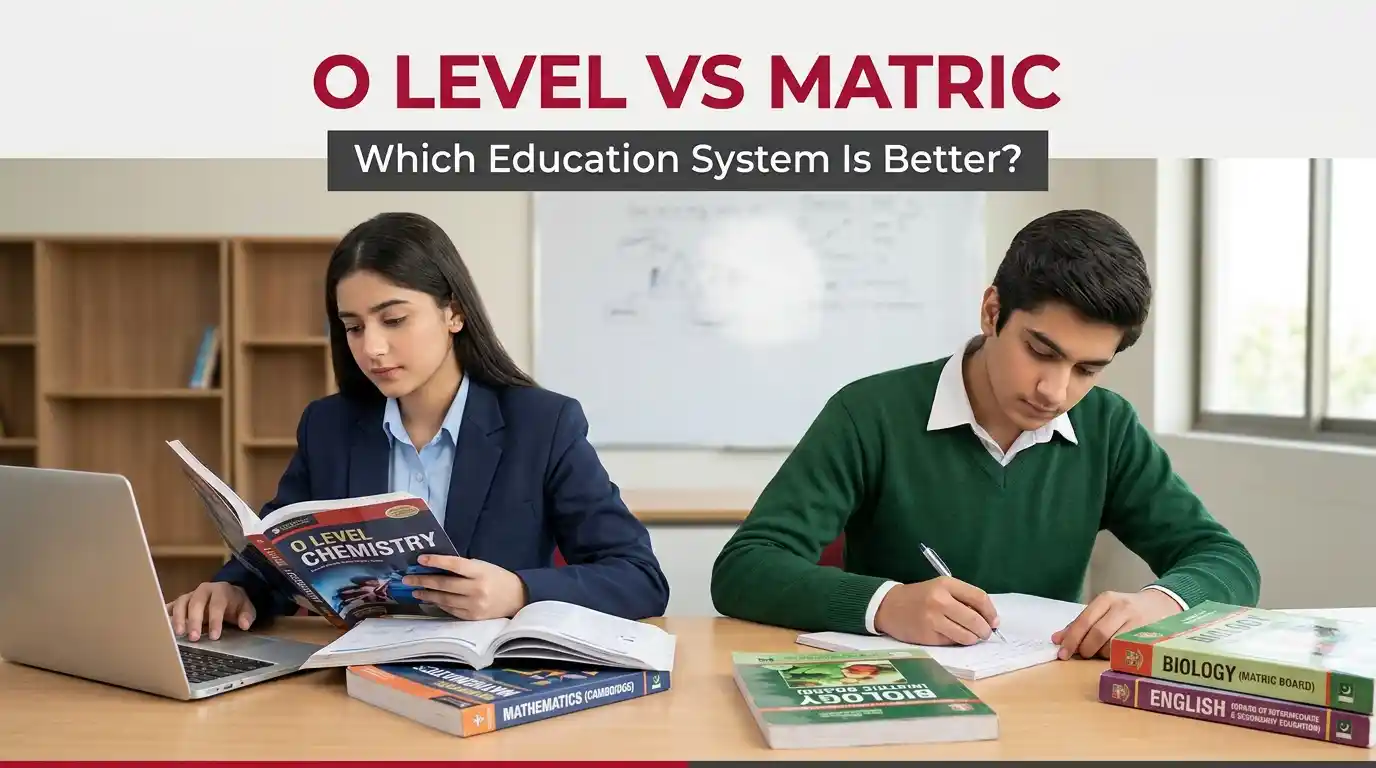
Choosing an education system is one of the biggest decisions parents make for their children. In Pakistan, two popular options are Cambridge O Level and Matric. Both are recognised pathways, but they differ in teaching style, exams and learning approach.
So is O Level better than Matric? It depends on your child’s learning style, future plans, your budget and your goals. This guide breaks down the differences so you can decide with confidence.
What Is the O Level Education System?
O Level (Ordinary Level) is an internationally recognised qualification offered by Cambridge International Education. It focuses on understanding concepts, solving problems and learning independently, rather than relying mainly on memorisation.
Students study English, Mathematics, Sciences and optional subjects. The exact combination depends on the school and the student’s academic plans. O Level often suits students who are interested in international qualifications or may want to study abroad later.
What Is the Matric Education System?
Matric (Matriculation) is the secondary education system run by Pakistan’s educational boards. Students complete Classes 9 and 10 and sit exams conducted by their board.
The curriculum covers compulsory and elective subjects, including English, Urdu, Mathematics and Science subjects, depending on the group chosen. Matric is widely recognised across Pakistan and leads to Intermediate programmes such as FSc, FA, ICS and ICom. It’s familiar and accessible for families who plan to continue their child’s education within Pakistan.
O Level vs Matric: What Is the Difference?
The main difference is that O Level follows the Cambridge International curriculum and exams, while Matric follows Pakistan’s board curriculum and exams. O Level leans conceptual and analytical, whereas Matric follows a structured local syllabus.
| Comparison | O Level | Matric |
|---|---|---|
| Education system | Cambridge International | Pakistani board |
| Learning approach | Conceptual and analytical | Curriculum and board-based |
| Examination | Cambridge exams | Local board exams |
| Assessment | Subject-specific structure | Board-prescribed structure |
| Study material | Cambridge syllabus and resources | Board textbooks and resources |
| Subject choices | Flexible combinations | Group-based combinations |
| Recognition | International qualification | Primarily national qualification |
| Further education | A Levels, IB or equivalent | Intermediate or equivalent |
Either system can give a strong foundation when the teaching is good and the student puts in consistent effort.
Key Differences Between O Level and Matric
How do teaching and learning methods differ?
O Level asks students to understand ideas, apply them, analyse information and explain their answers. Matric follows the board’s prescribed syllabus, with learning built around textbooks, classroom teaching, practice questions and board exam preparation.
Both can work well. Teacher quality and a student’s willingness to learn matter just as much as the system itself.
How do the exams and assessments differ?
O Level exams are set by Cambridge International, and students are assessed according to their chosen subjects and exam components. Matric exams are conducted by Pakistani boards, with Class 9 and Class 10 exams following the board’s schedule and syllabus.
In short, O Level follows an international exam framework and Matric follows the board system in Pakistan.
How do curriculum and subject choices differ?
O Level offers flexibility. A student interested in science might pick Biology, Chemistry and Physics, while another chooses a different mix. Matric offers choice through academic groups such as Science and Arts/Humanities, depending on the board and school.
Whichever route you take, let your child’s interests guide the subject combination.
Which costs more, O Level or Matric?
O Level is generally more expensive. Costs can include school fees, Cambridge exam fees, learning resources and extra academic support. Matric is usually more affordable, especially in government schools and many private ones.
Actual costs vary by school, location and subjects, so look at your family’s budget and your child’s long-term education needs before deciding.
What about international recognition and future opportunities?
O Level is an internationally recognised Cambridge qualification and leads towards A Levels and other further education options. Matric is widely accepted across Pakistan and leads to Intermediate qualifications.
If an O Level student continues in Pakistan, they may need an IBCC equivalence certificate, depending on admission requirements. For study abroad, always check your target universities’ requirements, since recognition and subject rules vary.
What Are the Advantages of Choosing O Level?
O Level works well for students who benefit from conceptual learning and want an internationally recognised qualification.
Conceptual Understanding
Students learn to understand subjects instead of leaning only on memorisation.
Critical Thinking
It builds analytical and problem-solving skills.
Subject Flexibility
Students can choose combinations that match their interests.
International Pathways
It offers a recognised route to A Levels and other international opportunities.
Independent Learning
Students take more responsibility for their studies and develop research skills.
The trade-off is that O Level needs consistent preparation, suitable academic support and careful financial planning.
What Are the Advantages of Choosing Matric?
Matric remains popular with Pakistani families because it’s familiar, accessible and tied to the local education system.
- Affordable Education: It’s often more budget-friendly than international exam systems.
- Local Recognition: Pakistani colleges and institutions widely accept it.
- Structured Curriculum: Students follow a clear syllabus and exam framework.
- Local Pathways: It opens the door to FSc, ICS, FA, ICom and other Intermediate programmes.
- Familiar Exam System: Parents and teachers generally know the board process well.
With effective teaching and proper guidance, Matric can give students a strong academic foundation too.
O Level or Matric: Which Is Better for Your Child?
Neither is automatically better. O Level may suit children who enjoy conceptual learning, independent thinking and flexible subjects, and it can be practical for families considering international education. Matric may suit students who want a more affordable route and plan to continue within Pakistan’s education system.
Ask Yourself These Five Questions
- Learning style: Does your child learn better through concepts or through a structured, textbook-based approach?
- Future goals: Are they planning to study in Pakistan or explore options abroad?
- Budget: Can your family comfortably manage school and exam costs?
- School quality: Does the school have qualified teachers, good guidance and a supportive environment?
- Interests: Which subjects and learning methods match your child’s strengths?
The best system isn’t the most expensive or the most internationally recognised one. It’s the one that helps your child learn with confidence and keep progressing.
Does the School Matter as Much as the System?
Yes. The system matters, but the school environment shapes your child’s development just as much. A good school focuses on academic performance, communication skills, creativity, confidence and personal growth.
At School of Scholars, we believe every child deserves an encouraging place to learn, where curiosity, knowledge and personal development go hand in hand. When you visit schools, look for one that understands individual learning needs, encourages classroom participation and supports children throughout their journey.
Choosing the Right Education Pathway
Choosing between O Level and Matric is a big decision, but don’t make it on popularity alone. O Level offers an international qualification with a focus on conceptual understanding. Matric offers an established, accessible route within Pakistan’s education system.
The right choice depends on your child’s abilities, future ambitions, your family budget and the quality of the school. Take time to understand both options, talk with your child about their interests, and pick the pathway that supports their long-term success.
Learn more about School of Scholars and explore an encouraging approach to education and learning.
Frequently Asked Questions
What is the main difference between O Level and Matric in Pakistan?
O Level follows the Cambridge International curriculum and exams, while Matric follows the curriculum and exams of Pakistani boards. O Level focuses on conceptual learning, and Matric follows a structured local syllabus.
Is O Level better than Matric?
Neither is automatically better. O Level may suit students interested in international qualifications and conceptual learning. Matric may suit students planning to continue their education in Pakistan.
Is O Level more expensive than Matric in Pakistan?
Generally, yes. O Level often involves higher school fees, exam charges and extra learning costs. Matric is usually more affordable, though costs vary between schools.
Can O Level students study in Pakistani universities?
Yes. They can apply to Pakistani colleges and universities, subject to IBCC equivalence requirements and each institution’s admission criteria.
Which is better for studying abroad, O Level or Matric?
O Level is an internationally recognised qualification with a familiar route to international education. Matric students can also study abroad by meeting the relevant university and qualification requirements.