
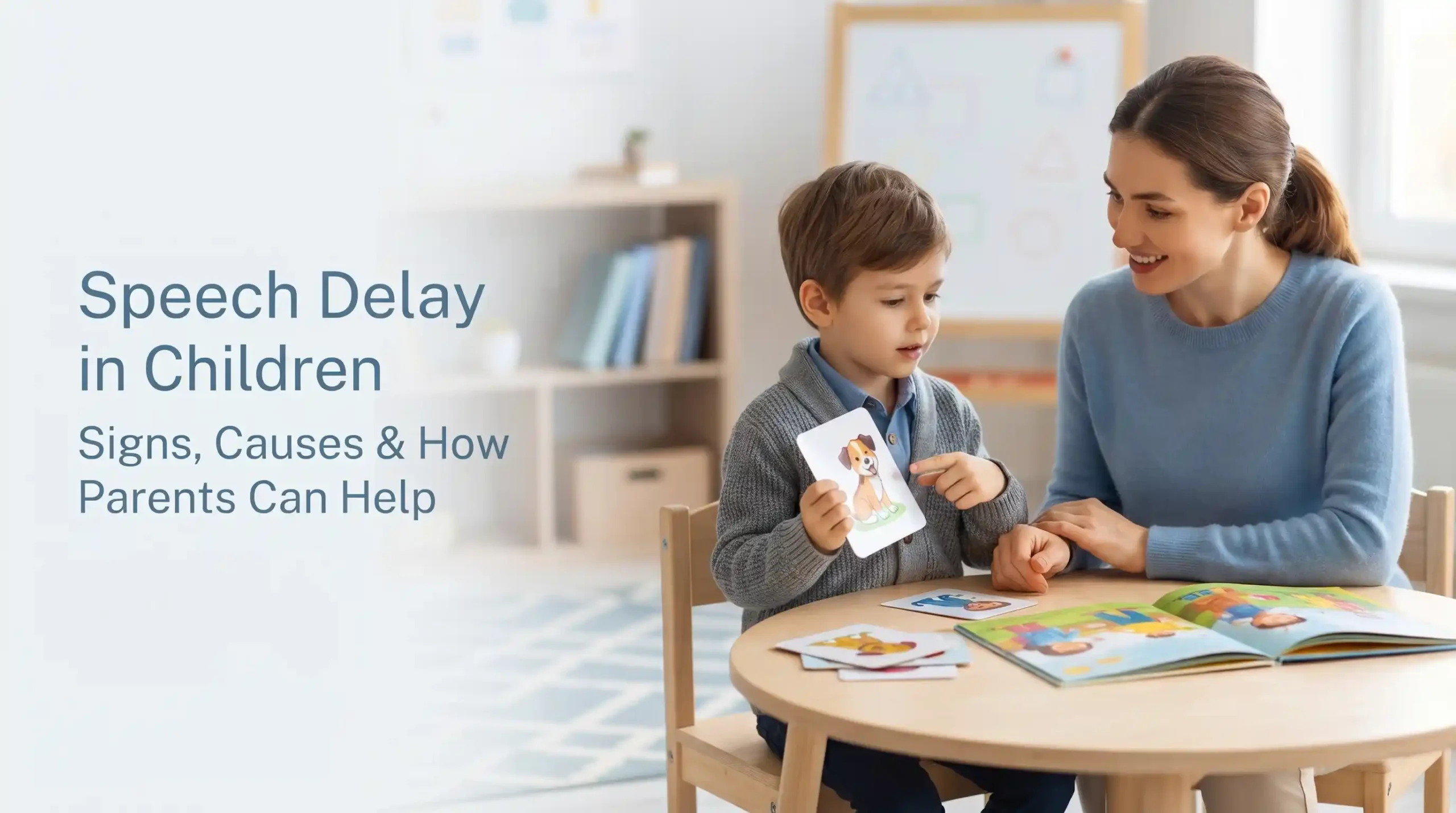
Quick answer: A speech delay means a child’s speech or language is developing more slowly than is typical for their age. Common signs include using few words, not combining words by around age two, being hard to understand, or struggling to follow simple instructions. If your child has lost words they used to say, or you simply feel something isn’t right, speak to a paediatrician or speech-language pathologist. You don’t have to wait.
Most parents have been there. Your friend’s toddler is chatting away, and yours is still pointing and grunting. Or your child is four and half the family still can’t work out what they’re saying.
Some of this is normal variation. Some of it is worth looking into. This guide will help you tell the difference, understand what might be behind it, and find practical things to try at home while you decide on next steps.
At School of Scholars, we work with children and families every day, and one thing holds true again and again: children communicate best when they feel safe, heard and unhurried.
What is speech delay in children?
Speech delay is when a child’s speech develops more slowly than expected for their age. It can show up as trouble making certain sounds, saying words, putting words together, or getting their ideas across clearly.
People often use “speech” and “language” as if they mean the same thing, but they don’t:
- Speech is the physical side: making sounds and saying words clearly.
- Language is the meaning side: understanding what others say, and using words, gestures and sentences to share your own thoughts.
A child might understand everything you say but struggle to say it back. Another child might find both parts hard. That difference matters, because it affects what kind of support helps.
One late milestone doesn’t mean there’s a disorder. What counts is the bigger picture: how your child communicates overall, and whether they’re making steady progress.
What are the early signs of speech delay?
The signs depend on age, but you might notice that your child:
- Uses fewer words than other children their age
- Finds it hard to join words into short sentences
- Can’t easily tell you what they need or how they feel
- Is hard for familiar people to understand
- Has trouble following simple instructions like “bring me your shoes”
- Doesn’t seem to understand everyday words or questions
- Mostly points or gestures instead of using words
- Gets upset or frustrated when they can’t get their message across
- Has stopped using words or skills they used to have
As a very rough guide, many children say their first words around their first birthday and start joining two words together by about two years old. These are general markers, not deadlines, and a professional can tell you what’s typical for your child’s exact age.
A single sign on its own usually isn’t a reason to panic. But if the concerns keep showing up, or progress seems stuck, it’s worth talking to a qualified professional. Losing skills your child once had needs prompt medical attention.
What causes speech delay?
There’s rarely one simple answer. A professional assessment is the best way to find out what’s going on for your child. These are the more common possibilities.
Some children just start later
Children do talk at different times. But “he’ll talk when he’s ready” isn’t a plan on its own. Keep an eye on progress, and don’t assume your child will catch up without any support.
Hearing difficulties
Children learn to speak by hearing the language around them. If hearing is affected, even temporarily by repeated ear infections, speech can be affected too. If your child doesn’t reliably respond to sounds or spoken instructions, ask your doctor about a hearing test. It’s one of the first things worth ruling out.
Speech sound difficulties
Some children struggle to pronounce particular sounds. Mistakes are completely normal in early childhood, but if they continue well past the age you’d expect, a speech-language pathologist can take a look.
Language development difficulties
Here the challenge is less about pronunciation and more about learning words, understanding questions, building sentences or explaining ideas. It can affect life at home and in the classroom.
Wider developmental differences
Speech and language delays can sometimes appear alongside other developmental conditions, including autism. But a speech delay on its own doesn’t mean a child has autism or any other diagnosis. Only a qualified professional looking at your child’s overall development can say that.
Fewer chances to communicate
Children pick up language through everyday back-and-forth: play, chat, songs and shared books. Having more of these moments helps. But please don’t blame yourself. Speech delay is not automatically a sign of poor parenting or too little talking.
Does speaking two languages cause speech delay?
No. Growing up with two or more languages does not cause a speech or language disorder.
In many Pakistani homes, children hear Urdu, English, Sindhi, Punjabi, Pashto or another language, sometimes all in the same day. Bilingual children often split their vocabulary across languages, so counting words in just one of them can make their skills look smaller than they are.
You don’t need to drop your home language. If you do seek an assessment, ask the professional to look at your child’s communication in all the languages they use.
When should parents seek professional help?
See a paediatrician or speech-language pathologist if your child:
- Isn’t reaching communication milestones for their age
- Is making very little progress with words
- Struggles to understand what’s said to them
- Can’t express their needs or ideas
- Is often frustrated because people can’t understand them
- May have trouble hearing
- Has lost words or communication skills they used to have
You don’t need to wait until a particular birthday. If your instinct says something is off, it’s reasonable to ask.
An assessment isn’t a diagnosis, and it doesn’t automatically lead to therapy. It simply shows what your child is good at, where they’re finding things hard, and whether extra support would help.
How can you encourage speech and language at home?
You don’t need flashcards or special equipment. Ordinary routines are full of chances to build language.
1. Talk through your day. Say what you’re doing as you do it: “Let’s wash the apples.” “Now we’re putting on your shoes.” Linking words to real actions helps meaning stick.
2. Read together daily. Pick picture books, point at things, name them and ask easy questions. Let your child answer by pointing or making a sound. It should feel like fun, not a test.
3. Follow their lead. If they love cars, animals, drawing or blocks, build conversation around that. Children learn new words faster when they care about the topic.
4. Wait. It’s tempting to jump in and answer for them. Instead, ask a simple question and count to five in your head. A word, a sound or a gesture all count as a reply. Respond warmly to the attempt.
5. Add a little to what they say. If they say “dog,” you say, “Yes, a big dog!” If they say “car go,” try, “The red car is going fast.” You’re showing them the next step without making a fuss.
6. Sing and rhyme. Songs and nursery rhymes repeat sounds and words in a way children find easy to pick up. Keep it playful and never make them perform.
7. Make space for real interaction. Screens can’t respond to your child the way you can. Shared play, chat and reading give them something to practise on.
8. Model the right word, gently. If your child says “tat” for “cat,” just reply, “Yes, that’s a cat!” There’s no need to make them repeat it. Correcting over and over tends to make talking feel stressful.
How can schools support a child with speech delay?
A good classroom makes it easier, not scarier, to speak up. Teachers can help by:
- Giving children enough time to answer
- Using clear, age-appropriate instructions
- Backing up spoken instructions with pictures or demonstrations
- Encouraging participation without forcing a child to speak in front of everyone
- Letting children show what they know in different ways
- Keeping parents updated on progress
- Following the advice of the child’s speech-language professional
A child who finds communication hard shouldn’t be called lazy, unintelligent or unwilling. Usually they’re working much harder than anyone can see. When parents and teachers share what they notice, children get more consistent support.
At School of Scholars, we try to meet each child where they are. You can find more practical guidance for families in our Knowledge Hub.
What does a speech-language pathologist do?
A speech-language pathologist (also called a speech therapist) assesses how your child communicates. They may look at:
- Speech sounds and pronunciation
- Vocabulary and sentence building
- Understanding of words and instructions
- Social communication, such as taking turns in conversation
- Fluency and voice
- How your child gets their needs and ideas across
Afterwards they might suggest home activities, therapy, further assessment, or strategies for parents and teachers. The goal is simple: helping your child communicate as comfortably as possible in daily life.
Can speech delay affect a child’s confidence?
Yes, it can. When people keep misunderstanding them, children get frustrated. Some go quiet in groups or avoid joining in at school.
You can help a lot by listening patiently, noticing every attempt to communicate, avoiding comparisons with other children, and celebrating small wins. No child should be teased or embarrassed about how they talk. Calm, encouraging adults make speaking feel safer.
Should I wait and see if my child starts talking?
Some late talkers do catch up. But there’s no way to know in advance which children will, so waiting alone is a gamble.
If you’re worried, getting advice is a sensible step. An early assessment will tell you whether support is needed and what kind. Try not to rely only on online milestone charts or on comparisons with siblings and classmates. A professional can look at your child as an individual.
What should parents avoid?
Try not to:
- Compare your child unfavourably with other children
- Call them slow or unintelligent
- Make them repeat words again and again
- Laugh at or mimic pronunciation mistakes
- Show impatience when communication takes time
- Assume they will definitely grow out of it
- Treat speech difficulties as laziness
- Put off getting advice when worries continue
Patience and good guidance will do far more than pressure ever could.
Frequently asked questions about speech delay
What is considered a speech delay in children?
A speech delay is when a child’s speech develops more slowly than expected for their age. It can affect pronunciation, vocabulary, joining words together or explaining ideas. Some children also have trouble understanding language, which should be assessed too.
What are the first signs of speech delay?
The main early signs are using fewer words than expected, difficulty combining words, trouble following spoken instructions, few attempts to communicate, and speech that others find hard to understand. Losing words or skills a child once had needs prompt medical attention.
Does speech delay mean my child has autism?
No. Speech delay on its own doesn’t mean a child has autism. Communication differences have many possible causes, and only a qualified professional who assesses the child’s overall development can make a diagnosis.
Can a child outgrow a speech delay?
Some children with mild delays catch up on their own, while others need extra support. It isn’t safe to assume a lasting delay will fix itself, so a professional assessment is the best way to decide what to do next.
Does speaking two languages cause speech delay?
No. Growing up with two or more languages doesn’t cause a speech or language disorder. A child’s communication should be judged across all the languages they use, not just one.
How can I help my child talk at home?
Talk through daily routines, read together, sing songs, follow your child’s interests, add a word or two to what they say, and give them time to reply. Keep it relaxed and enjoyable.
When should I see a professional about my child’s speech?
Consult a paediatrician or speech-language pathologist if your child isn’t reaching communication milestones, is making little progress, has trouble understanding language, may have hearing problems, or has lost skills they previously had.
Can speech delay affect learning at school?
It can. Communication difficulties may make it harder to join in class, follow instructions, share ideas and play with other children. The right classroom strategies and professional guidance can make a big difference.
Speech development isn’t a race
Every child has their own strengths and their own timeline. What matters is paying attention, noticing when something seems off, and getting the right help early rather than late.
Everyday moments, like chatting while you cook, reading before bed or simply waiting patiently for an answer, add up more than you might think. And if you’re worried, a professional can help you work out the next step.
For more parenting and education guidance, visit the School of Scholars Knowledge Hub, or learn about our approach at School of Scholars.
Disclaimer: This article is for general educational information only and doesn’t replace professional medical advice, assessment or treatment. If you’re concerned about your child’s speech or language development, please consult a qualified healthcare professional or speech-language pathologist.