Introduction
Early childhood education plays a vital role in shaping a child’s personality, learning habits, and overall development. In recent years, Montessori education in Karachi has gained significant popularity among parents who want a more child-centered and activity-based learning approach.
At School of Scholars, we believe that the early years of education should focus on curiosity, independence, and hands-on learning rather than pressure-based academic performance.
Montessori education is designed to support exactly that.
What Is Montessori Education?
Montessori education is a teaching method developed by Dr. Maria Montessori. It is based on the idea that children learn best when they are allowed to explore, discover, and learn at their own pace.
Instead of traditional teacher-led instruction, Montessori classrooms focus on:
- Hands-on learning
- Self-directed activities
- Mixed-age classrooms
- Practical life skills
- Individual learning pace
This approach helps children develop confidence and independence from an early age.
Why Montessori Education Is Growing in Karachi
In a fast-paced city like Karachi, parents are increasingly looking for educational systems that support both academic growth and personal development.
The growing popularity of Montessori education in Karachi is due to:
- Increased awareness of early childhood development
- Demand for activity-based learning
- Focus on soft skills and creativity
- Better school readiness programs
- Reduced pressure on young children
Parents now understand that early learning experiences shape lifelong attitudes toward education.
Key Benefits of Montessori Education for Kids in Karachi
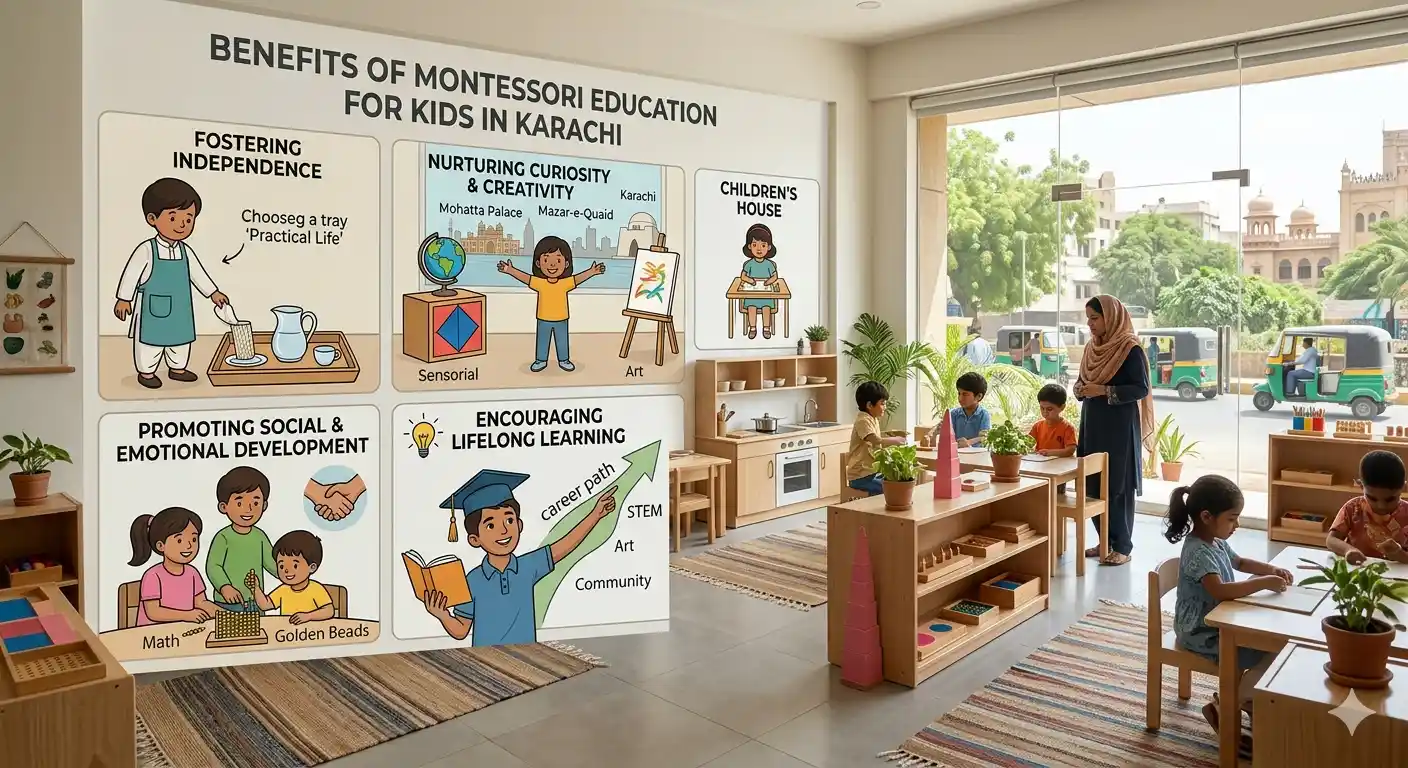
1. Develops Independence in Children
One of the most important benefits of Montessori education is independence.
Children learn to:
- Make simple decisions
- Complete tasks on their own
- Take responsibility for their learning
This builds confidence and self-reliance from an early age.
2. Encourages Creativity and Curiosity
Montessori classrooms are designed to encourage exploration.
Children are free to:
- Choose activities
- Explore materials
- Ask questions
- Discover new ideas
This naturally increases creativity and curiosity.
3. Improves Social Skills
Montessori classrooms often include mixed-age groups.
This helps children:
- Learn teamwork
- Help younger classmates
- Develop communication skills
- Respect others’ differences
These social skills are essential for future success.
4. Builds Strong Learning Foundations
Montessori education focuses on foundational skills such as:
- Language development
- Early math concepts
- Problem-solving
- Logical thinking
Children develop a strong academic base without pressure.
5. Reduces Academic Pressure
Unlike traditional systems, Montessori education does not focus on exams or grades in early years.
This allows children to:
- Learn at their own pace
- Enjoy the learning process
- Reduce stress and anxiety
It creates a positive attitude toward education.
6. Enhances Hands-On Learning Skills
Montessori learning is highly practical.
Children use real objects and activities to learn concepts, which helps them:
- Understand better
- Retain knowledge longer
- Develop fine motor skills
7. Prepares Children for Future Learning
Montessori education prepares students for future academic systems by building:
- Focus and discipline
- Time management skills
- Independent learning habits
- Confidence in problem-solving
Montessori Education in Karachi: A Growing Trend
Many schools in Karachi are now adopting Montessori-based programs or integrating Montessori principles into early education.
Parents prefer this system because it offers a balanced approach between learning and development.
It is especially beneficial in urban environments where children need structured yet flexible learning experiences.
Montessori vs Traditional Education
| Feature | Montessori Education | Traditional Education |
|---|---|---|
| Learning Style | Child-centered, self-paced learning | Teacher-centered, fixed pace |
| Teaching Method | Hands-on, activity-based learning | Lecture and textbook-based |
| Role of Teacher | Guide and facilitator | Instructor and authority |
| Student Activity | Active learning and exploration | Passive listening and memorization |
| Assessment Style | Observation-based evaluation | Exams and grades |
| Creativity Focus | High emphasis on creativity and curiosity | Limited creative freedom |
| Stress Level | Low-pressure learning environment | Higher academic pressure |
| Skill Development | Focus on independence and life skills | Focus mainly on academic performance |
School of Scholars Vision for Early Learning
At School of Scholars, we value early childhood education that focuses on:
- Creativity
- Curiosity
- Confidence building
- Skill development
- Child-centered learning
We believe that strong early education leads to lifelong success.
Whether through Montessori principles or modern learning methods, our goal is to prepare children for a bright and confident future.
Conclusion
Montessori education in Karachi is becoming an important choice for parents who want a balanced, child-focused, and stress-free learning environment for their kids.
It helps children become independent thinkers, creative learners, and confident individuals.
At School of Scholars, we support educational approaches that prioritize the overall development of the child not just academic performance.
Early learning is the foundation of future success, and Montessori education builds that foundation beautifully.
Frequently Asked Questions
1. What is Montessori education for kids?
Montessori education is a child-centered learning method where children learn through hands-on activities, self-directed tasks, and practical experiences instead of traditional memorization.
2. What are the benefits of Montessori education in Karachi?
It helps children develop independence, creativity, confidence, social skills, and strong early learning foundations in a stress-free environment.
3. At what age should a child start Montessori education?
Children can start Montessori education as early as 2.5 to 6 years old, depending on the school’s program and readiness level of the child.
4. Is Montessori better than traditional schooling?
Montessori focuses on independent learning and creativity, while traditional schooling is more structured. Montessori is often preferred for early childhood development.
5. Does Montessori education help in future studies?
Yes, it builds strong learning habits, focus, discipline, and problem-solving skills that help children perform better in later academic stages.