
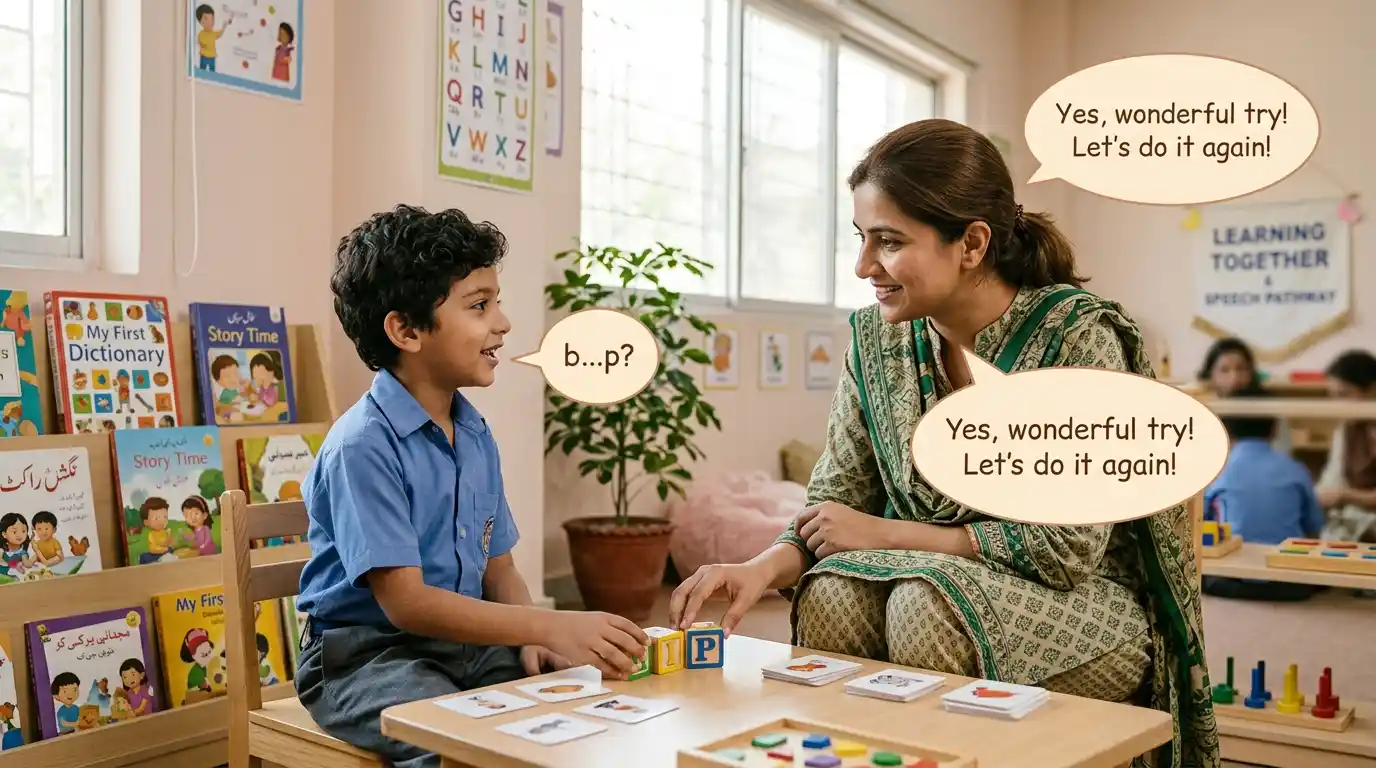
Quick answer: It’s totally normal for young kids to mispronounce words while they’re learning to talk. But if your child is hard to understand, keeps making the same mistakes past a certain age, or gets frustrated trying to speak, it might be time to check in with a professional.
For more parent-friendly guides, visit the School of Scholars Knowledge Hub.
What Counts as a Pronunciation Problem?
A pronunciation problem shows up when a child consistently struggles to say certain sounds correctly. That might look like:
- Dropping sounds from words
- Swapping one sound for another
- Mixing up the order of sounds
- Struggling with specific sounds
- Being hard for others to understand
- Avoiding words that are tricky to say
Here’s the thing — kids make pronunciation mistakes all the time while learning to talk. One mispronounced word doesn’t mean anything’s wrong. What matters is whether their speech is improving over time and whether people can understand them.
Why Do Kids Mispronounce Words?
A few reasons, really:
- They just need more time. Some sounds are harder to master than others.
- A speech sound disorder. This affects how they physically produce or organize sounds.
- Hearing issues. If a child can’t hear sounds clearly, it’s harder to learn to say them correctly.
- Other speech or motor-speech factors can play a role too.
Because there are so many possible causes, it’s best not to try to diagnose it yourself — a speech-language professional can figure out what’s actually going on.
When Are Mispronunciations Totally Normal?
Kids don’t learn every sound at the same age — some sounds are just harder and come later.
In fact, ASHA (the American Speech-Language-Hearing Association) points out that some speech sounds may not be fully mastered until children are around 4, 5, or 6 years old. So younger kids making sound errors is completely expected.
Bottom line: look at the big picture — is your child getting easier to understand over time? — instead of stressing over one mispronounced word.
Signs Worth Paying Attention To
Every child develops at their own pace, but here are signs that might be worth a conversation with a professional:
1. Speech is hard to understand
If parents, teachers, or other kids regularly struggle to understand your child, it’s worth flagging.
2. Errors keep piling up
Some mistakes are expected — but persistent or unusual patterns deserve a closer look.
3. Your child gets frustrated speaking
Watch for repeating themselves a lot, going quiet, avoiding certain words, or getting visibly upset when they’re not understood.
4. It’s affecting school
Speech difficulties can spill into classroom participation — and can sometimes connect to challenges with reading, spelling, or writing too.
5. Hearing concerns pop up
If your child often asks people to repeat themselves or doesn’t respond consistently to sound, it might be worth getting their hearing checked. Speech and hearing are closely linked, so don’t brush this one off.
When Should You Actually Seek Help?
Short answer: whenever you’re concerned — you don’t need to wait for a specific age.
You can bring it up with a pediatrician, teacher, or speech-language pathologist. ASHA specifically encourages parents to seek help early if they have any concerns about their child’s communication development.
And here’s some reassurance: getting your child assessed doesn’t automatically mean something’s wrong. Often, it just gives you a clearer picture of where your child stands.
How Parents Can Help at Home
Talk with your child often
Chat about everyday stuff — school, food, toys, animals, whatever’s happening around you. Let them talk without rushing them.
Read together
Reading aloud exposes kids to new words and sounds. Ask questions about the story and get them describing pictures and characters in their own words.
Model the correct pronunciation — don’t correct
If your child says something wrong, don’t stop and make them repeat it. Just respond naturally with the correct version.
For example:
Child: “Tat!”
Parent: “Yes, that’s a cat!”
This way, they hear the right sound without feeling put on the spot. ASHA specifically recommends this approach over correcting every mistake.
What Parents Should Avoid
- Making fun of mispronunciations
- Making them repeat a word over and over
- Comparing them to other kids
- Showing frustration
- Correcting every single sentence
- Pushing for “perfect” speech
Kids need encouragement, not pressure. A relaxed environment makes it easier for them to keep talking and trying.
How Can Schools Help?
Teachers spend a lot of time with kids and often notice things parents might miss at home. Schools can support by:
- Watching how the child communicates
- Flagging concerns to parents
- Encouraging classroom participation
- Giving kids enough time to respond
- Bringing in speech-language professionals when needed
- Creating a supportive, judgment-free classroom
Parents and teachers working together makes a real difference in catching and addressing issues early.
What Happens During a Speech Assessment?
A speech-language professional typically looks at:
- How the child produces different sounds
- Which specific sounds are tricky
- How easy their speech is to understand overall
- Broader language skills
- How they communicate in different settings
- Oral-motor factors
- Whether hearing might be part of the picture
This helps determine if their speech fits their age group, or if extra support would help.
What About Kids Who Speak More Than One Language?
Being bilingual (or multilingual) does not automatically mean a speech disorder. Speech professionals factor in a child’s full language background when evaluating them.
If you’re bringing your child in for an assessment, mention every language they use — at home, school, wherever — so the evaluation is accurate.
Frequently Asked Questions
Is it normal for kids to mispronounce words?
Yes, completely. Speech sounds develop at different ages, so one mistake isn’t a red flag on its own.
When should I worry about my child’s pronunciation?
If their speech stays hard to understand, errors persist, they get frustrated communicating, or you have hearing concerns — it’s worth checking in with a professional.
Should I correct my child every time they mispronounce something?
No — model the correct pronunciation naturally instead of interrupting to correct them. It’s less stressful and just as effective.
Can hearing problems cause pronunciation issues?
Yes. If a child can’t hear sounds clearly, it affects how they learn to produce them. A hearing check with an audiologist can help rule this out.
Who should I talk to about pronunciation concerns?
A speech-language pathologist (SLP) can assess and guide next steps. If hearing might be involved, an audiologist may also help.
Bottom Line
Mispronouncing words is a normal part of learning to talk — especially in the early years. But if your child stays hard to understand, gets frustrated speaking, or you’re noticing hearing concerns, it’s completely okay to reach out to a professional sooner rather than later.
The goal isn’t perfect pronunciation it’s helping your child feel confident communicating and comfortable being themselves.
For more parent-friendly resources, visit the School of Scholars Knowledge Hub.