Introduction
Education in Pakistan is changing faster than ever before. Traditional classrooms are evolving into interactive learning spaces where technology, creativity, and practical skills are becoming just as important as textbooks and examinations.
Parents today are looking for schools that prepare children not only for academic success but also for future careers and lifelong learning. As industries continue to embrace artificial intelligence, automation, and digital transformation, schools must also adapt to meet these new demands.
Understanding the modern education trends in Pakistan schools helps parents make informed decisions when choosing the right educational environment for their children.
At School of Scholars, we believe that quality education should prepare students to become confident learners, creative thinkers, and responsible global citizens. By embracing innovation while maintaining strong academic values, schools can equip students with the knowledge and skills they need to succeed in the 21st century.
What Are Modern Education Trends?
Modern education trends refer to new teaching methods, technologies, and learning approaches that improve student engagement, develop practical skills, and prepare learners for future challenges.
Unlike traditional education, which often focuses on memorization, modern education emphasizes:
- Critical thinking
- Creativity
- Communication
- Collaboration
- Digital literacy
- Real-world problem-solving
These trends are becoming increasingly common across Pakistan as schools invest in better learning experiences.
Why Modern Education Matters in Pakistan
Today’s students will work in careers that may not even exist yet.
For this reason, schools must prepare children with adaptable skills rather than simply helping them pass examinations.
The growing adoption of modern education trends in Pakistan schools helps students:
- Become independent learners
- Improve problem-solving abilities
- Build confidence
- Develop leadership skills
- Prepare for technology-driven careers
- Adapt to a rapidly changing world
Parents are increasingly recognizing that future success depends on both academic excellence and practical life skills.
Key Modern Education Trends in Pakistan Schools
| Education Trend | How It Benefits Students |
|---|---|
| Smart Classrooms | Makes lessons more interactive and engaging through digital technology. |
| STEM Education | Develops science, technology, engineering, and mathematics skills. |
| Coding & Robotics | Builds logical thinking and prepares students for future careers. |
| AI-Assisted Learning | Personalizes education and provides faster feedback. |
| Project-Based Learning | Encourages creativity, teamwork, and real-world problem-solving. |
| Digital Literacy | Helps students use technology safely and effectively. |
| Social & Emotional Learning | Strengthens communication, empathy, and emotional intelligence. |
| Personalized Learning | Supports individual learning styles and academic progress. |
1. Smart Classrooms Are Transforming Learning
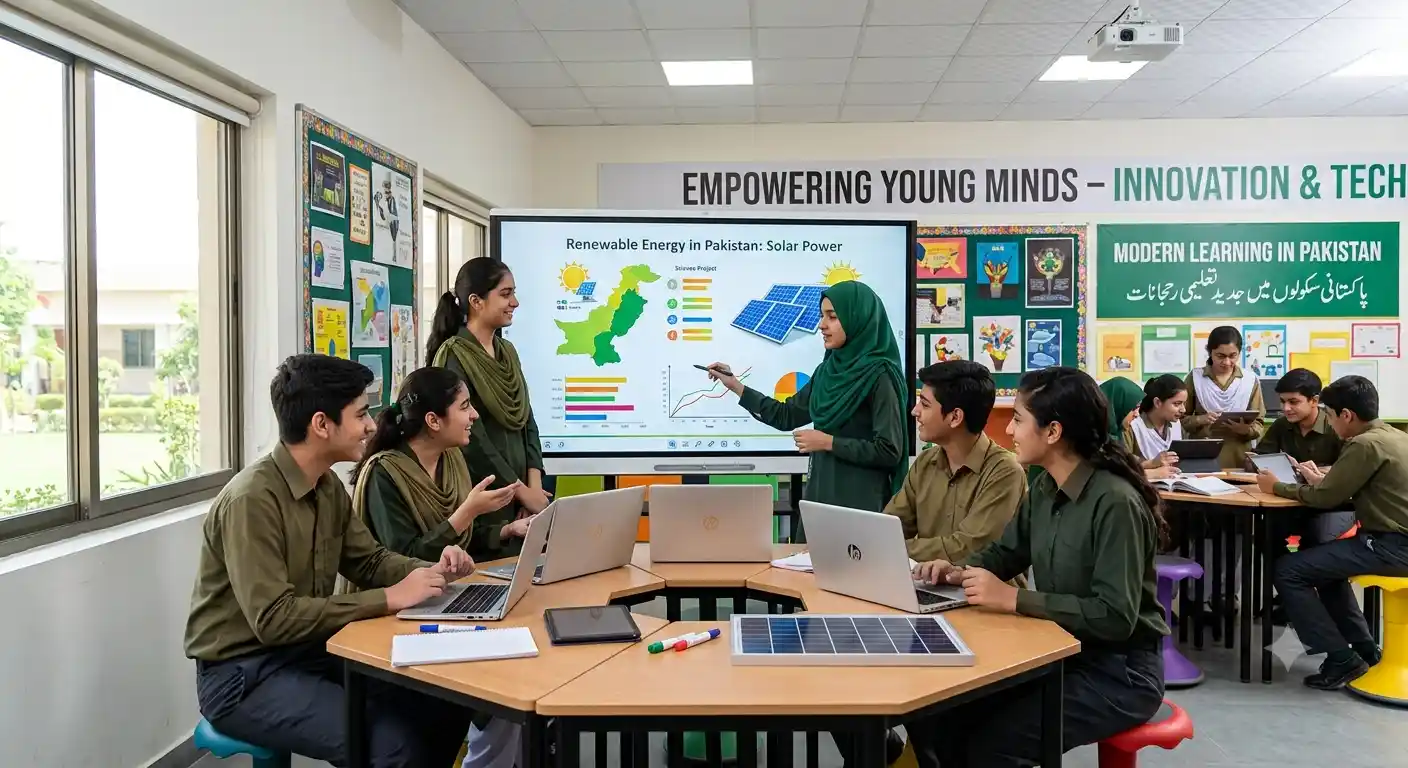
Interactive classrooms are becoming one of the most noticeable modern education trends in Pakistan schools.
Instead of relying only on whiteboards and textbooks, teachers now use:
- Interactive displays
- Educational videos
- Digital presentations
- Online quizzes
- Multimedia resources
Smart classrooms increase student participation and improve concept understanding.
Visual learning also makes lessons more enjoyable and memorable.
2. STEM Education Is Growing Rapidly
Science, Technology, Engineering, and Mathematics (STEM) education has become a major priority.
Many schools now encourage students to explore:
- Scientific experiments
- Engineering projects
- Mathematics challenges
- Technology innovation
STEM education helps students think logically and solve real-world problems.
It also prepares them for careers in engineering, healthcare, software development, and artificial intelligence.
This is one of the fastest-growing modern education trends in Pakistan schools.
3. Coding and Robotics in Classrooms
Technology skills are becoming essential from an early age.
Instead of simply using computers, students are now learning how technology works.
Schools introducing coding and robotics help children:
- Develop logical thinking
- Improve creativity
- Learn programming basics
- Build problem-solving skills
- Understand automation
Coding teaches students how to create rather than simply consume technology.
4. Artificial Intelligence Is Supporting Education
Artificial intelligence is changing how students learn.
AI-powered educational platforms can:
- Personalize lessons
- Identify learning gaps
- Provide instant feedback
- Recommend learning resources
- Track student progress
While teachers remain at the center of education, AI helps create more personalized learning experiences.
This is becoming one of the most exciting modern education trends in Pakistan schools.
5. Project-Based Learning Replaces Memorization
Education is gradually moving away from rote learning.
Project-based learning encourages students to solve practical problems while working individually or in teams.
Students learn through:
- Research projects
- Classroom presentations
- Science exhibitions
- Innovation challenges
- Community-based activities
This teaching approach develops confidence and critical thinking.
Instead of memorizing facts, students learn how to apply knowledge in real-life situations.
6. Digital Literacy Is Becoming Essential
Technology is now part of everyday life.
Students must learn how to use digital tools responsibly and effectively.
Digital literacy includes:
- Safe internet usage
- Online research
- Digital communication
- Cybersecurity awareness
- Responsible technology use
Schools that teach digital literacy prepare students for higher education and future careers.
7. Personalized Learning for Every Student
Every child learns differently.
One of the biggest modern education trends in Pakistan schools is personalized learning.
Teachers now recognize that students have different:
- Learning speeds
- Interests
- Strengths
- Challenges
By adapting lessons to individual needs, schools can improve both engagement and academic performance.
Personalized learning also helps students build confidence because they receive support based on their own abilities.
8. Social and Emotional Learning (SEL) Is Becoming a Priority
Academic excellence alone is no longer enough. Schools are now placing greater emphasis on helping students develop emotional intelligence, resilience, and interpersonal skills.
One of the most important modern education trends in Pakistan schools is the integration of Social and Emotional Learning (SEL).
SEL helps students:
-
Build self-confidence
-
Manage emotions effectively
-
Develop empathy
-
Resolve conflicts peacefully
-
Work collaboratively
-
Make responsible decisions
These life skills support academic success while preparing students for healthy personal and professional relationships.
9. Gamified Learning Increases Student Engagement
Learning becomes more effective when students enjoy the process.
Gamification uses game-like elements such as:
-
Points
-
Badges
-
Rewards
-
Challenges
-
Team competitions
These techniques motivate students to participate actively and improve their learning experience.
Instead of viewing lessons as a routine, students become excited about achieving learning goals.
Gamified learning is becoming one of the fastest-growing modern education trends in Pakistan schools, particularly in primary and middle school education.
10. Blended Learning Is Shaping Modern Classrooms
The combination of classroom teaching and digital learning is known as blended learning.
Rather than replacing teachers, technology supports classroom instruction through:
-
Learning management systems
-
Educational videos
-
Interactive assignments
-
Digital assessments
-
Virtual collaboration
Blended learning allows students to continue learning both inside and outside the classroom.
It also encourages greater independence and responsibility.
11. Sustainability and Environmental Education
Modern schools are helping students become environmentally responsible citizens.
Environmental education teaches students about:
-
Climate change
-
Recycling
-
Water conservation
-
Energy efficiency
-
Biodiversity
-
Sustainable living
Students often participate in tree plantation drives, recycling projects, and environmental awareness campaigns.
This trend develops responsible future leaders who care about their communities and the planet.
12. Career Readiness and Future Skills
Today’s students need more than academic knowledge.
Employers increasingly value practical skills such as:
-
Critical thinking
-
Communication
-
Leadership
-
Creativity
-
Adaptability
-
Collaboration
-
Digital literacy
One of the key modern education trends in Pakistan schools is preparing students for future careers rather than only examinations.
Schools are introducing entrepreneurship activities, coding, public speaking, innovation competitions, and leadership programs to help students succeed in higher education and the workplace.
Challenges of Adopting Modern Education in Pakistan
Although schools are making excellent progress, several challenges remain.
Some institutions continue to face:
-
Limited technology infrastructure
-
Budget constraints
-
Teacher training needs
-
Internet accessibility issues
-
Resistance to educational change
Despite these challenges, more schools across Pakistan are embracing innovation each year.
Government initiatives, private educational institutions, and parents all play an important role in supporting educational transformation.
How Parents Can Support Modern Learning at Home
Parents have a significant influence on their child’s educational journey.
They can reinforce modern learning by:
-
Encouraging curiosity and questions
-
Limiting passive screen time
-
Reading together regularly
-
Supporting project-based learning
-
Introducing educational technology
-
Promoting problem-solving activities
-
Celebrating creativity instead of memorization
When schools and families work together, children develop stronger learning habits and greater confidence.
How School of Scholars Embraces Modern Education
At School of Scholars, we believe education should prepare students for tomorrow’s opportunities while building a strong academic foundation today.
Our learning approach reflects the latest modern education trends in Pakistan schools by focusing on innovation, creativity, and student success.
We emphasize:
-
Student-centered learning
-
Interactive classrooms
-
Technology integration
-
STEM-focused education
-
Coding and robotics exposure
-
Critical thinking activities
-
Character building
-
Communication and leadership skills
-
Safe and inclusive learning environments
Our goal is to nurture confident learners who are academically strong, technologically aware, and ready to contribute positively to society.
Why These Trends Matter for Parents
When choosing a school, parents should look beyond examination results.
The right school prepares children for life—not just for tests.
Schools that embrace modern education help students become:
-
Independent learners
-
Confident communicators
-
Creative thinkers
-
Responsible citizens
-
Future-ready professionals
These qualities provide long-term benefits that extend well beyond the classroom.
Conclusion
Education in Pakistan is entering an exciting new era. Traditional teaching methods are evolving into engaging, technology-driven learning experiences that prepare students for the future. The growing adoption of modern education trends in Pakistan schools reflects a commitment to developing not only academic excellence but also creativity, leadership, critical thinking, and lifelong learning skills.
For parents, choosing a school means finding an environment that balances strong academics with innovation, character development, and practical learning opportunities. Schools that embrace these modern trends are better equipped to help children succeed in higher education, future careers, and everyday life.
At School of Scholars, we are proud to embrace the latest modern education trends in Pakistan schools while maintaining a strong focus on values, discipline, and holistic development. Our mission is to empower every student with the knowledge, confidence, and skills needed to thrive in an ever-changing world.
Because the future belongs to learners who are prepared not only to adapt—but to lead.
Frequently Asked Questions
1. What are the modern education trends in Pakistan schools?
Modern education trends in Pakistan schools include smart classrooms, STEM education, coding and robotics, artificial intelligence (AI)-assisted learning, project-based learning, digital literacy, personalized learning, and social-emotional learning. These approaches help students develop academic knowledge alongside practical and future-ready skills.
2. Why are modern education trends important for students?
Modern education trends prepare students for the future by improving critical thinking, creativity, communication, collaboration, digital literacy, and problem-solving skills. These competencies are essential for higher education and future careers.
3. How are schools in Pakistan using technology in education?
Many schools in Pakistan are integrating technology through smart classrooms, interactive digital boards, online learning platforms, educational apps, coding classes, robotics programs, and AI-powered learning tools to make education more engaging and effective.
4. How does School of Scholars implement modern education trends?
At School of Scholars, students benefit from technology-integrated classrooms, interactive teaching methods, STEM-focused learning, coding and robotics exposure, project-based activities, and character-building programs that support both academic excellence and holistic development.
5. How can parents support modern education at home?
Parents can support modern education by encouraging curiosity, reading regularly with their children, promoting problem-solving activities, using educational technology responsibly, limiting unnecessary screen time, and maintaining regular communication with teachers to support their child’s learning journey.