
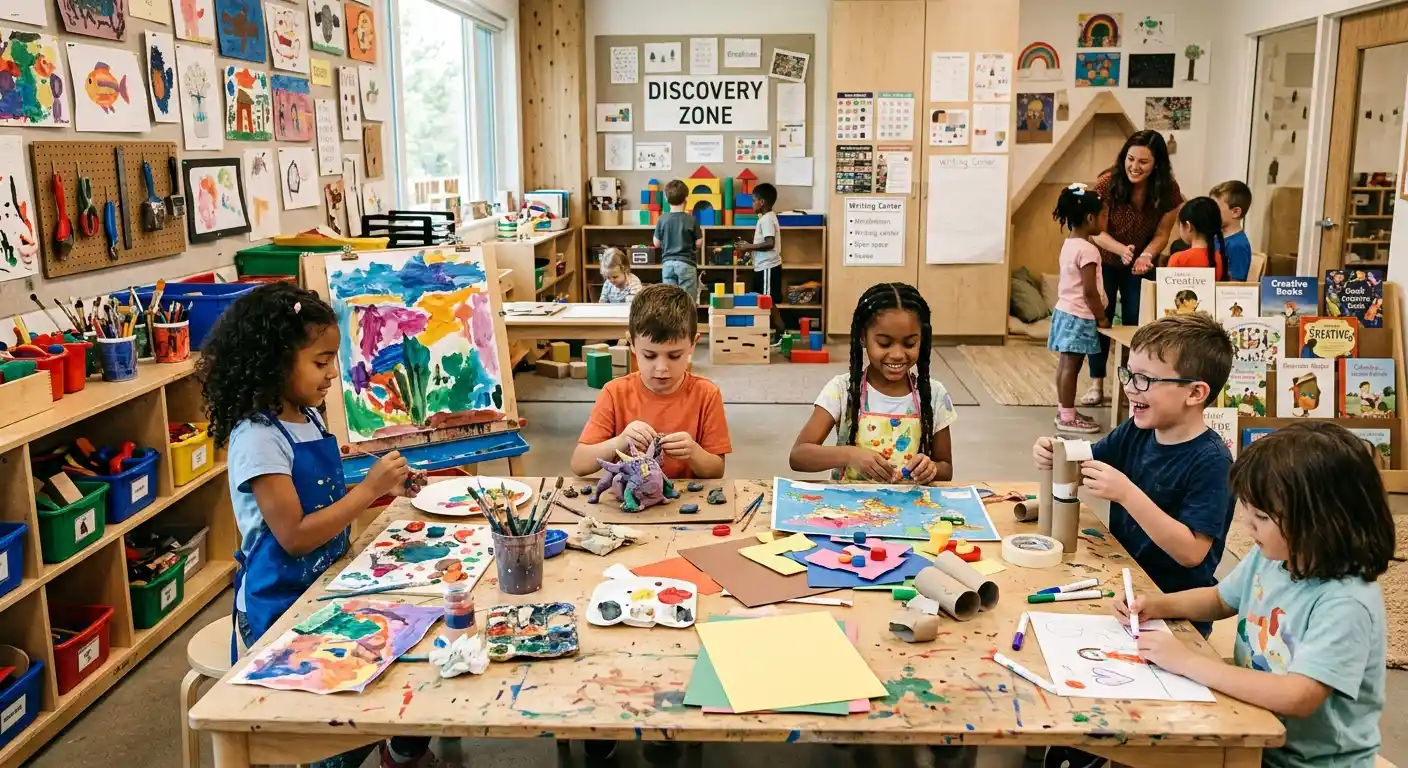
Introduction
Creativity is one of the most valuable skills a child can develop during their early years. In today’s rapidly changing world, success depends not only on academic knowledge but also on the ability to think creatively, solve problems, communicate ideas, and adapt to new challenges.
Many parents associate creativity only with painting, drawing, or music. While these activities certainly encourage imagination, creativity is much broader. It includes finding new solutions, asking thoughtful questions, exploring different perspectives, and expressing ideas with confidence.
Understanding how schools improve creativity in young children helps parents choose learning environments that prepare children for both academic achievement and lifelong success.
Modern schools no longer focus solely on memorization and examinations. Instead, they create classrooms where students learn through exploration, collaboration, experimentation, and hands-on experiences.
At School of Scholars, creativity is considered an essential part of every child’s educational journey. By combining innovative teaching strategies with strong academic foundations, the school helps children become confident, curious, and independent learners.
This comprehensive guide explains how schools improve creativity in young children and why creativity has become one of the most important skills for future generations.
1. What Is Creativity in Early Childhood?
Creativity is the ability to generate original ideas, solve problems in unique ways, and express thoughts through imagination and innovation.
In early childhood, creativity appears in many everyday activities. A child who builds a new structure with blocks, invents a story, asks thoughtful questions, or discovers different ways to solve a puzzle is demonstrating creative thinking.
Creativity is not limited to artistic talents. Instead, it supports learning across every subject, including mathematics, science, language, and technology.
Children naturally possess creative abilities, but these skills grow stronger when schools provide opportunities for exploration, experimentation, and independent thinking.
Examples of creativity in young children include:
- Creating imaginative stories
- Asking “why” and “how” questions
- Building structures with toys
- Solving classroom challenges
- Exploring nature
- Designing art projects
- Inventing games
- Thinking of multiple solutions to one problem
Understanding how schools improve creativity in young children begins with recognizing that creativity is a skill that can be developed rather than a talent that only some children possess.
2. Why Creativity Matters in Child Development
Creativity plays a significant role in every stage of child development.
Children who develop creative thinking become better learners because they are more willing to explore ideas, ask questions, and solve problems independently.
Research consistently shows that creativity contributes to cognitive, emotional, social, and academic growth.
Benefits of Creativity for Children
| Area of Development | Benefits of Creativity |
|---|---|
| Cognitive Development | Improves critical thinking, reasoning, and problem-solving skills. |
| Language Development | Encourages communication, storytelling, and vocabulary growth. |
| Emotional Development | Helps children express emotions in healthy and constructive ways. |
| Social Development | Promotes teamwork, empathy, and collaboration. |
| Academic Success | Supports learning across all subjects through active engagement. |
| Confidence | Builds self-esteem by encouraging children to share ideas without fear. |
| Innovation | Inspires curiosity and a willingness to explore new possibilities. |
Creative children often become more resilient because they learn that there can be multiple ways to approach a challenge.
This mindset prepares them for future careers where innovation and adaptability are highly valued.
Understanding how schools improve creativity in young children helps parents appreciate why creativity deserves equal attention alongside academic achievement.
3. How Schools Nurture Creative Thinking
Schools play a critical role in developing creativity because children spend a large portion of their day in the classroom.
A supportive learning environment encourages students to think independently, experiment with ideas, and participate actively in learning.
Rather than giving students every answer, effective teachers ask meaningful questions that encourage exploration.
Schools nurture creativity by:
- Encouraging curiosity
- Allowing students to ask questions
- Supporting independent thinking
- Promoting collaboration
- Providing hands-on learning experiences
- Celebrating original ideas
- Giving constructive feedback
- Creating opportunities for experimentation
When children feel safe expressing their ideas, they become more confident and willing to explore new possibilities.
Modern classrooms recognize that mistakes are valuable learning opportunities rather than failures.
This positive environment is one of the most effective ways how schools improve creativity in young children.
4. Creative Teaching Methods
Teaching methods have evolved significantly over the past decade.
Traditional lectures are increasingly being replaced by interactive learning experiences that encourage participation and discovery.
Creative teaching methods focus on making learning engaging while helping students develop higher-order thinking skills.
Some of the most effective teaching strategies include:
Inquiry-Based Learning
Students investigate questions and discover answers through research, discussion, and exploration.
Problem-Based Learning
Teachers present real-world challenges that encourage students to develop practical solutions.
Hands-On Activities
Experiments, classroom projects, and practical tasks help students understand concepts more effectively.
Visual Learning
Charts, diagrams, educational videos, and interactive presentations improve understanding and engagement.
Discussion-Based Learning
Open classroom discussions encourage students to share ideas, defend opinions, and consider different perspectives.
These methods demonstrate how schools improve creativity in young children by encouraging active participation instead of passive memorization.
5. Play-Based Learning
Play is one of the most powerful tools for developing creativity during childhood.
Through play, children naturally explore, experiment, imagine, and solve problems without fear of making mistakes.
Play-based learning combines educational objectives with enjoyable activities that motivate children to participate actively.
Examples include:
- Building blocks
- Pretend play
- Educational games
- Role-playing
- Puzzle-solving
- Outdoor exploration
- Creative crafts
- Team challenges
Play-based learning helps children develop:
- Creativity
- Communication
- Collaboration
- Leadership
- Emotional intelligence
- Decision-making
- Problem-solving
Instead of simply memorizing information, students experience learning through action.
This approach not only improves academic understanding but also develops confidence and independent thinking.
At School of Scholars, play-based learning forms an important part of early childhood education, helping students discover their interests while building the creative skills needed for future success.
As educators continue exploring how schools improve creativity in young children, play remains one of the most effective and research-supported teaching strategies.
6. Arts, Music, and Drama
Creative expression plays a vital role in helping children discover their talents and develop confidence. Among the many ways how schools improve creativity in young children, arts, music, and drama remain some of the most effective and enjoyable learning experiences.
These activities encourage children to think imaginatively while expressing their ideas in unique ways. They also help students communicate emotions, develop social skills, and appreciate different cultures.
How Art Develops Creativity
Art allows children to experiment with colors, shapes, textures, and designs without worrying about right or wrong answers.
Through activities such as drawing, painting, sculpture, and craft projects, students learn to:
Express their imagination
Improve observation skills
Develop patience
Strengthen fine motor skills
Build confidence in their ideas
Art also teaches children that creativity comes from exploration rather than perfection.
The Importance of Music
Music stimulates multiple areas of the brain and contributes to both academic and emotional development.
Music education helps children:
Improve listening skills
Strengthen memory
Develop rhythm and coordination
Enhance concentration
Build teamwork through group performances
Children who participate in music activities often become more confident speakers and better communicators.
Drama and Role-Playing
Drama encourages students to step into different roles, imagine new situations, and communicate effectively.
Role-playing activities help children:
Build confidence
Improve public speaking
Develop empathy
Strengthen communication
Solve problems creatively
Drama also teaches students how to work collaboratively while respecting different opinions and perspectives.
At School of Scholars, creative arts are integrated into learning to ensure students develop academically while exploring their unique talents.
7. Storytelling and Reading
Stories have inspired creativity for generations. Reading and storytelling introduce children to new ideas, cultures, characters, and possibilities that stimulate imagination.
Storytelling is one of the simplest yet most powerful examples of how schools improve creativity in young children.
Benefits of Storytelling
Listening to and creating stories helps children:
Expand vocabulary
Improve communication
Develop imagination
Strengthen memory
Build confidence
Understand emotions
Teachers often encourage students to create their own stories, allowing them to think independently and express original ideas.
Reading Encourages Creative Thinking
Reading exposes children to different worlds, experiences, and perspectives.
As students read, they naturally begin asking questions such as:
What happens next?
Why did the character make that decision?
How would I solve this problem?
Could the ending be different?
These questions encourage analytical and creative thinking simultaneously.
Creative Writing Activities
Schools also encourage creativity through:
Story writing
Poetry
Journaling
Letter writing
Comic creation
Book reviews
Writing allows students to organize thoughts while expressing themselves confidently.
Schools that prioritize storytelling and literacy create learners who think critically and communicate effectively.
8. STEM, Coding, and Robotics
Technology has transformed education, making STEM (Science, Technology, Engineering, and Mathematics) one of the fastest-growing educational approaches worldwide.
Many parents assume coding and robotics are only technical subjects. In reality, they are excellent tools for developing creativity.
Understanding how schools improve creativity in young children requires recognizing that creativity and technology work together.
STEM Encourages Innovation
STEM activities encourage students to:
Ask questions
Test ideas
Build models
Conduct experiments
Solve practical problems
Instead of memorizing scientific facts, students become active investigators.
Coding Builds Creative Problem-Solving
Coding teaches children to think logically while creating something entirely new.
Students learn to:
Design games
Create animations
Develop apps
Solve programming challenges
Build digital projects
Every coding project requires creativity because students must design solutions rather than simply follow instructions.
Robotics Makes Learning Practical
Robotics combines creativity with engineering and technology.
Students learn how to:
Design robots
Build mechanical systems
Program movements
Solve engineering challenges
Work collaboratively
These experiences prepare students for careers in artificial intelligence, engineering, automation, and computer science.
At School of Scholars, exposure to STEM learning and emerging technologies helps students become confident innovators and future-ready learners.
9. Project-Based Learning
Project-Based Learning (PBL) is transforming classrooms by helping students learn through meaningful experiences rather than memorization.
Instead of completing isolated worksheets, students investigate real-world questions and develop practical solutions.
Project-Based Learning is another excellent example of how schools improve creativity in young children.
How Project-Based Learning Works
Students work individually or in groups to complete projects that involve:
Research
Planning
Collaboration
Creativity
Presentation
Reflection
Teachers act as facilitators, guiding students while allowing them to make decisions independently.
Benefits of Project-Based Learning
Students develop:
Critical thinking
Communication
Leadership
Creativity
Time management
Problem-solving
Teamwork
Projects often connect classroom learning with real-life situations, making education more meaningful and memorable.
Examples include:
Science exhibitions
Environmental campaigns
Community service projects
Business simulations
Robotics competitions
Innovation fairs
These activities help students understand that learning extends beyond textbooks.
10. Outdoor Learning
Learning does not have to happen only inside a classroom.
Outdoor education provides children with opportunities to observe, explore, and interact with the world around them.
Nature inspires curiosity, creativity, and discovery.
Benefits of Outdoor Learning
Outdoor activities help children:
Improve observation skills
Develop curiosity
Build teamwork
Increase physical activity
Reduce stress
Strengthen environmental awareness
Students become active participants in learning rather than passive observers.
Examples of Outdoor Learning
Schools may organize:
Nature walks
Gardening projects
Science observations
Field trips
Environmental activities
Outdoor storytelling
Sports and adventure challenges
These experiences encourage children to ask questions and discover answers through direct observation.
Nature Inspires Creative Thinking
Natural environments stimulate imagination because they provide endless opportunities for exploration.
Children may:
Collect leaves for art projects
Observe insects
Study weather patterns
Build simple structures
Create nature journals
Outdoor experiences encourage children to think creatively while developing respect for the environment.
At School of Scholars, learning extends beyond classroom walls to provide meaningful experiences that inspire curiosity, creativity, and lifelong learning.
When educators explore how schools improve creativity in young children, outdoor learning continues to prove that some of the best lessons happen through exploration, observation, and real-world experiences.
11. Collaborative Activities
Collaboration is one of the most effective ways to inspire creativity in children. When students work together, they exchange ideas, solve problems, and learn to appreciate different perspectives. This collaborative environment is a key example of how schools improve creativity in young children.
Working with classmates encourages children to think beyond their own ideas. They learn that there can be multiple solutions to the same problem, which strengthens both creativity and critical thinking.
Benefits of Collaborative Learning
Group activities help students:
Develop communication skills
Learn teamwork
Respect different opinions
Improve leadership abilities
Build confidence
Solve problems creatively
Strengthen decision-making skills
These experiences prepare children for future academic and professional environments where collaboration is essential.
Classroom Activities That Promote Collaboration
Modern schools encourage teamwork through:
Group science projects
Classroom debates
STEM challenges
Art collaborations
Reading circles
Educational games
Community service projects
Innovation competitions
Rather than competing against one another, students learn how to achieve common goals while valuing each team member’s contribution.
12. Role of Teachers
Teachers play one of the most significant roles in nurturing creativity. Their teaching style, classroom environment, and encouragement can greatly influence how children think, explore, and express themselves.
Understanding how schools improve creativity in young children begins with recognizing the impact of skilled educators.
Characteristics of Creative Teachers
Creative teachers:
Encourage questions
Welcome different opinions
Celebrate original ideas
Promote curiosity
Use interactive teaching methods
Allow students to experiment
Provide constructive feedback
Instead of giving students all the answers, effective teachers guide them toward discovering solutions independently.
Creating a Safe Learning Environment
Children become more creative when they feel safe to express themselves.
Teachers support creativity by:
Respecting student ideas
Encouraging participation
Avoiding unnecessary criticism
Viewing mistakes as learning opportunities
Recognizing individual strengths
A positive classroom culture gives students the confidence to share ideas without fear of failure.
Inspiring Lifelong Learning
Great teachers inspire children to remain curious beyond the classroom.
They encourage students to:
Read independently
Explore hobbies
Conduct research
Participate in competitions
Ask meaningful questions
These habits help children become lifelong learners who continue developing creativity throughout their lives.
13. Role of Parents
While schools provide structured learning opportunities, parents play an equally important role in supporting creativity at home.
When schools and families work together, children receive consistent encouragement that strengthens creative thinking.
Ways Parents Can Encourage Creativity
Parents can nurture creativity by:
Reading together every day
Encouraging storytelling
Providing art materials
Limiting passive screen time
Asking open-ended questions
Supporting hobbies
Allowing independent play
Celebrating effort instead of perfection
Simple daily activities often have the greatest impact.
Encourage Curiosity
Instead of immediately answering every question, parents can encourage children to investigate and discover answers themselves.
Questions like:
“What do you think?”
“How could we solve this?”
“Can you think of another idea?”
help children develop independent thinking.
Create Opportunities for Exploration
Children become more creative when they have opportunities to:
Visit museums
Explore nature
Conduct simple science experiments
Cook with family
Build projects
Read different types of books
These experiences expose children to new ideas and inspire innovation.
14. Technology and Creativity
Technology has transformed the way children learn, create, and communicate. When used responsibly, digital tools can significantly enhance creativity rather than replace it.
Understanding how schools improve creativity in young children includes recognizing technology as a tool for innovation.
Educational Technology Supports Creativity
Interactive technology allows students to:
Design digital artwork
Create presentations
Build animations
Learn coding
Produce videos
Collaborate online
Technology gives students opportunities to express ideas in ways that were not possible in traditional classrooms.
Balancing Technology with Hands-On Learning
While digital tools offer many advantages, balance is essential.
Schools should combine technology with:
Outdoor activities
Reading
Art
Music
Physical play
Classroom discussions
This balanced approach ensures children develop both digital literacy and real-world creative skills.
Teaching Responsible Technology Use
Modern schools also teach students:
Online safety
Digital citizenship
Responsible communication
Information evaluation
Ethical technology use
These skills prepare children to become responsible digital citizens while using technology creatively.
15. Building Creative Classrooms
A creative classroom is more than a room filled with colorful decorations.
It is an environment where students feel inspired to think, ask questions, experiment, and explore.
Schools that understand how schools improve creativity in young children intentionally design learning spaces that encourage curiosity and innovation.
Characteristics of Creative Classrooms
Creative classrooms often include:
Flexible seating arrangements
Interactive learning materials
Reading corners
STEM resources
Art stations
Technology integration
Student project displays
Collaborative workspaces
These environments encourage active participation instead of passive learning.
Encouraging Student Voice
Creative classrooms allow students to:
Share opinions
Ask questions
Lead discussions
Present projects
Suggest solutions
Reflect on their learning
When children know their ideas matter, they become more confident and motivated.
Celebrating Creativity
Schools can foster creativity by recognizing:
Original thinking
Innovative projects
Creative writing
Artistic achievements
Problem-solving efforts
Team collaboration
Celebrating creativity encourages students to continue exploring new ideas without fear of making mistakes.
How School of Scholars Builds Creative Learning Environments
At School of Scholars, creativity is woven into everyday learning experiences. Our classrooms encourage exploration, collaboration, innovation, and independent thinking through engaging lessons, interactive activities, project-based learning, STEM education, arts, and technology integration.
By creating a supportive environment where curiosity is valued and every student’s ideas are respected, we help children develop the confidence to become creative thinkers, effective communicators, and future-ready leaders.
A creative classroom is not simply a place where children learn facts it is a place where they discover their potential and develop the skills needed to thrive in an ever-changing world.
16. Common Mistakes That Limit Creativity
Although every child is naturally creative, certain teaching methods and parenting habits can unintentionally reduce creativity over time. Recognizing these challenges is essential when understanding how schools improve creativity in young children.
Schools and parents should work together to create an environment where children feel confident exploring new ideas instead of worrying about making mistakes.
1. Focusing Only on Memorization
When education revolves only around memorizing facts, children have fewer opportunities to think independently.
Modern classrooms encourage students to:
Analyze information
Ask questions
Explore solutions
Apply knowledge in practical situations
Balancing academic learning with creative activities helps children become more innovative thinkers.
2. Fear of Making Mistakes
Many children hesitate to share ideas because they fear being wrong.
Creative schools teach students that mistakes are part of learning. Every unsuccessful attempt provides valuable experience that leads to better ideas and stronger problem-solving skills.
3. Limited Opportunities for Exploration
Children need time to experiment, imagine, and discover.
When every activity has only one correct answer, creativity becomes restricted.
Providing open-ended projects encourages children to think beyond standard solutions.
4. Overloaded Schedules
A busy schedule filled with continuous homework and structured activities leaves little room for imagination.
Children also need time for:
Reading
Free play
Art
Outdoor exploration
Building projects
Storytelling
These experiences often inspire the most creative ideas.
5. Comparing Children
Every child develops creativity differently.
Comparing one child with another can reduce confidence and discourage creative expression.
Instead, teachers and parents should celebrate each child’s unique strengths and progress.
17. How School of Scholars Encourages Creativity
At School of Scholars, creativity is considered an essential life skill rather than an optional classroom activity.
Our educational philosophy focuses on developing curious learners who can think independently, solve problems confidently, and adapt to future challenges.
We encourage creativity through:
Student-Centered Learning
Students actively participate in discussions, projects, and classroom activities that encourage independent thinking.
Interactive Teaching Methods
Our teachers use engaging strategies that make learning enjoyable while promoting creativity and critical thinking.
STEM, Coding, and Robotics
Technology-based learning helps students develop innovation, logical reasoning, and practical problem-solving skills.
Arts and Creative Expression
Drawing, music, drama, storytelling, and creative writing allow students to express themselves confidently.
Project-Based Learning
Students work on real-world projects that develop collaboration, communication, leadership, and innovation.
Safe and Supportive Learning Environment
Children are encouraged to ask questions, share ideas, and explore new concepts without fear of failure.
By combining academic excellence with creative learning experiences, School of Scholars prepares students to succeed in higher education and the rapidly changing world beyond the classroom.
Conclusion
Creativity is no longer viewed as a talent reserved for artists or musicians—it is a vital skill that helps children think independently, solve problems, communicate effectively, and adapt to an ever-changing world. Understanding how schools improve creativity in young children enables parents to appreciate the value of learning environments that encourage curiosity, imagination, and innovation alongside academic excellence.
From play-based learning and storytelling to STEM education, collaborative projects, outdoor exploration, and technology integration, modern schools provide countless opportunities for children to develop creative thinking. These experiences help students become confident learners who are prepared to face future academic, personal, and professional challenges.
Parents also play a significant role by supporting creativity at home through reading, exploration, meaningful conversations, and encouraging independent thinking. When schools and families work together, children receive the guidance and confidence needed to unlock their full creative potential.
At School of Scholars, we are committed to nurturing creativity through engaging teaching methods, interactive learning experiences, and a student-centered approach that empowers every child to think beyond textbooks. Our goal is to inspire young learners to become innovative thinkers, responsible citizens, and lifelong learners who are ready to shape the future with confidence.
Because today’s creative children become tomorrow’s leaders, innovators, entrepreneurs, and problem-solvers.
Frequently Asked Questions
1. How do schools improve creativity in young children?
Schools improve creativity in young children through play-based learning, storytelling, arts, music, STEM education, coding, project-based learning, collaborative activities, and interactive teaching methods that encourage curiosity, imagination, and problem-solving.
2. Why is creativity important for young children?
Creativity helps children develop critical thinking, communication, confidence, emotional intelligence, and problem-solving skills. It also prepares them for academic success and future careers that require innovation and adaptability.
3. What classroom activities encourage creativity?
Activities such as art projects, storytelling, drama, music, science experiments, coding, robotics, group projects, outdoor learning, and creative writing help children express their ideas and think independently.
4. How can parents encourage creativity at home?
Parents can support creativity by reading with their children, encouraging imaginative play, providing art supplies, asking open-ended questions, limiting passive screen time, exploring nature, and allowing children to solve problems independently.
5. How does School of Scholars nurture creativity in students?
At School of Scholars, creativity is encouraged through student-centered learning, interactive classrooms, STEM and robotics programs, creative arts, project-based learning, collaborative activities, and a supportive environment where every child is inspired to explore, innovate, and grow.