
Introduction
Education has always been the foundation of personal and professional growth. However, the way students learn has changed significantly over the years. While traditional education often emphasized memorization, today’s world demands skills such as critical thinking, creativity, collaboration, and problem-solving.
This shift has sparked an important discussion: critical thinking vs rote learning. Which approach truly prepares students for academic achievement, career success, and lifelong learning?
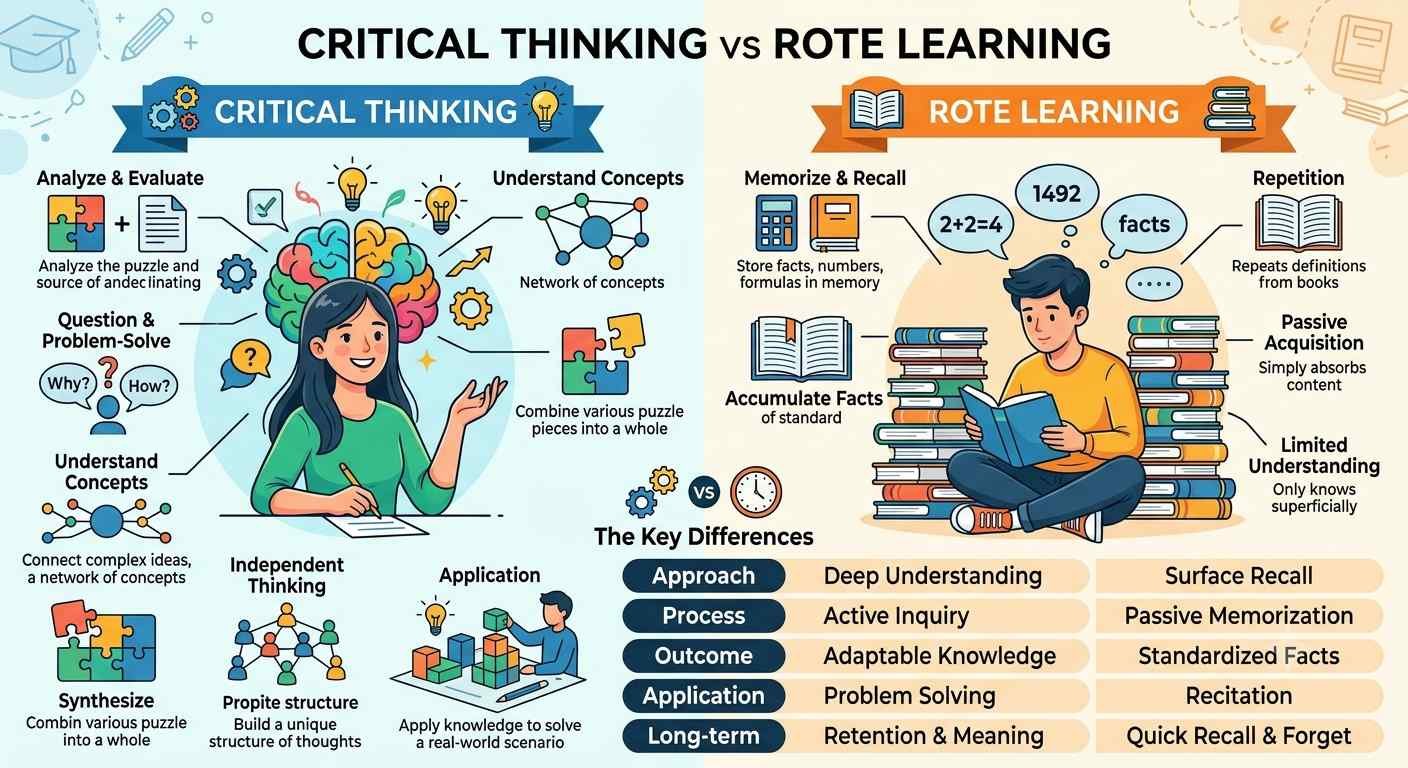
Rote learning helps students remember information, formulas, and facts. Critical thinking, on the other hand, enables them to analyze information, solve complex problems, evaluate different perspectives, and make informed decisions.
Modern education does not view these approaches as complete opposites. Instead, the goal is to build a strong knowledge base while teaching students how to apply that knowledge in meaningful ways.
At School of Scholars, we believe students thrive when they are encouraged to understand concepts, ask thoughtful questions, and develop the confidence to think independently.
What Is Rote Learning?
Rote learning is a teaching method that focuses on repetition and memorization. Students repeatedly practice information until they can recall it accurately.
This approach has been used for generations because it helps learners remember:
- Mathematical formulas
- Grammar rules
- Historical dates
- Scientific terminology
- Vocabulary
- Multiplication tables
Rote learning is particularly useful when students need to build foundational knowledge that can later support deeper understanding.
However, memorization alone does not always ensure that students understand how or why concepts work.
What Is Critical Thinking?
Critical thinking is the ability to analyze information, evaluate evidence, solve problems, and make logical decisions.
Rather than simply remembering answers, critical thinkers ask questions such as:
- Why does this happen?
- Is there another solution?
- What evidence supports this idea?
- How can I apply this knowledge in real life?
Students who develop critical thinking skills become active learners instead of passive recipients of information.
These abilities prepare them for challenges both inside and outside the classroom.
Critical Thinking vs Rote Learning: Understanding the Difference
Although both methods contribute to education, they serve different purposes.
| Aspect | Critical Thinking | Rote Learning |
|---|---|---|
| Learning Style | Understanding and analysis | Memorization and repetition |
| Student Role | Active learner | Passive learner |
| Problem Solving | Encourages independent solutions | Focuses on recalling information |
| Creativity | Promotes innovation | Limited creative thinking |
| Long-Term Learning | Stronger concept retention | May fade without practice |
| Real-World Application | High | Limited |
| Decision Making | Encourages logical reasoning | Relies on remembered answers |
This comparison shows that while memorization helps students build knowledge, critical thinking helps them use that knowledge effectively.
Benefits of Rote Learning
Despite criticism, rote learning still has an important role in education.
Some of its key advantages include:
Builds Strong Foundations
Students must remember certain facts before they can apply them.
For example:
- Multiplication tables
- Alphabet recognition
- Grammar rules
- Scientific symbols
- Mathematical formulas
Without this foundation, higher-level learning becomes more difficult.
Improves Memory
Regular repetition strengthens memory and helps students recall information quickly during classroom activities and examinations.
Supports Early Learning
Young learners often begin by memorizing letters, numbers, words, and simple concepts before progressing to more advanced thinking skills.
For this reason, rote learning remains valuable during the early stages of education.
Limitations of Rote Learning
Although memorization has benefits, relying on it exclusively can create challenges.
Limited Understanding
Students may remember answers without understanding the concepts behind them.
As a result, they struggle when faced with unfamiliar questions.
Reduced Creativity
When every question has only one expected answer, students may hesitate to explore alternative ideas or creative solutions.
Difficulty Applying Knowledge
Real-world situations often require analysis rather than memorization.
Students who rely only on rote learning may find it difficult to solve practical problems.
Lower Engagement
Repeated memorization can become repetitive and reduce students’ interest in learning.
Modern classrooms therefore combine memorization with interactive learning strategies.
Benefits of Critical Thinking
Critical thinking equips students with skills that extend far beyond examinations.
Better Problem-Solving Skills
Critical thinkers analyze situations carefully before making decisions.
Instead of accepting information at face value, they evaluate evidence and consider multiple solutions.
Greater Confidence
Students become more confident when they understand concepts rather than simply memorizing answers.
They are more willing to participate in discussions, ask questions, and present ideas.
Improved Decision-Making
Critical thinking helps students make informed decisions based on logic and evidence.
This ability becomes valuable throughout education, careers, and everyday life.
Encourages Lifelong Learning
Curious learners continue asking questions long after they leave the classroom.
Critical thinking encourages continuous learning, adaptability, and innovation.
Why Modern Education Prioritizes Critical Thinking
Today’s world is driven by innovation, technology, and rapid change.
Artificial intelligence can instantly provide information.
However, AI cannot replace human judgment, creativity, empathy, or ethical decision-making.
For this reason, employers increasingly seek graduates who can:
- Solve complex problems
- Think independently
- Communicate effectively
- Collaborate with diverse teams
- Adapt to changing environments
- Generate innovative ideas
These qualities are developed through critical thinking rather than memorization alone.
How Schools Develop Critical Thinking Skills
Schools play a crucial role in helping students move beyond memorization and become independent thinkers. Modern classrooms are designed to encourage curiosity, discussion, collaboration, and practical problem-solving.
Rather than asking students to simply remember information, teachers challenge them to understand concepts, evaluate evidence, and apply knowledge to real-life situations.
Some of the most effective ways schools develop critical thinking include:
1. Inquiry-Based Learning
Inquiry-based learning encourages students to ask questions, investigate ideas, and discover answers on their own.
Instead of providing immediate solutions, teachers guide students through the learning process by asking thought-provoking questions such as:
-
Why do you think this happened?
-
Can you find another solution?
-
What evidence supports your answer?
-
How would you solve this problem differently?
This approach develops curiosity and analytical thinking while helping students become more confident learners.
2. Project-Based Learning
Project-based learning allows students to apply classroom knowledge to practical situations.
Projects often involve:
-
Research
-
Collaboration
-
Planning
-
Problem-solving
-
Presentations
-
Reflection
For example, students might design a sustainable city, create a science model, or develop a business idea. These activities require them to analyze information, make decisions, and work together—skills that extend beyond textbooks.
3. Classroom Discussions and Debates
Healthy discussions encourage students to express their opinions while respecting the views of others.
Debates help students:
-
Evaluate evidence
-
Build logical arguments
-
Improve communication
-
Listen actively
-
Think from multiple perspectives
These experiences strengthen both confidence and critical thinking.
4. STEM and Technology Integration
Science, Technology, Engineering, and Mathematics (STEM) education naturally promotes critical thinking.
Coding, robotics, engineering challenges, and science experiments require students to:
-
Test ideas
-
Analyze results
-
Solve problems
-
Improve solutions
-
Think creatively
Rather than memorizing facts, students become active innovators.
5. Real-Life Problem Solving
Modern education often uses real-world scenarios to make learning meaningful.
Examples include:
-
Environmental projects
-
Community initiatives
-
Financial literacy activities
-
Entrepreneurship programs
-
Social awareness campaigns
These experiences teach students how to apply academic knowledge outside the classroom.
Why a Balanced Approach Is Best
The debate around critical thinking vs rote learning should not suggest that one method completely replaces the other.
Both approaches have value when used appropriately.
Rote learning provides the foundational knowledge students need, while critical thinking helps them apply that knowledge effectively.
For example:
-
Students memorize multiplication tables before solving complex mathematical problems.
-
They learn grammar rules before writing persuasive essays.
-
They study scientific concepts before conducting experiments.
A balanced educational approach combines strong foundational knowledge with opportunities for inquiry, creativity, and problem-solving.
How Parents Can Encourage Critical Thinking at Home
Parents play a significant role in developing thinking skills beyond the classroom.
Simple daily habits can make a lasting impact.
Encourage Questions
Instead of providing immediate answers, encourage children to think by asking:
-
What do you think?
-
Why do you believe that?
-
Can you explain your reasoning?
-
Is there another solution?
These conversations help children develop confidence in their own thinking.
Read Together
Reading books, articles, and stories introduces children to different ideas and perspectives.
After reading, discuss questions like:
-
What was the main message?
-
Which character made the best decision?
-
How would you have solved the problem?
Reading becomes more meaningful when children are encouraged to reflect and analyze.
Allow Independent Problem-Solving
Parents naturally want to help, but allowing children to solve age-appropriate challenges independently builds resilience and confidence.
Whether assembling a puzzle, completing homework, or organizing a project, independent thinking strengthens critical reasoning.
Encourage Creativity
Creative activities such as drawing, storytelling, building models, coding, or experimenting with science projects naturally complement critical thinking.
Creativity and analytical thinking often work together to generate innovative solutions.
How School of Scholars Prepares Future-Ready Learners
At School of Scholars, we believe education should prepare students for life not just examinations.
Our teaching philosophy combines academic excellence with modern learning strategies that develop confident, curious, and independent learners.
We encourage critical thinking through:
-
Interactive classroom discussions
-
Project-based learning
-
STEM and robotics education
-
Creative arts and storytelling
-
Technology-enhanced learning
-
Collaborative group activities
-
Problem-solving challenges
-
Student-centered teaching methods
Our classrooms inspire students to ask questions, explore new ideas, and apply their knowledge with confidence.
By balancing foundational learning with practical application, we prepare students to succeed in higher education and an increasingly dynamic world.
Conclusion
The discussion around critical thinking vs rote learning is not about choosing one method over the other it is about understanding how both contribute to a child’s education.
Rote learning provides essential knowledge that forms the foundation for future learning. Critical thinking transforms that knowledge into understanding, innovation, and practical application.
In today’s rapidly evolving world, students need more than the ability to remember information. They need to evaluate evidence, solve problems, communicate effectively, collaborate with others, and adapt to change.
Schools that combine memorization with inquiry-based learning, creativity, and real-world experiences help students become confident learners who are prepared for lifelong success.
At School of Scholars, we are committed to creating an engaging learning environment where curiosity is encouraged, creativity is celebrated, and every student is empowered to think independently. By nurturing critical thinking alongside academic excellence, we prepare future-ready learners who can thrive in school, higher education, and beyond.
The future belongs not only to those who know the answers but to those who know how to ask the right questions.
Frequently Asked Questions
1. What is the difference between critical thinking and rote learning?
Critical thinking focuses on analyzing, evaluating, and applying knowledge to solve problems, while rote learning emphasizes memorization and repetition to remember facts and information. Both approaches have value, but critical thinking better prepares students for real-world challenges.
2. Why is critical thinking important for students?
Critical thinking helps students solve problems, make informed decisions, think creatively, communicate effectively, and adapt to changing situations. These skills are essential for academic success, higher education, and future careers.
3. Is rote learning still useful in modern education?
Yes. Rote learning is useful for building foundational knowledge, such as mathematical formulas, vocabulary, grammar rules, and scientific concepts. However, it is most effective when combined with critical thinking and practical application.
4. How can schools develop critical thinking skills?
Schools develop critical thinking through inquiry-based learning, project-based activities, STEM education, classroom discussions, debates, collaborative projects, and real-world problem-solving experiences.
5. How does School of Scholars promote critical thinking?
At School of Scholars, students develop critical thinking through interactive teaching, project-based learning, STEM and robotics, creative classroom discussions, technology integration, and student-centered activities that encourage curiosity, innovation, and independent learning.