
Introduction
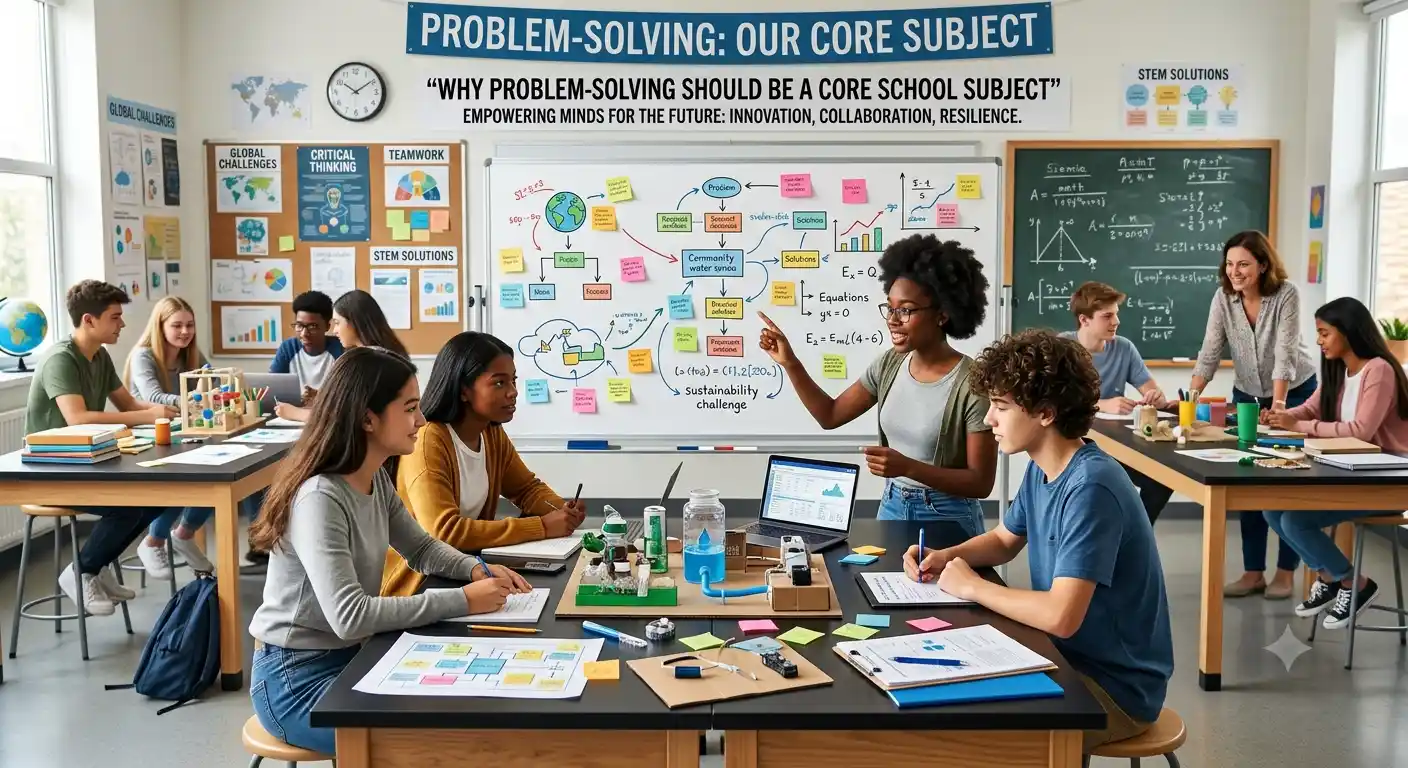
Education is evolving to meet the demands of a rapidly changing world. While traditional subjects like mathematics, science, languages, and social studies remain essential, today’s students also need practical life skills that help them navigate complex challenges. Among these, problem-solving skills in schools have become one of the most valuable abilities students can develop.
Every day, children encounter situations that require them to think critically, make decisions, and find effective solutions. Whether they are resolving disagreements with classmates, completing a science experiment, or tackling a challenging math problem, problem-solving is at the heart of learning.
Unfortunately, many education systems still prioritize memorization over independent thinking. Students may learn facts and formulas, but they are not always taught how to apply that knowledge in real-life situations.
At School of Scholars, we believe that education should prepare students not only to succeed in examinations but also to become confident thinkers, effective communicators, and capable problem-solvers who are ready for the future.
What Are Problem-Solving Skills?
Problem-solving skills refer to the ability to identify challenges, analyze information, evaluate possible solutions, and choose the most effective course of action.
Rather than giving up when faced with obstacles, strong problem-solvers approach situations with curiosity and confidence.
Problem-solving involves several important abilities, including:
- Critical thinking
- Logical reasoning
- Creativity
- Decision-making
- Collaboration
- Communication
- Adaptability
- Analytical thinking
These skills help students become independent learners who can apply classroom knowledge to everyday situations.
Why Are Problem-Solving Skills Important in Schools?
The world students will enter after graduation is very different from the one previous generations experienced.
Technology is advancing rapidly, industries are evolving, and many future careers will require employees to solve problems that do not yet exist today.
Teaching problem-solving skills in schools prepares students to adapt to these changes with confidence.
Some key benefits include:
1. Builds Independent Thinkers
Students who develop problem-solving skills learn to think for themselves instead of relying on others for every answer.
They become more confident in making decisions and evaluating different options.
2. Improves Academic Performance
Problem-solving is closely connected to subjects such as mathematics, science, and technology.
Students who understand how to analyze information often perform better because they focus on understanding concepts rather than simply memorizing answers.
3. Encourages Creativity
Many problems have more than one solution.
Problem-solving encourages students to explore different ideas, experiment with new approaches, and develop innovative solutions.
4. Strengthens Communication Skills
Students often work together to solve classroom challenges.
During this process, they learn how to:
- Share ideas clearly
- Listen to others
- Explain their reasoning
- Respect different perspectives
These communication skills are valuable throughout life.
5. Prepares Students for Future Careers
Employers consistently value candidates who can think critically and solve complex problems.
Whether students become engineers, doctors, entrepreneurs, teachers, or software developers, problem-solving remains an essential professional skill.
Problem-Solving vs Memorization
While memorization helps students remember information, problem-solving teaches them how to use that information effectively.
| Problem-Solving Skills | Memorization |
|---|---|
| Encourages critical thinking | Focuses on recalling facts |
| Promotes creativity | Relies on repetition |
| Develops decision-making | Builds foundational knowledge |
| Applies learning to real situations | Primarily supports examinations |
| Encourages collaboration | Often individual learning |
| Builds long-term understanding | May fade without regular practice |
The most effective education combines both approaches. Students need foundational knowledge, but they also need opportunities to apply what they have learned.
Real-Life Examples of Problem-Solving in School
Problem-solving is already part of many classroom activities, even if it is not taught as a separate subject.
Examples include:
Science Experiments
Students observe results, identify variables, and determine why an experiment succeeded or failed.
Mathematics Challenges
Instead of memorizing formulas alone, students learn to apply mathematical concepts to solve practical problems.
Group Projects
Working in teams teaches students how to organize tasks, manage disagreements, and reach shared goals.
Coding and Robotics
Programming requires students to identify errors, test different solutions, and improve their designs through logical thinking.
Creative Writing
Students solve storytelling challenges by developing characters, plots, and meaningful conclusions.
These activities demonstrate that problem-solving naturally supports learning across every subject.
Why Traditional Classrooms Need to Evolve
For many years, classrooms emphasized finding the “correct answer.”
While accuracy remains important, today’s learners also need opportunities to:
- Ask questions
- Explore ideas
- Test solutions
- Learn from mistakes
- Collaborate with classmates
- Think creatively
Modern education recognizes that mistakes are valuable learning experiences rather than failures.
This mindset encourages students to become resilient learners who continue searching for solutions even when challenges arise.
Skills Developed Through Problem-Solving
Teaching problem-solving skills in schools helps students build a wide range of lifelong abilities.
These include:
- Critical thinking
- Creativity
- Leadership
- Communication
- Teamwork
- Adaptability
- Decision-making
- Time management
- Innovation
- Resilience
These skills benefit students not only during their school years but throughout higher education, employment, and everyday life.
How Schools Can Teach Problem-Solving Effectively
Teaching problem-solving skills in schools requires more than adding another lesson to the timetable. It involves creating a learning environment where students are encouraged to think independently, ask questions, test ideas, and learn from experience.
Modern schools use a variety of teaching methods to develop these skills across all subjects.
1. Inquiry-Based Learning
Inquiry-based learning encourages students to investigate questions instead of simply memorizing answers.
Teachers guide students by asking:
-
Why do you think this happened?
-
What evidence supports your idea?
-
Can you think of another solution?
-
What would happen if we changed the approach?
This method develops curiosity, analytical thinking, and confidence.
2. Project-Based Learning
Projects allow students to solve real-world challenges while working collaboratively.
Examples include:
-
Designing eco-friendly communities
-
Creating business ideas
-
Building science models
-
Developing coding projects
-
Conducting environmental research
Students learn to plan, research, communicate, and evaluate their own work.
3. STEM Education
Science, Technology, Engineering, and Mathematics (STEM) naturally promote problem-solving.
Students learn by:
-
Conducting experiments
-
Building prototypes
-
Writing code
-
Testing solutions
-
Improving designs
Instead of focusing only on the final answer, STEM education values the learning process itself.
4. Collaborative Learning
Working in teams helps students understand that many problems can be solved through cooperation.
Group activities teach students to:
-
Listen to different opinions
-
Share responsibilities
-
Resolve conflicts respectfully
-
Reach common goals
These are essential skills for both academic success and future careers.
5. Reflection and Feedback
After completing a task, students should reflect on questions such as:
-
What worked well?
-
What challenges did I face?
-
What would I do differently next time?
-
What did I learn from this experience?
Reflection strengthens critical thinking and encourages continuous improvement.
The Role of Teachers in Developing Problem-Solving Skills
Teachers are key facilitators of meaningful learning experiences.
Rather than providing immediate answers, effective teachers encourage students to explore possibilities and develop their own solutions.
Teachers can support problem-solving by:
-
Asking open-ended questions
-
Encouraging classroom discussions
-
Using real-life examples
-
Creating hands-on learning activities
-
Celebrating creative ideas
-
Viewing mistakes as learning opportunities
This approach helps students become confident and independent thinkers.
How Parents Can Support Problem-Solving at Home
Learning does not end when children leave the classroom. Parents play an important role in reinforcing problem-solving skills in schools through everyday experiences.
Simple ways to encourage problem-solving include:
Encourage Independent Thinking
Instead of solving every challenge immediately, ask children:
-
What do you think you should do?
-
Can you think of another way?
-
What might happen if you try this?
These conversations build confidence and resilience.
Provide Practical Experiences
Children develop stronger problem-solving skills when they participate in activities such as:
-
Cooking
-
Gardening
-
Building models
-
Completing puzzles
-
Playing strategy games
-
Organizing small projects
These activities teach planning, observation, and logical thinking.
Read and Discuss Stories
Books provide opportunities to analyze situations and consider different perspectives.
Ask questions like:
-
Why did the character make that decision?
-
What would you have done differently?
-
Can you think of another ending?
Reading becomes a valuable exercise in critical thinking.
Why Problem-Solving Matters for Future Careers
The workplace is changing rapidly due to automation, artificial intelligence, and digital transformation.
While technology can process information quickly, it cannot replace human creativity, empathy, leadership, and complex decision-making.
Future employers will increasingly seek individuals who can:
-
Analyze challenges
-
Think critically
-
Collaborate effectively
-
Adapt to change
-
Communicate clearly
-
Develop innovative solutions
Teaching problem-solving skills in schools helps prepare students for careers that may not even exist today.
How School of Scholars Develops Problem-Solving Skills
At School of Scholars, we believe education should prepare students for real life, not just examinations.
Our teaching approach encourages students to become curious learners who actively engage with ideas, ask meaningful questions, and develop practical solutions.
We foster problem-solving through:
-
Inquiry-based learning
-
Project-based activities
-
STEM and robotics education
-
Interactive classroom discussions
-
Collaborative teamwork
-
Creative arts and innovation
-
Technology-integrated lessons
-
Student-centered teaching strategies
By combining academic excellence with experiential learning, we help students develop the confidence and skills needed to overcome challenges both inside and outside the classroom.
Conclusion
As the world becomes more complex and technology continues to reshape industries, education must evolve to meet new demands. Memorizing facts alone is no longer enough. Students need the ability to analyze information, think critically, collaborate with others, and develop creative solutions to real-world challenges.
That is why problem-solving skills in schools deserve greater emphasis within every curriculum. These skills empower students to become confident decision-makers, resilient learners, and adaptable professionals who are prepared for lifelong success.
The most effective schools combine strong academic foundations with meaningful opportunities for inquiry, experimentation, collaboration, and reflection. This balanced approach not only improves academic achievement but also develops the essential life skills students need for the future.
At School of Scholars, we are committed to creating an engaging learning environment where every child is encouraged to think independently, embrace challenges, and discover innovative solutions. By nurturing curiosity and problem-solving from an early age, we prepare our students to become tomorrow’s leaders, innovators, and responsible global citizens.
Education should not simply teach students what to think it should empower them with the confidence and skills to solve the problems of tomorrow.
Frequently Asked Questions
1. Why are problem-solving skills important in schools?
Problem-solving skills help students analyze situations, think critically, make informed decisions, and apply classroom knowledge to real-life challenges. These abilities improve academic performance and prepare students for future careers.
2. How can teachers develop problem-solving skills in students?
Teachers can encourage problem-solving through inquiry-based learning, project-based activities, STEM education, classroom discussions, collaborative projects, and real-world learning experiences that require students to think independently.
3. Can problem-solving skills improve academic performance?
Yes. Students with strong problem-solving skills often understand concepts more deeply, perform better in mathematics and science, and become more confident in tackling challenging assignments across all subjects.
4. How can parents encourage problem-solving at home?
Parents can support problem-solving by asking open-ended questions, encouraging independent decision-making, involving children in practical activities like cooking or puzzles, and discussing stories that require analysis and creative thinking.
5. How does School of Scholars help students develop problem-solving skills?
At School of Scholars, students build problem-solving skills through inquiry-based learning, project-based education, STEM and robotics programs, collaborative classroom activities, technology integration, and student-centered teaching methods that encourage curiosity, innovation, and independent thinking.