
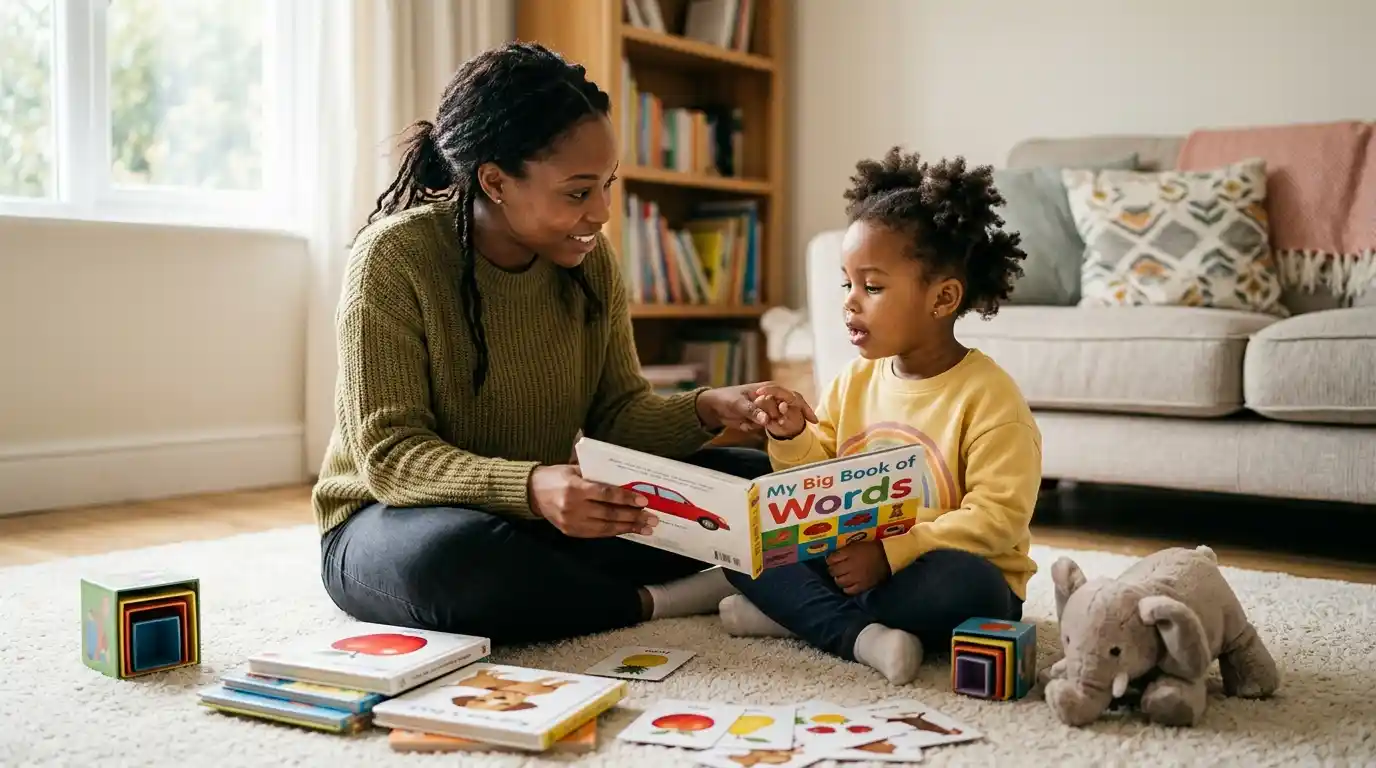
Quick answer: Speech delay means a child’s speech or language is developing more slowly than expected for their age. Some late talkers catch up on their own, but you can’t tell which ones will just by waiting. Common causes include normal variation, hearing problems, trouble producing sounds, and language difficulties. See a professional if your child is not reaching milestones, is hard to understand, doesn’t seem to understand you, or loses words or skills they once had. At home, talking through daily routines, reading together, and giving your child time to respond all help.
What is speech delay?
Speech delay means a child’s communication is progressing more slowly than expected for their age. People often use “speech” and “language” as if they were the same thing, but they are different:
- Speech is producing sounds and words clearly.
- Language is understanding and using words, gestures, and sentences to share meaning.
A child may have trouble with one, the other, or both. That might look like:
- Late first words
- Difficulty pronouncing certain sounds
- Trouble putting words together
- A small vocabulary
- Difficulty understanding what others say
- Trouble expressing needs or ideas
Children develop communication at different speeds, so one late milestone is not a diagnosis. Professionals look at the whole picture: how much your child understands, how they communicate, and whether they are still making progress.
What are the signs of speech delay?
Signs depend on age, but parents may notice that their child:
- Uses fewer words than expected for their age
- Has trouble combining words
- Is hard for familiar people to understand
- Struggles to express basic needs
- Has difficulty following simple spoken instructions
- Doesn’t seem to understand common words or questions
- Relies mostly on gestures instead of words
- Gets frustrated when trying to communicate
- Stops using words they previously used
One sign alone rarely means a serious problem. Look at the pattern and whether your child keeps progressing.
Is every late talker experiencing a problem?
No. Some children start talking later and go on to develop typical communication skills. But it would be a mistake to assume every delay resolves without help. Speak to a professional if your child is significantly behind, isn’t making progress, has trouble understanding language, or has lost skills they once had.
What causes speech delay?
There is rarely one cause. The most common ones:
Normal developmental variation
Some children simply take longer. This can be perfectly normal, but progress should still be monitored.
Hearing difficulties
Children learn to speak by hearing clearly. Even temporary hearing loss, such as from repeated ear infections or fluid in the ears, can affect speech. Raise it with your doctor if your child:
- Has frequent ear infections
- Doesn’t consistently respond when spoken to
- Seems not to hear certain sounds
A hearing test is one of the first things to check, and it is quick and painless.
Speech sound difficulties
Some children swap sounds, or leave them out of words. Some of this is expected in younger children. If your child’s speech stays hard for others to understand, a speech-language professional can assess it.
Language development difficulties
This is different from pronunciation. These children may struggle to learn new words, build sentences, understand questions, follow directions, or explain ideas and events.
Developmental conditions
Speech and language differences can occur with autism, intellectual disability, or other developmental conditions. But speech delay alone does not mean a child has autism or any other condition. Only a full assessment can tell.
Limited chances to interact
Children learn language through talking, reading, singing, playing, and having their attempts to communicate answered. This does not mean parents cause speech delay. It means that responsive, everyday conversation helps.
Does bilingualism cause speech delay?
No. Learning two or more languages does not cause a speech or language disorder. Bilingual children may split their vocabulary between languages, so counting words in only one language can make their skills look smaller than they are. Families usually do not need to drop a home language. If you have concerns, ask for an assessment that considers all of your child’s languages.
When should parents be concerned?
Talk to your pediatrician or a speech-language professional if your child:
- Is not reaching expected communication milestones
- Is making little or no progress
- Is hard to understand
- Has trouble understanding language
- Is often frustrated when trying to communicate
- Has possible hearing problems
- Has lost words or communication skills they previously had
Loss of previously acquired skills needs prompt attention. And you don’t have to wait for a specific age if your concern is real. You know your child.
How can parents encourage speech and language?
Everyday routines are enough. You don’t need special equipment.
1. Talk about what you’re doing
Narrate simply: “We’re washing the apples.” “Now we’re putting on your shoes.” “The car is going fast.” Your child hears words tied to real things.
2. Read together every day
You don’t need to finish the book. Point to pictures, name objects, ask simple questions, let your child turn pages, repeat fun words, and talk about what characters are doing. Interaction matters more than reading every word.
3. Follow your child’s interests
If they love cars, talk about cars. If it’s animals or blocks, describe what they see and build. Children communicate more when they care about the topic.
4. Pause and wait
Adults often answer for children too quickly. After asking a question, count silently to five or ten. Your child may respond with a word, a sound, or a gesture, and all of these count.
5. Expand what they say
Add a little more without turning it into a test:
- Child: “Dog.” You: “Yes, a big dog!”
- Child: “Car go.” You: “Yes, the red car is going fast.”
6. Sing songs and rhymes
Repetition helps children absorb sounds, rhythms, sentence patterns, and new words. Keep it playful, and don’t ask your child to perform.
7. Balance screen time with real conversation
Children learn language from people responding to them. If screens are replacing talking, reading, and play, there are fewer chances to practice. Aim for plenty of face-to-face time.
Should you correct every speech mistake?
No. Constant correction makes talking feel stressful. Model the right word instead. If your child says “tat” for “cat,” don’t say “No, say cat.” Say, “Yes, that’s a cat!” They hear the correct version without feeling corrected.
How can schools support a child with speech delay?
- Give the child enough time to answer
- Use clear, simple instructions
- Add visual supports to spoken instructions
- Encourage participation without forcing public speaking
- Allow different ways to show understanding
- Stay in touch with parents
- Follow any recommendations from a speech-language professional
Focus on what the child can communicate, not on what they can’t yet do.
What does a speech-language pathologist do?
A speech-language pathologist (called a speech and language therapist in some countries) assesses and supports communication. They may look at:
- Speech sounds
- Understanding of language
- Spoken language and vocabulary
- Sentence building
- Social communication
- Fluency (for example, stuttering)
- Voice
- Communication strategies
They then suggest activities and, if needed, therapy.
Can speech delay affect confidence?
It can. Children who can’t say what they want may get frustrated, avoid talking, withdraw, lean on gestures, or get upset when misunderstood. You can help by giving them time, listening closely, responding to their attempts, and never teasing or embarrassing them.
Should parents “wait and see”?
This is the most common question, and it’s understandable. Some children do catch up. But waiting can’t tell you why your child is delayed.
Seeking an assessment does not mean your child will automatically get a diagnosis or therapy. It simply gives you information about where they are now. If support is needed, finding out earlier helps you access it sooner. If everything is fine, you gain peace of mind.
What should parents avoid?
- Comparing your child unfavorably with siblings
- Calling your child “slow”
- Making them repeat words on demand
- Mocking their pronunciation
- Showing frustration when they can’t get words out
- Assuming it’s laziness
- Assuming they’ll definitely grow out of it
- Relying only on online milestone checklists
Frequently asked questions
What is considered speech delay?
Speech or language development that is slower than expected for a child’s age. It can involve pronunciation, vocabulary, combining words, understanding language, or expressing ideas.
What are the early signs?
Fewer words than expected, trouble combining words, difficulty understanding language, few attempts to communicate, speech that is hard to understand, or loss of skills a child once had.
Does speech delay mean autism?
No. Many children with speech delay do not have autism. Autism involves a broader pattern of developmental features, and only a qualified professional can assess that.
Does being bilingual cause speech delay?
No. Children learning two languages should be assessed across both languages.
Can a child outgrow speech delay?
Some children with mild or temporary delays catch up. But persistent delays shouldn’t be assumed to disappear. A professional can tell you whether support is needed.
How can I help my child at home?
Talk during daily routines, read together, sing, follow your child’s interests, pause for their response, and expand on what they say.
Should I correct my child’s pronunciation?
Not directly. Say the word correctly in your reply. If speech stays hard to understand, get it assessed.
When should I seek help?
If your child isn’t reaching milestones, is making little progress, is hard to understand, struggles to understand you, may have hearing issues, or has lost skills.
The bottom line
Speech development is not a race. Some children talk early and some take longer. What matters is your child’s overall communication, understanding, and progress.
You can help every day through simple things: chatting over meals, reading before bed, singing in the car, playing together, and waiting patiently when your child tries to speak. If you’re worried, reach out to your pediatrician or a speech-language pathologist. Getting clarity is never a mistake.
A child should never be defined by how quickly or clearly they talk. Communication is about connection, and with patience and the right support, children can build it in many ways.
This article is for general information and does not replace medical advice. If you are concerned about your child’s speech or language, speak with a pediatrician or speech-language pathologist.