
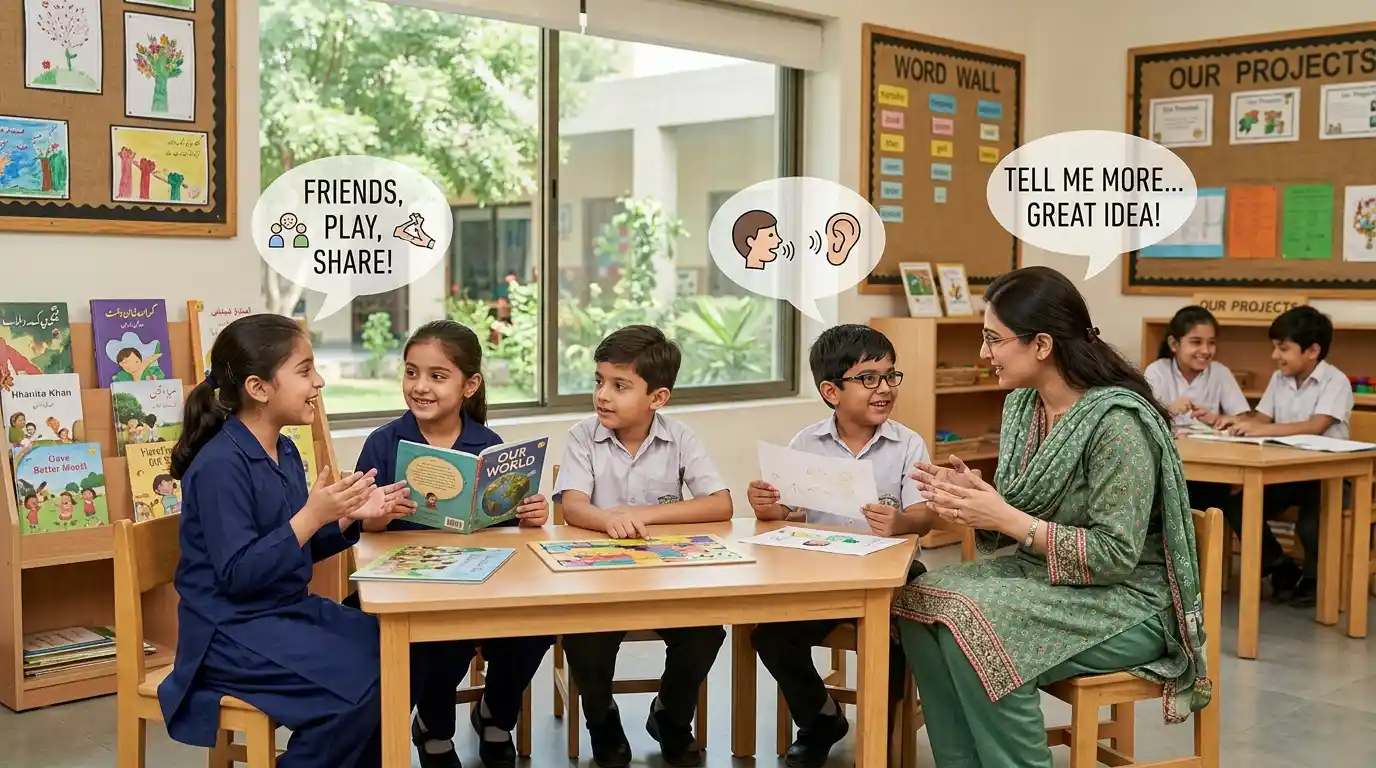
Quick answer: Communication isn’t just about talking it’s also about reading facial expressions, taking turns, understanding jokes, and picking up on social cues. When a child struggles with this side of things, it’s called a social communication difficulty. It’s different from having trouble pronouncing words, and it deserves its own kind of attention.
For more parent-friendly guides, visit the School of Scholars Knowledge Hub.
What Exactly Are Social Communication Difficulties?
Social communication is about how kids use language when they’re around other people — not just what words they know.
A child can have a great vocabulary and still struggle with things like:
- Starting conversations
- Taking turns while talking
- Listening to others
- Understanding questions
- Staying on topic
- Reading facial expressions
- Making appropriate eye contact
- Picking up on gestures and body language
- Recognizing social cues
- Adjusting how they talk depending on the situation
- Understanding what someone else might be thinking or feeling
Every child picks these skills up at their own pace. But when the difficulties stick around, they can start affecting friendships, classroom life, and everyday interactions.
Common Signs to Watch For
1. Trouble starting conversations
Your child might want to play with other kids but not know how to say “Can I play with you?” or join in naturally.
2. Trouble taking turns
This might show up as interrupting a lot, talking on and on without noticing the other person’s reaction, giving very short answers, or struggling to wait their turn to speak.
3. Trouble staying on topic
It’s normal for excited kids to jump between subjects. But some kids keep talking about their favorite thing even after the conversation has clearly moved on — without noticing.
4. Trouble reading social cues
Facial expressions, tone of voice, gestures, body language — these all carry meaning without words. A child might struggle to tell if someone’s joking, bored, upset, or interested.
5. Trouble with non-literal language
Jokes, sarcasm, idioms, and metaphors can be confusing for some kids. If someone says “it’s raining cats and dogs,” a child might genuinely wonder how that’s possible. This kind of understanding develops over time — but if it’s really sticking, it’s worth a conversation with a professional.
How This Shows Up at School
School is full of chances to practice communication — and it’s also where difficulties often become more visible. A child might struggle to:
- Join group activities
- Work well with classmates
- Follow along in conversations
- Ask for help
- Pick up on classroom rules that aren’t spelled out directly
- Take part in discussions
- Make or keep friends
Teachers sometimes notice these patterns before parents do, simply because they see kids in group settings all day. That’s why staying in touch with your child’s teacher can really help.
Social Communication and Friendships
Making friends takes more than just talking — it means knowing how to:
- Share interests
- Take turns
- Listen
- Respond appropriately
- Understand how another kid is feeling
- Work through disagreements
- Join in on games
- Respect personal space
If your child struggles with these things, it doesn’t mean they don’t want friends or don’t care about others. Often, they just need help understanding social situations and practicing the skills.
What Causes Social Communication Difficulties?
There’s no single cause. Sometimes these difficulties show up alongside things like:
- Autism spectrum disorder
- Developmental language difficulties
- Speech and language disorders
- Hearing difficulties
- Other developmental differences
But having a social communication difficulty doesn’t automatically mean your child has any specific condition. Only a qualified professional can properly assess what’s going on.
Social Communication vs. Speech Problems — Not the Same Thing
These two get mixed up a lot, but they’re separate:
- A child can pronounce every word perfectly and still struggle to start conversations, read facial expressions, or stay on topic.
- Another child might have pronunciation difficulties while being great at social communication.
Thinking of these as separate areas helps you (and any professional you talk to) pinpoint what’s actually going on.
How Parents Can Help at Home
Talk about feelings
Ask things like “How do you think your friend felt?” or “What do you think happened?” This gets kids thinking about other people’s perspectives.
Practice conversations through play
Try simple role-play — greeting someone, asking to join a game, asking for help, starting a chat, saying goodbye. Keep it light and fun.
Read stories together
Ask “Why do you think the character did that?” or “How do you think they feel?” Stories are a great low-pressure way to talk about emotions and social situations.
Model good communication yourself
Kids learn a lot just by watching. Show them what listening, turn-taking, and genuine interest look like in your own conversations.
When Should You Seek Professional Support?
Consider talking to a pediatrician, speech-language professional, or teacher if your child:
- Has ongoing difficulty communicating with others
- Struggles significantly with conversations
- Has trouble reading social cues
- Frequently struggles to make or keep friends
- Gets frustrated during social interactions
- Faces challenges that affect school
- Shows these patterns across different settings — home, school, elsewhere
And just like with speech concerns — getting an evaluation doesn’t mean something is seriously wrong. It just gives you a clearer picture of how your child communicates and what kind of support might help.
How Schools Can Support Kids
Teachers can make a real difference by:
- Creating opportunities for group interaction
- Encouraging turn-taking
- Supporting cooperative activities
- Giving kids time to respond
- Modeling good communication themselves
- Encouraging respectful peer interactions
- Keeping parents in the loop
When schools and families work together, kids get more consistent support.
Why Early Support Matters
Communication skills keep developing throughout childhood. Catching difficulties early means parents and teachers can figure out what kind of support actually helps — whether that’s:
- Conversation skills
- Understanding social cues
- Emotional communication
- Turn-taking
- Social problem-solving
- Seeing other perspectives
- Classroom communication
Every child’s needs look a little different, so the right approach depends on the individual kid.
Frequently Asked Questions
What are social communication difficulties in children?
Challenges with using communication appropriately in social situations — things like conversations, turn-taking, reading social cues, or understanding someone else’s perspective.
What are common signs to look for?
Trouble starting conversations, taking turns, staying on topic, reading social cues, understanding jokes or sarcasm, and making or keeping friends.
Can a child have this without a speech problem?
Yes. A child can pronounce every word clearly and still struggle with social cues, turn-taking, or conversation skills.
When should parents seek help?
When difficulties are ongoing, affect friendships or school, cause noticeable frustration, or show up across multiple settings.
How can parents help at home?
Practice conversations, read stories together, talk about feelings, use role-play, and model good communication in everyday life.
Bottom Line
Social communication is a huge part of how kids build friendships, join classrooms, and understand the world around them. Some struggles are just part of growing up — but persistent difficulties with conversations, social cues, or friendships are worth a conversation with a professional.
You don’t need to diagnose anything yourself. What your child needs most is patience, encouragement, and plenty of safe chances to practice.
For more child-development resources, visit the School of Scholars Knowledge Hub.