The world of work is changing faster than most of us can keep up with.
Artificial intelligence, automation, robotics, data, cybersecurity, and digital platforms are reshaping how businesses operate and along the way, they’re creating jobs that barely existed a few years ago.
For today’s students, that’s both exciting and a little daunting.
Choosing a career used to mean asking one question: which profession is popular right now? That’s no longer enough. The better question is: which skills will still matter once the technology around them has changed three more times?
None of this means traditional careers are going away. Doctors, teachers, engineers, lawyers, architects, and accountants will still matter — a lot. What’s shifting is how people in these professions actually work day to day.
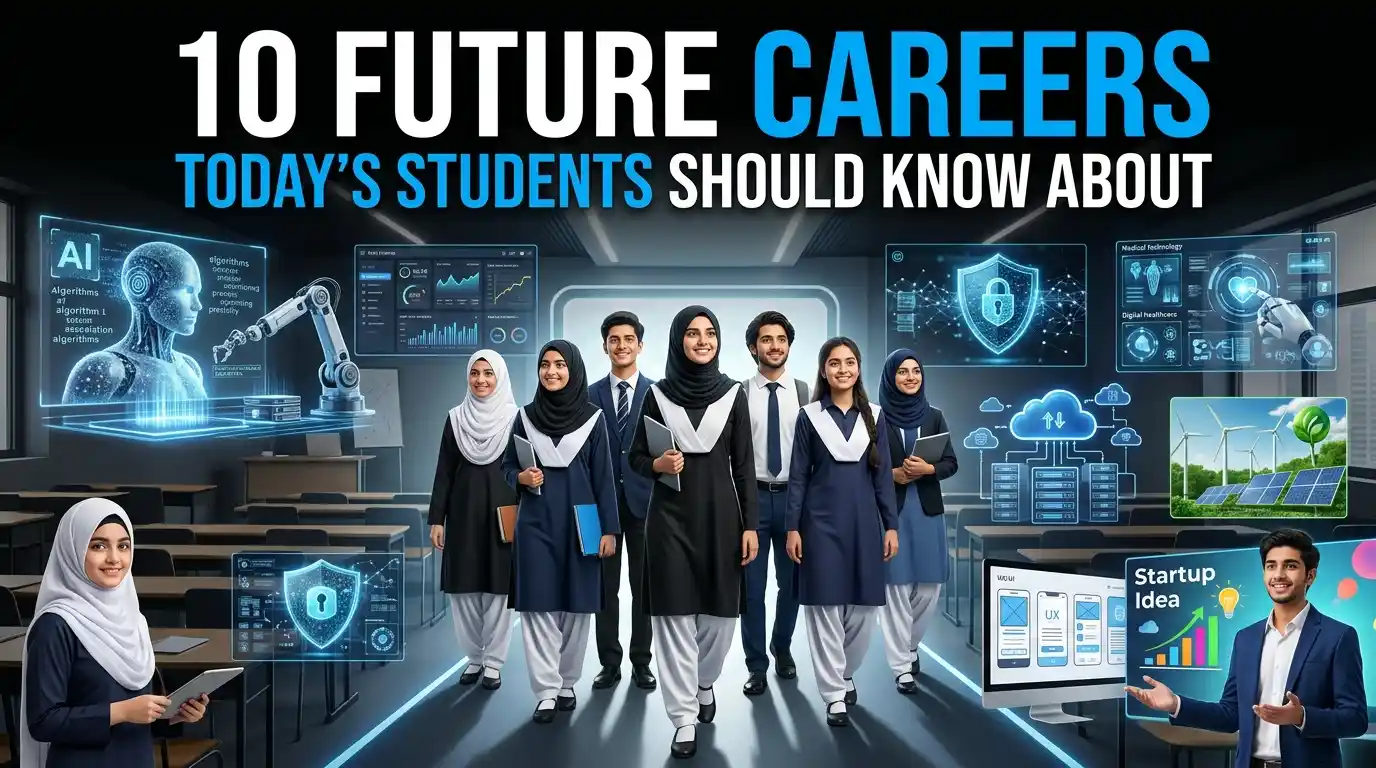
For Gen Z and Gen Alpha especially, getting a head start on understanding where things are headed can make a real difference in the subjects they pick, the degrees they pursue, and the skills they build along the way. Here are ten future career paths worth knowing about.
1. Artificial Intelligence Specialist
AI has quietly worked its way into almost every major industry, and the people building, refining, and deploying those systems sit at the center of that shift.
Depending on the specific role, an AI specialist might be knee-deep in machine learning, natural language processing, computer vision, generative AI, deep learning, automation, or predictive modeling — the field is broad enough that no two AI jobs look quite the same.
Students who gravitate toward math, computer science, and genuine problem-solving tend to find this an exciting direction. And they don’t need to arrive at university already fluent in machine learning a solid foundation in mathematics, programming (Python especially), statistics, and data structures, paired with real curiosity, is more than enough to start.
2. Data Scientist
We’re surrounded by data whether we notice it or not. Every business is collecting information about customers, products, websites, markets, operations and someone has to turn that pile of numbers into something a company can actually act on.
That’s the data scientist’s job. They’re the ones answering questions like why customers are leaving, which products are likely to sell, how a company should plan for future demand, or what factors are actually driving a particular outcome. The work blends statistics, programming, machine learning, and a good eye for visualizing what the numbers are actually saying.
Students who enjoy math, SQL, Python, and generally like solving puzzles the kind where the answer isn’t obvious until you dig tend to enjoy this path.
3. Cybersecurity Specialist
As more of daily life moves online, protecting all of it websites, networks, applications, databases, cloud systems, customer data has become a genuinely urgent need, not a nice-to-have.
Cybersecurity covers a surprisingly wide range of jobs: security analysts, penetration testers, security engineers, incident responders, security architects. What ties them together is the same underlying idea technology opens doors, but it also opens vulnerabilities, and someone needs to understand both sides well enough to close the gap.
Students curious about this path can start with networking basics, Linux, some programming, and an introduction to ethical hacking concepts mostly it comes down to developing a genuinely security-minded way of thinking.
4. Robotics Engineer
Robots have moved well beyond factory floors they’re showing up in healthcare, logistics, agriculture, and research labs now too. Robotics engineering sits at the intersection of mechanical engineering, electronics, programming, and increasingly, AI.
If a student likes building things and figuring out how machines actually work, this is a natural fit. Math, physics, electronics, mechanical design, and some exposure to robotics platforms are the practical building blocks and schools can introduce a lot of this early through simple projects, STEM programs, and robotics competitions, long before university.
5. AI Product Manager
Not every future tech career requires heavy-duty coding.
AI product managers sit in the middle of everything developers on one side, designers and business teams on another, customers and company leadership somewhere in the mix and their job is to make sure the products a company builds actually use AI in ways that make sense for real people.
It’s a role that genuinely requires understanding both technology and people, which makes it a good fit for students who like tech but are equally drawn to business, communication, and leadership. Product strategy, user research, project management, and enough AI fundamentals to speak the language fluently all matter here.
6. UX/UI Designer
Technology isn’t only judged by what it can do it’s judged by how it feels to use.
UX and UI designers shape that experience across websites, apps, and software, constantly asking questions like: is this easy to use? Can people find what they need without frustration? Does this interface actually make sense to someone seeing it for the first time?
Students with a creative streak who also enjoy problem-solving tend to thrive here. Design, psychology, user research, prototyping, and visual communication are the core skills the best UX designers are equal parts artist and detective.
7. Sustainability and Climate Technology Specialist
The economy of the next few decades is going to need people who can bridge environmental challenges and real technical solutions renewable energy, sustainable construction, waste management, energy efficiency, climate data, green technology.
As governments and businesses lean harder into sustainability commitments, professionals who genuinely understand both the environmental science and the technology side of the equation are going to be in short supply, and in demand because of it.
Students interested in environmental science, biology, engineering, or climate data analysis are exactly the ones who could end up defining this field. It’s one of the clearer examples of science, technology, and social responsibility genuinely converging into one career path.
8. Digital Health and Health Technology Specialist
Healthcare is getting more connected to technology by the year telemedicine, health apps, electronic records, wearable devices, medical data, AI-assisted diagnostics, remote patient monitoring.
This is where medicine and technology genuinely meet, which makes it a compelling option for students who love the idea of medicine but are just as fascinated by tech. Biology, medicine, computer science, data science, AI, and health informatics all feed into this space the healthcare professional of the future will likely need fluency in both patient care and the systems supporting it.
9. Cloud and Computing Specialist
Almost every modern organization now runs on cloud infrastructure in some form, and someone has to build, maintain, and secure all of it.
The career paths here include cloud engineers, cloud architects, DevOps engineers, site reliability engineers, and cloud security specialists none of it as flashy as robotics or AI on the surface, but it’s the infrastructure quietly holding up most of the digital services we use every day.
Students drawn to this path should get comfortable with computer networks, operating systems, programming, databases, and automation it’s less glamorous than some of the other entries on this list, but arguably just as essential.
10. Entrepreneur and Digital Business Creator
Not every future career fits neatly into a job title and one of the most interesting paths available to students today is simply building something of their own.
Technology has dramatically lowered the barrier to starting a business. Students can experiment with e-commerce, software products, online courses, content businesses, digital marketing, AI-powered services, apps, and creator-driven businesses often without needing much capital at all to get started.
What entrepreneurship really teaches is how to spot a real problem and build something that solves it. That requires communication, marketing instincts, basic financial literacy, leadership, some comfort with sales, and maybe most importantly resilience when the first few attempts don’t work.
Not every student is going to become an entrepreneur, and that’s fine. But entrepreneurial thinking tends to make people better at almost any career they eventually choose.
What Do All These Careers Actually Have in Common?
On the surface, an AI specialist, a UX designer, a cybersecurity analyst, a health-tech professional, and an entrepreneur look like they have nothing to do with each other. Look closer, and a few threads run through all of them.
They all demand continuous learning, because the tools and techniques underneath each field keep shifting. They tend to sit at the overlap of multiple disciplines rather than staying neatly inside one box that’s usually where the most interesting opportunities show up. They’re all fundamentally about solving real problems, not just applying technology for its own sake. And despite being “tech” careers, none of them work without genuinely human skills — communication, creativity, teamwork, and judgment still carry more weight than people expect.
Don’t Choose a Career Just Because It Sounds Futuristic
Here’s an important caution: a career sounding impressive or trendy isn’t a good enough reason to chase it.
A student shouldn’t gravitate toward AI simply because everyone’s talking about AI right now. What actually matters is the overlap between interest, ability, real skill, and genuine opportunity.
A student who loves math might find their way into data science. Someone who enjoys building and tinkering might land in robotics. A naturally creative kid might thrive in UX design. Someone endlessly curious about how systems get broken into might be drawn to cybersecurity. And a student who cares deeply about the environment might end up in sustainability work.
The point was never to predict exactly what job a child will hold at 30 nobody can do that reliably anymore. The real goal is helping them build the ability to adapt as the landscape keeps shifting underneath them.
What Should Schools Actually Be Teaching?
Schools don’t need to turn every student into a programmer to prepare them for what’s coming. What matters more is a broader set of future-ready habits of mind.
Critical thinking the ability to question information rather than accept it at face value. Digital literacy genuinely understanding how modern technology works, not just how to use an app. AI literacy knowing what these systems can and can’t do, along with the ethics involved in using them responsibly. Strong communication, whether that’s writing, speaking, or presenting an idea clearly to someone who doesn’t already understand it. Real creativity actual room to design, build, and experiment, not just memorize. Collaboration, since almost every future career will involve working across diverse teams. And some grounding in entrepreneurial thinking spotting a problem, shaping an idea, and following it through to something real.
What Can Parents Actually Do?
Parents don’t need to become experts in every emerging technology to help here that’s an unreasonable bar, and thankfully not the point.
What helps more is simply encouraging curiosity. Try asking “what did you build or create today?” instead of only “what marks did you get?” it’s a small shift, but it changes what a child thinks their effort is actually for.
Beyond that, small nudges go a long way: encouraging kids to build little projects of their own, read about new technologies out of genuine interest, mess around with basic coding, join a STEM club or competition, learn a new digital tool just to see what it does, or simply try to solve a real problem they’ve noticed in their own life. A child who learns how to explore and figure things out independently carries that advantage well beyond their school years.
The Future of Work Will Be Far More Flexible
The old model pick one profession, stay in it for 40 years is fading fast, and probably won’t come back.
It’s increasingly normal for someone to start as a software developer, shift into product management, launch their own company a few years later, and eventually end up consulting on AI strategy. A biology student might land in biotech or digital health. A designer might become a creative director, or just as easily launch their own product line.
That’s exactly why adaptability matters more than having a fixed plan. Students don’t need their entire career mapped out at 15 — what they actually need is the skill and the confidence to navigate whatever comes next.
The Most Important Future Career: Lifelong Learner
If there’s one skill every student should walk away with, it’s simply the ability to keep learning.
Technology isn’t going to slow down. New industries will keep emerging, existing jobs will keep changing shape, some roles will disappear entirely, and others we haven’t even imagined yet will take their place.
The students who come out ahead won’t necessarily be the ones who guessed the future correctly. They’ll be the ones who know how to learn, adapt, and reinvent themselves whenever the ground shifts underneath them.
Final Thoughts
The future of work is already taking shape around us. AI specialists, data scientists, cybersecurity professionals, robotics engineers, AI product managers, UX designers, sustainability experts, digital health specialists, cloud professionals, and entrepreneurs are just some of the paths today’s students should have on their radar.
But the goal was never to push every student toward a tech career specifically. The goal is simply to show them what’s possible.
Technology will keep changing the jobs. Human curiosity, creativity, and problem-solving are what will let people go on to create the jobs of tomorrow the ones that don’t exist yet.
For today’s students, the most valuable thing they can walk away with might not be a clear answer to “what will I be when I grow up.” It might just be the confidence to say: whatever the future looks like, I know how to learn my way into it.
FAQs
1. What are the top future careers for today’s students?
Some promising future career areas include artificial intelligence, data science, cybersecurity, robotics, UX/UI design, cloud computing, digital healthcare, sustainability, AI product management and entrepreneurship.
2. Why should students learn about future careers?
Understanding emerging careers can help students make informed decisions about subjects, university programmes, skills and extracurricular activities while preparing for changes in the job market.
3. Will AI replace traditional jobs?
AI may automate certain tasks within many professions, but it is also creating new roles and changing existing ones. Human skills such as creativity, communication, critical thinking and judgment will remain important.
4. What skills will be important for future careers?
Important skills include critical thinking, problem-solving, communication, creativity, collaboration, digital literacy, AI literacy, adaptability and continuous learning.
5. Is artificial intelligence a good career option for students?
AI can be a strong career option for students interested in mathematics, programming, technology and problem-solving. Students can begin by learning mathematics, Python, statistics and basic AI concepts.
6. What does a data scientist do?
A data scientist analyses large amounts of data to identify patterns, generate insights and help organisations make better decisions using statistics, programming and machine learning.
7. Why is cybersecurity becoming an important career?
As businesses, governments and individuals rely more heavily on digital systems, protecting networks, applications and data from cyber threats is becoming increasingly important.
8. How can students prepare for future careers while still in school?
Students can participate in STEM activities, learn digital tools, build small projects, explore coding, join competitions, practise communication and research different career pathways.
9. Do students need a technology degree for every future career?
No. Many future careers combine technology with other fields. Students can explore areas such as healthcare, design, business, sustainability, education and entrepreneurship while developing digital skills.
10. What is the most important skill for future careers?
Adaptability and continuous learning may be among the most valuable skills. Since technology and job requirements will continue to change, students need to be comfortable learning new skills throughout their careers.