
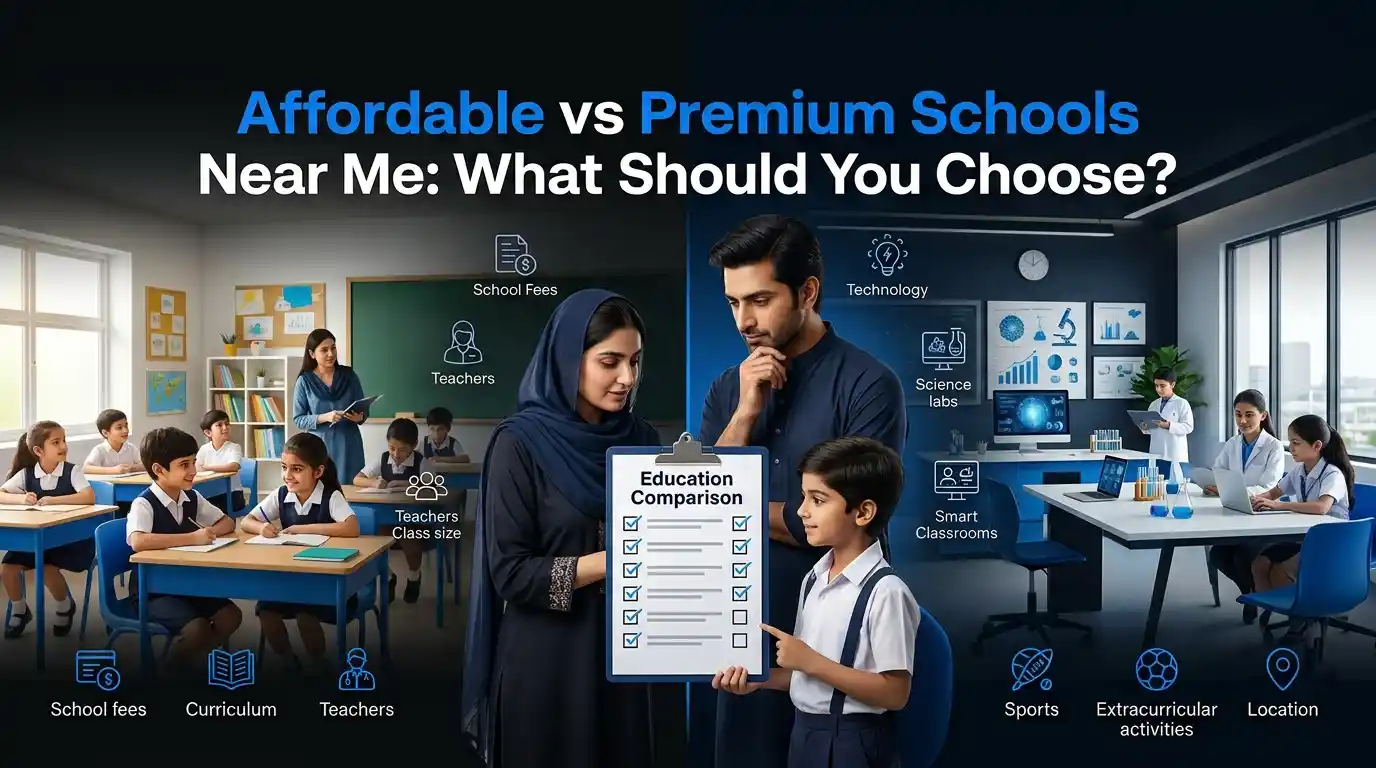
Choosing a school ranks among the bigger decisions any parent makes right up there with where you live and what kind of childhood you want your kid to have.
If you’ve typed “affordable schools near me” or “premium schools near me” into a search bar, you already know the dilemma: pay less and hope the education still holds up, or pay significantly more and trust that the extra money buys something meaningful.
The honest answer isn’t “just pick the expensive one.” A premium school can have gorgeous facilities and a packed activity calendar, but a more affordable school down the road might have better teachers and a genuinely more supportive environment for your specific child.
The right school is really the one that gets the mix right education, safety, support, opportunity, and cost for your family, not for the family down the street. Let’s actually walk through the comparison and what’s worth paying attention to before you commit.
What Actually Makes a School “Affordable”?
An affordable school simply charges less lower tuition, lower admission costs. That’s the definition, and it stops there. It says nothing about whether the teaching is any good.
Plenty of affordable schools have qualified teachers, a properly structured curriculum, solid academics, real extracurricular options, computer access, sports programs, and teachers who genuinely care plus, often, a location that’s actually convenient for daily life.
Where it gets tricky is that quality varies enormously from one affordable school to the next. You can’t assume a lower price tag means lower quality any more than you can assume the opposite. The only way to know is to actually look.
What Actually Makes a School “Premium”?
Premium schools charge more, and in exchange, usually offer more smaller classes, modern classrooms, better-equipped labs, more tech in the classroom, stronger sports facilities, international curricula, dedicated arts and music programs, counseling services, university guidance, and broader exposure generally.
But here’s the catch that’s easy to forget in the excitement of a nice campus tour: a higher price doesn’t guarantee the school is the right fit for your child. A school can be genuinely excellent and still be wrong for a kid whose personality, learning style, or interests just don’t align with what that particular school does well.
The Real Difference Between the Two
The question worth asking isn’t “which one is better” it’s “what am I actually getting for the extra money?”
Broadly speaking, affordable schools tend to run larger classes, basic-to-decent facilities, and more variable curriculum and counseling options, while premium schools tend toward smaller classes, more extensive facilities, broader extracurriculars, and more structured university guidance usually alongside a heavier fee and more financial pressure on the family.
But treat all of that as a general pattern, not a rule. Plenty of exceptions exist in both directions, and the only way to find them is to evaluate each school on its own, not by category.
1. Start With What Your Family Can Actually Afford
Before comparing a single school, get honest about the number your family can sustain not just the monthly tuition figure that shows up in the brochure.
Work out the real annual cost: admission fees, tuition, books, uniforms, transport, exam fees, activity charges, trips, technology fees, and whatever “annual charges” or event costs get tacked on separately. A school that looks affordable on paper can balloon once all of that is added up and a premium school sometimes bundles more into its base tuition than you’d expect. Ask for the complete fee breakdown before you decide anything.
2. Don’t Let a School Destabilize Your Finances
Education is a multi-year commitment, not a one-time purchase. A school that feels manageable this year can become genuinely difficult after a fee hike, a sibling joining the same school, or a few unplanned expenses stacking up.
Ask yourself honestly: can we keep paying this comfortably for the next several years, not just this one? A school shouldn’t put your family’s financial stability at risk no matter how impressive its facilities look on the tour. Education is meant to support your family’s future, not strain it.
3. Look Hard at the Teachers
This one gets overlooked more than it should. Facilities are visible; teaching quality often isn’t until it’s too late to matter.
A school with an expensive campus and mediocre teaching won’t deliver the value parents think they’re paying for. Ask about qualifications, experience, training, how often teachers actually leave, the student-to-teacher ratio, and how well the school communicates with parents. Better yet, watch how teachers actually interact with kids during your visit that’s worth more than any brochure.
4. Think Carefully About Class Size
Smaller classes generally mean more individual attention, but don’t assume “premium” automatically means “small class.” Some premium schools run surprisingly large sections despite the fee.
Ask directly how many students are typically in a classroom, and just as importantly, how the school supports kids who need extra help. That second question matters more in the early years, when individual attention can shape a child’s whole relationship with learning.
5. Match the Curriculum to Your Actual Goals
The right curriculum depends entirely on what you’re aiming for. Some families are happy with a local curriculum; others want Cambridge or another international pathway specifically.
Before enrolling anywhere, find out exactly which curriculum and examination board the school uses, which grades it covers, what subjects are actually offered, and whether O-Level and A-Level are available if that matters to you. And be honest with yourself don’t pay a premium purely for an international label if it’s not actually serving your child’s goals.
6. Take Facilities Seriously, But Don’t Get Dazzled
Premium campuses often come with genuinely impressive setups labs, libraries, computer rooms, sports grounds, pools, art studios, music rooms, tech labs. All of that can add real value.
But ask the question that actually matters: how often do students use any of it? A beautiful science lab that sits mostly unused during the school year isn’t delivering value just because it exists. What matters is implementation, not the square footage of the building.
7. Compare What’s Actually on Offer Outside the Classroom
Kids need more than textbooks sports, art, music, debate, public speaking, STEM, coding, robotics, clubs, competitions, trips. Premium schools often have a wider menu here, but that doesn’t mean affordable schools are lacking.
The real question isn’t which school has more activities listed on its website it’s what your specific child actually enjoys and would genuinely engage with.
8. Consider How the School Handles Technology
Technology matters more in classrooms every year, and it’s worth asking whether a school offers computer access, digital learning tools, coding, robotics, STEM programs, or general AI literacy.
But keep some perspective technology should be enhancing how kids learn to think, not functioning as a marketing hook on a prospectus. A school doesn’t need the newest devices in every classroom to teach a child to think critically and use technology responsibly.
9. Your Child’s Personality Matters More Than Any Ranking
This might be the single most underrated factor on this whole list.
Some kids genuinely thrive in structured, competitive environments. Others do noticeably better somewhere smaller and more supportive, where they’re not just another face in a crowded classroom. Before choosing between affordable and premium, ask what environment actually helps your child learn thinking honestly about their confidence, learning style, social temperament, strengths, interests, and how much individual attention they tend to need.
A premium school isn’t automatically the better choice if the environment doesn’t match who your child actually is.
10. Location Matters More Than People Give It Credit For
There’s a reason “schools near me” is such a common search proximity genuinely changes daily life.
A shorter commute buys back time for sleep, homework, sports, hobbies, just being a family in the evening. Calculate the actual travel time during real school-hour traffic, not what a map app estimates on a quiet Sunday. A school 20 minutes away can genuinely beat one that’s an hour each way, even if the farther school has better facilities on paper.
Affordable Doesn’t Mean Low Quality
There’s a common assumption that cheaper automatically means worse. It doesn’t hold up.
A reasonably priced school with strong teachers, manageable class sizes, solid academic support, and a genuinely safe environment can outperform a premium school whose expensive facilities your child barely touches. The comparison that actually matters is outcomes and day-to-day experience not the number on the fee slip.
Premium Doesn’t Always Mean Better, Either
The opposite assumption is just as misleading. Premium schools absolutely can deliver real advantages more subject choice, smaller classes, better facilities, richer extracurriculars, international exposure, stronger university counseling.
But the honest question is always whether those specific advantages actually matter for your child. Paying more only makes sense if the extra cost is buying something your kid will genuinely use and benefit from.
When Does an Affordable School Make the Most Sense?
Generally, when your budget is genuinely tight, the teachers are strong, your child gets real attention, the curriculum lines up with your goals, the commute works, safety standards hold up, your child actually likes being there, and the extracurricular offering covers what your child cares about. There’s no good reason to pay more just because a higher price feels safer.
When Does a Premium School Actually Earn Its Fee?
When your child specifically benefits from smaller classes, advanced facilities, an international curriculum, a genuinely broad range of activities, specialized academic support, structured university counseling, or serious STEM programs. The extra investment should have a clear, specific reason behind it not just a general sense that “expensive means good.”
Don’t Compare Schools by Fee Alone
Picture two schools.
School A charges lower monthly fees and offers experienced teachers, moderate class sizes, solid academic support, and a convenient location but its sports facilities are limited.
School B charges significantly more and offers a modern campus, advanced labs, smaller classes, extensive sports, and an international curriculum.
Which one’s actually better? Honestly, there isn’t enough information yet to say. It comes down to your child’s specific needs, what your family can actually afford long-term, and what you’re really trying to achieve educationally.
Build a Simple Scorecard
One of the easiest ways to cut through the noise is to score each school you’re seriously considering, from 1 to 5, across the factors that matter most to you:
| Factor | School A | School B | School C |
|---|---|---|---|
| Teachers | /5 | /5 | /5 |
| Curriculum | /5 | /5 | /5 |
| Class Size | /5 | /5 | /5 |
| Safety | /5 | /5 | /5 |
| Facilities | /5 | /5 | /5 |
| Activities | /5 | /5 | /5 |
| Academic Support | /5 | /5 | /5 |
| Location | /5 | /5 | /5 |
| Fees | /5 | /5 | /5 |
| Future Pathway | /5 | /5 | /5 |
Once it’s on paper, the comparison stops being emotional and starts being genuinely objective.
Questions Worth Asking During a Visit
Bring a list, and actually write down the answers don’t rely on memory once you’re three school tours deep and everything starts blurring together.
Ask what curriculum the school follows, the average class size, teacher qualifications, how they support struggling students, what extracurriculars actually exist beyond the brochure, what technology and STEM programs are genuinely running, the full annual fee, whether hidden charges exist, the actual school timings, and what pathway exists after the final grade.
The Best School Is About Value, Not Price
There’s a tempting shortcut a lot of parents fall into: assuming higher fees automatically mean better education. It doesn’t work that cleanly.
The right way to judge a school is by the actual value it delivers to your child genuinely good teaching, real individual attention, a curriculum that fits their goals, a safe environment, activities that mean something to them, sensible use of technology, real support when they struggle, and a clear path forward afterward. Sometimes that value shows up in the most expensive school in town. Just as often, it doesn’t.
Final Thoughts
The choice between affordable and premium schools shouldn’t come down to a simple tug-of-war between low fees and impressive facilities.
Start with what your family can genuinely afford. Then actually compare curriculum, teachers, class size, safety, facilities, activities, academic support, and location not just the number on the fee structure.
Most importantly, go visit. Talk to the teachers. Ask the uncomfortable questions. Watch how a classroom actually feels when you’re standing in it. And think honestly about whether your child would feel confident and comfortable there not just impressed by the building on the way in.
A premium school might be exactly right for one family. An affordable school might genuinely be the smarter choice for another. The goal was never to find the most expensive school on your list. It’s to find the one that actually delivers the best value for your child’s education, growth, and future.
FAQs
1. Are premium schools always better than affordable schools?
No. Higher fees do not automatically mean better education. Parents should compare teaching quality, curriculum, class size, safety, facilities, activities and student support.
2. What should parents consider when choosing an affordable school?
Parents should look at teacher qualifications, curriculum, class size, safety, academic support, extracurricular activities, facilities, location and the complete fee structure.
3. What are the advantages of premium schools?
Premium schools may offer smaller classes, advanced facilities, international curricula, broader extracurricular programmes, specialised support and university counselling.
4. Can affordable schools provide quality education?
Yes. Many affordable schools can provide strong academic programmes, experienced teachers and supportive learning environments without premium-level fees.
5. How much should parents spend on school fees?
Parents should choose fees that they can comfortably manage over the long term. They should consider tuition along with admission, books, uniforms, transport, examinations and activity costs.
6. Does school location matter when choosing a school?
Yes. A shorter commute can give children more time for sleep, homework, sports, hobbies and family activities. However, location should be balanced with educational quality.
7. Are smaller class sizes better for students?
Smaller classes can make it easier for teachers to provide individual attention, but class size alone does not determine educational quality. Teacher quality and teaching methods are also important.
8. Should parents choose a school based on facilities?
Facilities are important, but parents should also ask how frequently students actually use them and whether they contribute meaningfully to learning.
9. What questions should parents ask during a school visit?
Parents should ask about curriculum, class size, teacher qualifications, fees, academic support, safety, extracurricular activities, technology, school timings and future academic pathways.
10. How can parents decide between an affordable and premium school?
Compare each school’s overall value against your child’s needs and your family’s budget. The best choice is the school that provides a safe, supportive and effective learning environment at a sustainable cost.