Picking the right school is one of the toughest calls parents in Pakistan have to make. Families here have plenty of options from the usual day schools to boarding and residential setups. Both can give kids a solid academic base, but the day-to-day experience, how much independence a child gets, the activities on offer, and how involved you as a parent get to be all of that looks very different depending on which one you choose.
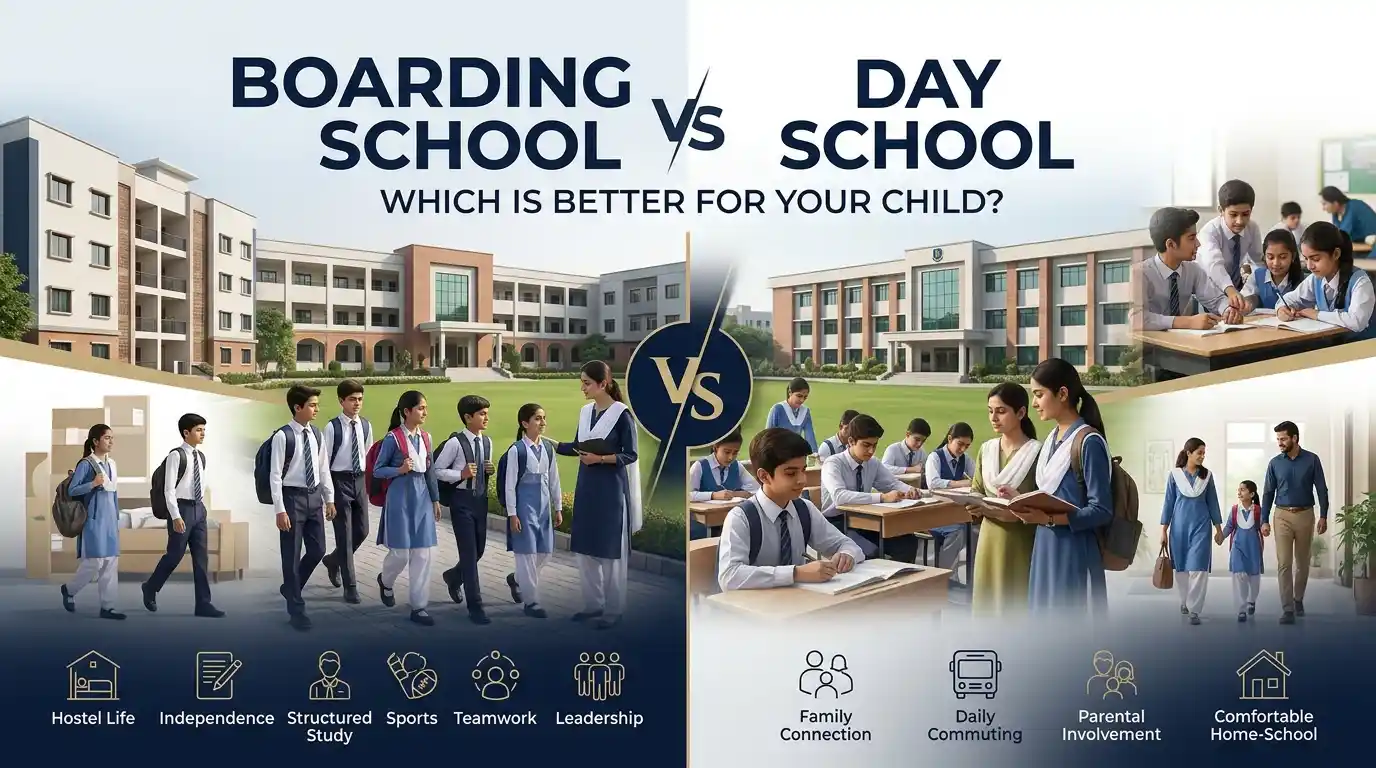
In a boarding school, kids live on or near the campus for the school term. Besides attending classes, they go through supervised study time, sports, and general hostel life.
A day school works the more familiar way kids go for classes, then come home in the evening, leaving weekends and evenings free for family time.
So which one is actually better? Honestly, there’s no single right answer. It really comes down to your child’s personality, age, how independent they are, your family’s situation, and what you’re hoping for long-term.
This guide breaks down both options so you can make a more informed call.
What Is a Boarding School?
A boarding school is where students study and live together on campus for the academic term.
They usually stay in hostels or residential houses run by trained staff, and their day is built around classes, meals, study time, sports, and some free time to unwind. This kind of setup can work well for families who want their child in an environment that combines proper academics with independence and personal growth, all at once.
Depending on the institution, boarding schools in Pakistan follow different systems Matric, O Levels, A Levels, or other recognized programs.
What Is a Day School?
A day school, on the other hand, just means classes during school hours, then home in the evening.
This is still the more common setup for most Pakistani families. Kids go to school, take part in whatever activities are on offer there, and then spend the rest of their day at home with family.
Day schools also let parents stay closely involved in things like homework, meals, daily routine, and general academic progress basically, the day-to-day of raising a child.
For families living close to a decent school, this combination of education and home life tends to work out really well.
Boarding School vs Day School: Key Differences
The core difference really comes down to one thing where the child actually lives.
| Factor | Boarding School | Day School |
|---|---|---|
| Accommodation | Student lives at school | Student lives at home |
| Family time | Less daily interaction | More daily interaction |
| Routine | Very structured | More flexible |
| Independence | Usually develops earlier | Develops gradually, at home |
| Study environment | Supervised, at school | At home |
| Extracurricular activities | Often available all day | Mostly limited to school hours |
| Social interaction | Constant, with peers | Mainly during school hours |
| Parental involvement | Remote, through regular contact | Direct, day to day |
| Travel | No daily commute | Daily commute possible |
| Living experience | Residential community | Family-centered |
Neither is automatically the better choice. What matters is which one actually fits your child.
1. Academic Environment
Both types of schools can offer a strong education — that part really comes down to the school itself, not the model.
What actually matters more is things like the quality of teachers, the curriculum, class sizes, teaching methods, and how well the school supports its students academically.
That said, boarding schools do have one edge supervised study time. Many residential schools build in evening study sessions where kids can finish homework, revise, or get ready for exams without much distraction.
Day school kids, meanwhile, usually study at home which works great as long as parents can provide a quiet space and a bit of support along the way.
Winner: Depends on the child. A self-driven student can do just as well in either setup.
2. Independence and Responsibility
This is where boarding schools genuinely have the upper hand.
Boarding students end up managing a lot of things on their own organizing their belongings, sticking to schedules, handling assignments, and getting along with roommates all within a supervised, age-appropriate environment.
Day school kids can absolutely become independent too, but parents naturally stay more involved in the daily routine.
Winner: Boarding school. It just gives more natural opportunities to practice being on your own.
3. Family Interaction
For a lot of Pakistani families, being together really matters and this is where day schools clearly win.
Kids come home every evening, so parents get to see their routine up close, help with homework, talk about their day, and just be part of family life.
Boarding students, on the other hand, spend most of the term away from home. Even with regular calls and visits, there’s simply less face-to-face time.
Winner: Day school. If keeping that daily connection matters most to you, this is the better fit.
4. Discipline and Daily Routine
Boarding schools run like clockwork fixed times for waking up, meals, classes, study, sports, and lights out.
That kind of consistency helps kids build discipline and better time management, almost without realizing it.
Day school kids have schedules too, but evenings are usually managed at home, which gives more flexibility though sometimes at the cost of consistency.
Winner: Boarding school. Kids who do well with structure tend to benefit here.
5. Sports and Extracurricular Activities
A good education shouldn’t stop at textbooks, and boarding schools often have the edge here simply because of time.
Since students already live on campus, there’s usually more room in the day for cricket, football, swimming, debate, drama, robotics, or whatever else the school offers.
Day schools have activities too, but kids usually head home right after, unless they join outside clubs or academies to keep it going.
Winner: Often boarding school though it really depends on what facilities each specific school actually has, so don’t assume.
6. Social Skills and Friendships
Boarding school puts kids around their peers basically all day, every day.
They learn to share space, sort out disagreements, work as a team, and build genuine friendships often with kids from completely different cities or backgrounds.
Day school kids build strong friendships too, just mostly within school hours, which leaves more room to also stay close with family and neighborhood friends.
Winner: Depends. Boarding gives more constant peer time; day school keeps a broader balance.
7. Parental Involvement
Day school naturally means more hands-on involvement for parents you’re there for homework, sleep, meals, and just generally keeping tabs on things.
With boarding school, that relationship shifts. You’ll mostly stay in touch through parent-teacher meetings, calls, school portals, and scheduled visits instead.
Winner: Day school for parents who like staying closely involved day to day.
8. Travel and Location
In cities like Karachi, Lahore, Islamabad, or Rawalpindi, daily commuting can eat up a surprising amount of a kid’s day.
Boarding school removes that problem entirely since the student already lives on campus, freeing up time for studying, sports, or just resting.
The trade-off? If the school is far from home, getting there for weekends or holidays can be a hassle.
Winner: Depends on location. Boarding makes sense if a good school is far away; day school works better if there’s one nearby.
9. Cost of Education
Cost is a big deal for most families, and here day schools usually come out cheaper.
Day school fees mainly cover tuition, plus extras like transport, uniforms, and books. Boarding school fees add accommodation, meals, and residential supervision on top which adds up fast.
Still, it’s worth comparing the full annual cost of each option rather than just looking at the tuition number.
Winner: Usually day school though actual costs vary a lot between institutions.
10. Emotional Readiness
This might be the most important factor of all and it has nothing to do with facilities or fees.
Not every child is ready to live away from home. Some settle into boarding life quickly and love it; others struggle with homesickness, especially early on.
Before deciding, think honestly about whether your child is okay with spending nights away, sharing a room, managing their own things, and asking adults for help when needed.
If your child clearly prefers being home and isn’t emotionally ready for that shift, day school is probably the safer choice.
Winner: Depends entirely on the child. This should come before rankings or reputation, not after.
So, Which One Is Actually Better?
Honestly, it comes down to your own child.
Boarding school could work well if your child:
- Is ready for more independence
- Does well with structure and routine
- Wants more time for extracurriculars
- Is comfortable being away from home
- Would benefit from supervised study time
- Is heading toward university and could use the head start
Day school might be the better fit if your child:
- Prefers living at home
- Does better with close parental support
- Has a strong family routine already in place
- Isn’t quite ready emotionally for residential life
- Has a good school nearby
- Needs more flexibility outside school hours
How to Actually Choose the Right School
Whichever way you lean, don’t decide purely on reputation. Go visit the school if you can, and look closely at a few things.
Academic quality — Ask about the curriculum, teacher qualifications, results, and how much academic support is actually available.
Facilities — Check out the classrooms, library, labs, computer setup, and sports grounds.
Student safety — For boarding schools especially, ask about supervision, security, emergency procedures, and medical support.
Hostel setup — Look at room sharing, cleanliness, washrooms, food, and study areas.
Extracurriculars — Find out what’s actually on offer — sports, clubs, arts, competitions — not just what’s listed in the brochure.
School culture — Talk to teachers, current students, and other parents if you get the chance. That tells you a lot more than any prospectus ever will.
A Simple Way to Decide
Ask yourself these five questions:
- Is my child ready to live away from home? If yes, boarding is worth a serious look.
- Does my child need more structure? If yes, residential life could help.
- Is spending daily time together as a family a priority? If yes, day school probably makes more sense.
- Is there a good school close to home? If yes, day schooling is the practical option.
- What environment will actually help my child thrive? This is the question that matters most.
Don’t aim for the school that sounds the most impressive on paper. Aim for the one where your child can genuinely learn, feel safe, and grow into their own person.
Final Verdict
There’s really no universal winner in the boarding vs day school debate.
Boarding school can offer independence, structure, leadership chances, and a packed extracurricular life. Day school keeps kids close to family while still offering a solid education.
For parents in Pakistan, the right call depends on your child’s personality, emotional readiness, your family’s priorities, location, and budget all put together, not just one factor in isolation.
And above everything else, talk to your child about it. The best school isn’t the one with the flashiest campus or the longest list of facilities it’s the one where your child can learn with confidence, build real relationships, and grow into who they’re meant to be.
Frequently Asked Questions
Is boarding school better than day school?
Not universally, no. Boarding suits kids who are independent and comfortable with structured residential life; day school suits kids who do better with close family involvement.
Are boarding schools good for kids in Pakistan?
Yes, as long as the school offers proper academics, safety, supervision, and real support for students which is worth checking carefully before enrolling.
What’s the main difference between the two?
Simply put where the child lives. Boarding students stay at school; day school students go home every evening.
Is boarding school more expensive?
Usually, yes, since fees often include accommodation, meals, and supervision on top of tuition. But costs vary a lot from school to school.
Do boarding schools actually help kids become independent?
Yes the day-to-day responsibility of managing their own routine, under proper supervision, naturally builds independence over time.
Which is better for a shy child?
It really depends on the individual. Some shy kids open up in a supportive boarding environment; others need the comfort of home before they’re ready for new social settings.
Can kids stay close to family while boarding?
Yes. Most boarding schools have regular calls, visits, and holidays built in specifically so students can stay connected.
What should parents check before choosing a boarding school?
Academics, hostel quality, safety, supervision, medical support, activities, fees, location, and how the school communicates with parents.
Do boarding schools really offer better extracurriculars?
Often, yes simply because students are on campus longer. But it’s worth comparing actual programs school by school rather than assuming.
How do I know if my child is ready for boarding school?
Look at their emotional maturity, independence, comfort with routines, and willingness to be away from home and talk it through with them before making the final call.