
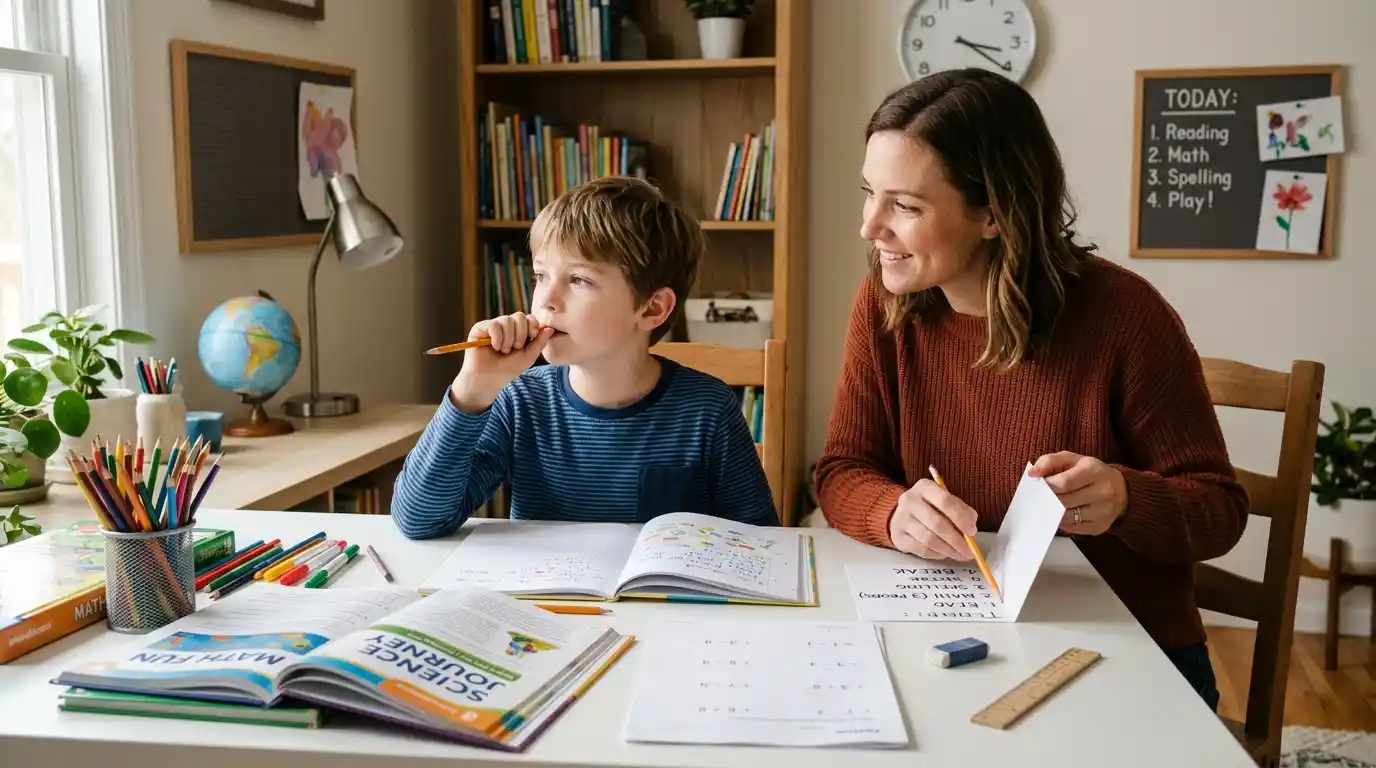
Does your child stare at their books without starting? Do they forget instructions a minute after hearing them, or need three reminders to finish one simple task? If so, you’re not alone. Almost every parent has been there.
Trouble concentrating is very common in children, and it doesn’t mean something is seriously wrong. Kids lose focus for all kinds of everyday reasons: they’re tired, hungry, bored, stressed, or the work is simply too hard. Sometimes they just need a different way into the task.
The good news is that a few small changes at home can make schoolwork feel much more manageable.
Why Does My Child Find It Hard to Focus?
Usually there’s a simple reason behind it. The work might be too difficult, too repetitive, or just not interesting. Your child might be hungry, worn out from the school day, or worried about something. They may also be sitting in front of a worksheet without really understanding what it asks, or they may have fallen behind in a subject and feel lost.
In short: Children struggle to concentrate because of distractions, tiredness, hunger, stress, unclear instructions, boring or difficult tasks, inconsistent routines, or sometimes deeper attention or learning challenges. A calm workspace, smaller tasks, short breaks, and plenty of encouragement can make a real difference.
What Does It Look Like?
Every child drifts off sometimes. But if you notice these patterns often, it may be worth paying closer attention:
- Looking around or fiddling with objects during homework
- Starting a task, then quickly moving on to something else
- Needing lots of reminders to stay on track
- Forgetting instructions almost immediately
- Taking far longer than expected to finish
- Leaving work half done
- Making careless mistakes from rushing
- Losing notebooks or school supplies
- Avoiding hard assignments
- Getting frustrated when asked to focus
- Struggling to switch from one task to another
- Needing frequent breaks
- Not knowing what to do first
None of this automatically means your child has an attention disorder. Their age, the situation, how often it happens, and how much it affects daily life all matter.
What Can You Do at Home?
1. Build a simple routine
Children focus better when they know what’s coming. Rather than deciding each day when homework happens, try a predictable pattern, like: snack, short break, homework, movement break, finish up, playtime.
Doing homework at about the same time each day also cuts down on arguments about when to start.
2. Set up a calm study spot
It doesn’t need to be big or fancy, just comfortable and fairly quiet. Try to keep away the TV, phones, video games, loud conversations, and stray toys. Keep only what your child needs for the current task on the desk. A tidy space makes it easier to know what to focus on.
3. Break the work into small pieces
“Finish all your homework” can feel huge. Try smaller steps instead: do questions 1 to 5 of math, take a five-minute break, read three pages, take another break, then write the first paragraph. Small goals feel doable.
Parent tip: Focus on the next task, not the whole pile that’s still waiting.
4. Try short bursts of focus
Long stretches are hard for kids. You might try 20 minutes of work followed by a five-minute break, then another 20 minutes. Adjust the timing to your child’s age. Younger children need shorter sessions, and older ones can slowly build up. The aim is to grow their focus gradually, not to make them sit still for hours.
5. Let them move
A quick movement break helps kids reset. They can stretch, walk around, have some water, do a few jumping jacks, step outside, or take a few deep breaths. Try not to let every break turn into screen time, because it’s much harder to go back to homework after an exciting video or game.
6. Check that they understand the task
What looks like poor concentration is sometimes just confusion. A child might be staring at a worksheet because they have no idea what it wants. Ask, “Can you tell me what this question is asking?” If they can’t, go through it together. For longer assignments, write the steps down so they don’t have to keep asking.
7. Help them take the first step
Getting started is often the hardest part. If your child says “I don’t know where to begin,” resist the urge to just do it for them. Ask gentle questions instead: What’s the first question? What do you already know? Which part looks easiest? One small push is often enough.
8. Use a checklist
A simple list of today’s tasks, such as math questions, reading, spelling words, and packing the school bag, helps children stay organized. Ticking things off feels good, and it means fewer reminders from you.
9. Keep screens out of homework time
This doesn’t mean screens are bad. It just helps to have a clear rule: homework first, entertainment after. When the rule is predictable, the daily negotiating fades.
10. Encourage specific things
Saying “Pay attention!” or “Stop getting distracted!” usually just adds frustration. It doesn’t teach your child how to focus. Try noticing what they do well instead: “I saw you stuck with that problem until you solved it,” or “You finished those five questions without giving up. Well done.” Specific praise shows them exactly what to repeat.
11. Don’t compare them to others
Comments like “Your brother finishes much faster” can make a child feel embarrassed or not good enough. Every child develops at their own pace. Compare them only to themselves, and ask, “What can we do today to make this a little easier than yesterday?”
12. Make hard subjects more fun
A child who seems distracted may actually be bored. Add a little play:
- Math: number games, puzzles, flashcards, real-life examples, counting objects, drawing out problems
- Reading: talk about the story, take turns reading aloud, act out characters, discuss new words
- Science: simple experiments, short videos, nature walks, hands-on activities
Learning doesn’t always have to happen on a worksheet.
13. Connect schoolwork to real life
Kids care more when they see why something matters. Math shows up in shopping, cooking, sports, and telling time. Reading shows up in recipes, signs, comics, and magazines. When schoolwork feels useful, it feels less like a chore.
14. Protect their sleep
A tired child will naturally struggle to focus. A steady bedtime routine helps. If homework is being done very late at night, see whether the schedule can shift. The goal isn’t more work time. It’s finding a time when your child is alert.
15. Don’t forget food and water
Hunger and thirst make it hard to settle down. A snack and a glass of water after school can help. Keep it simple, and don’t turn snack time into another complicated routine.
16. Teach basic organization
Focus and organization go hand in hand. A child may seem distracted when they simply don’t know what homework they have, what to do first, where their books are, or when things are due. Encourage habits like checking the school bag every afternoon, keeping supplies in the same place, and using a planner or checklist.
17. Help them handle mistakes
Some children lose focus because a mistake upsets them. They erase again and again, refuse to continue, or say “I can’t do this.” Remind them that mistakes are part of learning. Instead of fixing the answer yourself, try, “Let’s look at this step together. Where do you think it went off track?” That teaches them to see mistakes as something to work through, not something to fear.
18. Give them a little control
Small choices help children feel involved. Let them pick which subject to start with, which pencil to use, or whether to take a break before or after a task. Keep the choices inside a clear routine. “Would you like to start with math or reading?” works better than “Do you want to do your homework?”
What to Avoid
Some reactions make homework more stressful without meaning to. Try to avoid:
- Shouting when they get distracted
- Doing the homework for them
- Comparing them with siblings or classmates
- Using homework as a punishment
- Expecting long stretches of silent focus
- Giving too many instructions at once
- Turning every mistake into an argument
- Allowing endless distractions during study time
A calm, steady approach usually works better than turning up the pressure.
A Simple After-School Routine
Here’s an example you can adapt to your child’s age and schedule:
- Snack and a drink of water
- A short break after school
- Set up a quiet study space
- Go over the homework checklist
- Start with one manageable task
- Work for a short, focused stretch
- Take a quick movement break
- Move on to the next task
- Check the finished work
- Pack the school bag for tomorrow
When to Seek Extra Support
Occasional distraction is normal. But if the difficulty keeps going, shows up in different places, or really affects school and daily life, it’s worth talking to your child’s teacher or a qualified professional.
Watch for signs like these:
- Trouble finishing age-appropriate schoolwork
- Difficulty following instructions even when they understand the subject
- Big struggles with organization
- Often losing school materials
- Trouble focusing at both school and home
- Extreme frustration over ordinary tasks
- Ongoing learning difficulties alongside concentration problems
- Problems that seriously affect grades or everyday life
A teacher can tell you a lot about how your child learns in class. If concerns continue, a qualified professional can help figure out whether learning or attention issues are involved. Please don’t try to diagnose your child from an online checklist or a few isolated behaviors.
Working Together with Teachers
Good communication between home and school makes a big difference. Some helpful questions to ask the teacher:
- When does my child seem most focused?
- Which subjects come easiest, and which are hardest?
- Does my child finish work in class?
- Do they follow instructions well?
- Are there certain situations where focus falls apart?
- What seems to help in the classroom?
The answers can show you whether the struggle is mainly about homework or happens everywhere.
The Goal Is Better Focus, Not Perfect Focus
No child concentrates perfectly all day. Focus is a skill that grows over time. Instead of expecting your child to sit for hours, aim to help them start a task, stay with it, handle distractions, take breaks, and come back again.
Small wins count. If your child can focus for 10 minutes today and 15 minutes a few weeks from now, that’s real progress worth celebrating.
Final Thoughts
Telling a child to “just pay attention” rarely works. Focus problems usually come from tiredness, distractions, hard work, unclear instructions, missing routines, stress, or boredom, and sometimes from learning or attention challenges.
You can help by keeping a predictable routine, cutting down distractions, breaking work into smaller parts, using short focus sessions, allowing movement breaks, and offering lots of encouragement. Most of all, try to understand why your child is struggling instead of only reacting to the behavior.
With patience, steady routines, the right support, and good teamwork between home and school, children can slowly build stronger focus and more independence. They don’t need to become perfectly focused overnight. They just need help building the skills and confidence to keep learning, one small step at a time.
Frequently Asked Questions
Why does my child have trouble concentrating on schoolwork?
There are many possible reasons, including distractions, tiredness, hunger, stress, hard or boring tasks, unclear instructions, inconsistent routines, or learning and attention challenges.
How can I help my child focus better on homework?
Set up a quiet study space, keep a regular routine, break work into smaller tasks, use short focus sessions, allow movement breaks, and give plenty of positive encouragement.
How long should a child concentrate on homework?
There’s no one right answer. It depends on the child’s age and needs. Short, focused sessions with breaks are usually easier than long ones.
Is trouble concentrating always a sign of ADHD?
No. It can come from tiredness, stress, distractions, hard schoolwork, learning difficulties, or lack of sleep. If the concerns don’t go away, talk to a teacher or qualified professional.
When should I get help?
Consider extra support if the difficulty is persistent, appears in different settings, gets in the way of learning or daily life, or comes with other learning or behavior concerns.