
If you’ve ever looked at your child’s homework and wondered how “friend” became “freind” for the fifth time this month, you’re far from alone. Spelling mistakes are one of the most common things parents worry about and one of the most misunderstood.
Spelling mistakes are a completely normal part of learning to read and write. Every child develops these skills at their own pace some pick up word patterns almost instantly, while others need more repetition, more visual support, or a completely different approach before it clicks. The real question isn’t “why is my child making mistakes?” it’s “what kind of mistakes, and what do they tell us?”
This guide walks through why spelling struggles happen, what to actually watch for, and how you can help without turning every homework session into a battle.
A quick note before we start: spelling difficulties can come from many different places and don’t automatically point to a learning disorder. This is general educational information, not a diagnosis. If you have ongoing concerns, a conversation with your child’s teacher, a learning specialist, or a speech-language professional is always a reasonable next step.
So Why Does My Child Keep Getting Spelling Wrong?
Spelling isn’t one single skill it’s several working together at once: listening, recognizing sounds, remembering letter patterns, reading, writing, attention, and memory. When any one of those pieces is still developing, spelling mistakes tend to follow.
Your child might be struggling because their phonics skills aren’t fully developed yet, they’re finding it hard to connect sounds to letters, they haven’t yet locked in irregular spelling patterns, they mix up similar-sounding letters, they haven’t been exposed to much reading, they’re writing faster than they can think through spelling, they have trouble holding a sequence of letters in memory, they simply need more repetition, their concentration wanders, or in some cases there’s a specific learning difficulty affecting their literacy development.
The most useful thing you can do isn’t to count the mistakes on one spelling test. It’s to notice the pattern across several pieces of writing over time.
Reason 1: They’re Still Learning Phonics
Phonics is the bridge between sounds and letters. To spell “cat” correctly, a child first needs to hear it as three distinct sounds /k/, /a/, /t/ before they can match each one to a letter.
If that skill is still developing, you might see things like “kat” instead of “cat,” sounds left out entirely, extra letters added in, mixed-up vowel sounds, or real struggles with anything unfamiliar. None of this necessarily signals a problem it usually just means more phonics instruction and practice is needed, and that’s a completely normal stage to be in.
Reason 2: Some Words Are Just Genuinely Hard to Spell
English spelling doesn’t always play fair. Plenty of words simply can’t be sounded out the way they’re written think enough, through, because, beautiful, Wednesday, or different. These require repeated exposure to actually stick, not logic.
So a child who nails every simple phonetic word can still trip over these irregular ones and that’s not a red flag. It just means we can’t expect a child to memorize a word perfectly after seeing it exactly once.
Reason 3: Remembering the Order of Letters Is Genuinely Hard
Spelling also demands that a child hold an exact sequence of letters in memory. A child might understand the word “friend” perfectly and still write “freind” the meaning is there, but the letter order slipped.
This tends to improve with repeated exposure, grouping similar words together, visual memory activities, and consistent writing practice it’s a memory skill as much as a spelling one.
Reason 4: Reading Habits Quietly Shape Spelling
Reading and spelling feed each other. Every time a child reads a word spelled correctly, it reinforces that pattern a little more. Kids with less reading exposure simply have fewer chances to build that visual familiarity.
Try leaning into whatever your child actually enjoys storybooks, comics, kids’ magazines, short stories, or age-appropriate content online. The goal here is genuine enjoyment, not another test disguised as reading time.
Reason 5: They’re Spelling Purely by Sound
Some kids spell words exactly the way they hear them: “sed” for “said,” “nite” for “night,” “wuz” for “was.” This usually just means they’re leaning on sound-based strategies while they’re still learning the actual conventions.
Instead of a flat “that’s wrong,” try turning it into a small discovery together:
Child: “sed” Parent: “Let’s look at ‘said’ together which letters make it look different from how it sounds?”
This kind of gentle comparison gets them thinking about spelling instead of just memorizing a correction and moving on.
The Most Common Types of Spelling Mistakes and What They Usually Mean
Missing letters (like “school” becoming “shool”) often happen when a child is writing quickly or hasn’t caught every sound in a word.
Added letters (like “running” becoming “runingg”) tend to show up when a spelling pattern isn’t fully locked in yet.
Letter reversals are common during early writing development and, on their own, aren’t proof of dyslexia or any other learning difficulty. If reversals stick around alongside broader, persistent reading and writing struggles, that combination is worth mentioning to a teacher or professional but reversals by themselves usually aren’t cause for concern.
Confusing similar sounds mixing up b/p, d/t, f/v, or s/z — varies a lot from child to child and often just reflects sounds that are genuinely close together to a developing ear.
Vowel pattern mix-ups ai/ay, ee/ea, ou/ow, oa/o, i/e — are especially common since English vowels are notoriously inconsistent. Teaching words in grouped patterns tends to make these differences click faster than isolated memorization does.
Is This Actually Normal?
Yes — genuinely, completely normal. Making spelling mistakes is part of how literacy develops, not a sign that something’s off track.
What matters more than the mistakes themselves is their frequency, type, persistence, and impact. An occasional slip on an unfamiliar word is nothing to worry about.
It’s worth paying closer attention if your child keeps struggling with very common, everyday words, repeats the exact same mistakes over and over, can’t seem to retain spellings despite regular practice, avoids writing whenever possible, gets visibly frustrated by it, is also struggling with reading, has trouble connecting sounds to letters, struggles to write full sentences, or seems noticeably behind where their class generally is.
Even then, none of this automatically means there’s a learning disorder it just means some extra support could genuinely help.
Could This Be Connected to Dyslexia?
Sometimes, yes — persistent spelling difficulties can show up alongside dyslexia, since dyslexia affects reading and language processing more broadly, and spelling often gets caught up in that too.
But here’s the important part: spelling mistakes alone can’t diagnose dyslexia. A child who struggles with spelling might simply need more targeted instruction or practice nothing more complicated than that.
If the spelling difficulties are persistent and show up alongside real reading or writing challenges, that’s a reasonable moment to talk to your child’s teacher and consider whether a proper educational assessment makes sense.
What Can You Actually Do to Help?
Work with small word groups, not giant lists. Instead of a huge memorization list, focus on a handful of related words light, night, right, bright so your child starts noticing the shared -ight pattern instead of treating each word as unrelated.
Teach patterns, not isolated words. Show connections like play, playing, played, player so spelling starts to feel like a system with logic behind it, not an endless list to memorize one at a time.
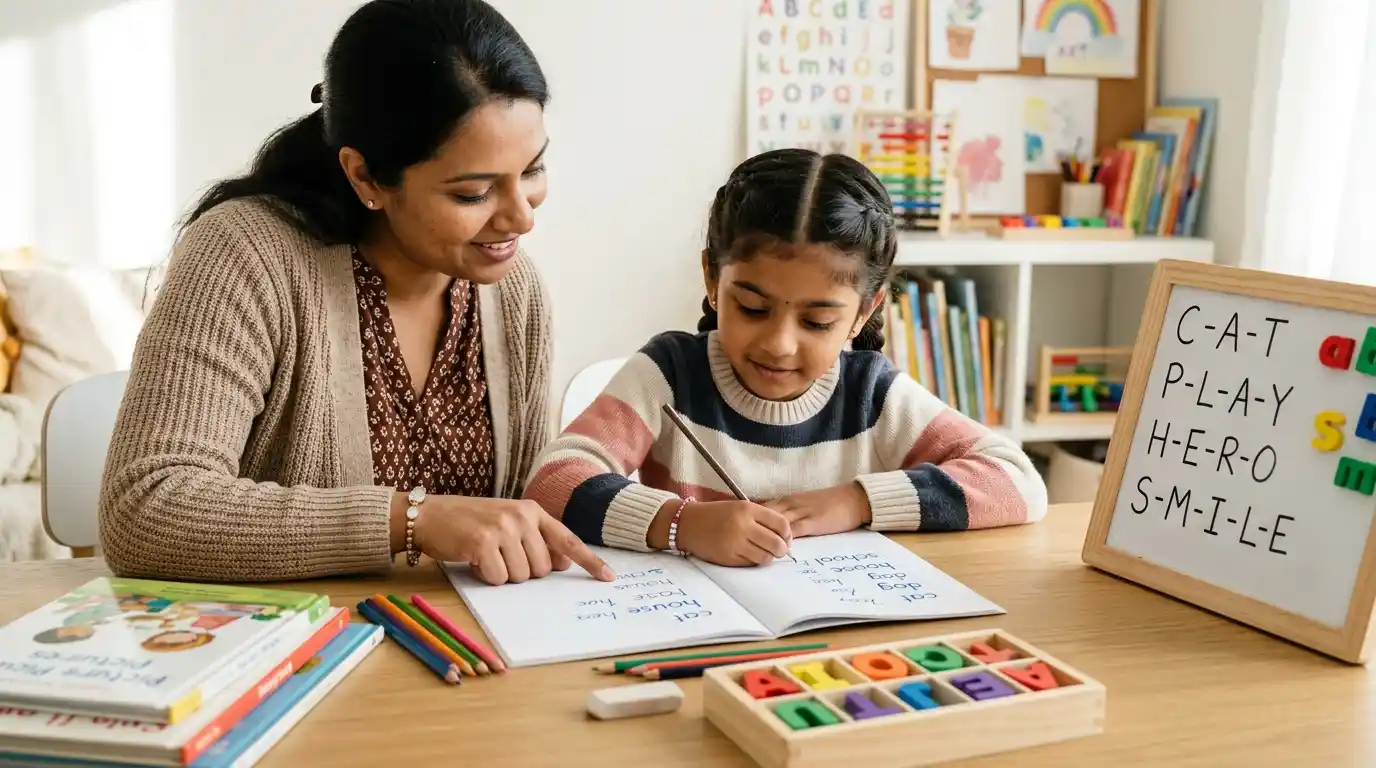
Bring in multiple senses. Try writing words in sand, building them with letter tiles, tracing letters, saying sounds out loud, using a whiteboard, playing with magnetic letters, clapping out syllables, or breaking words into smaller chunks. Different kids respond to different approaches it’s worth experimenting to see what actually clicks for yours.
Keep reading part of the routine. Even 10–15 minutes of genuinely enjoyable reading exposes kids to correct spelling and new vocabulary in a low-pressure way. Let them pick books that match their interests, not just their reading level.
Turn practice into play. Word puzzles, letter games, word searches, Scrabble-style games, flashcards, spelling bingo, and matching games all give repeated exposure without making every mistake feel like a failure.
A Few Things Worth Avoiding
Skip the shame. Comments like “you should know this by now” tend to build frustration, not motivation.
Resist comparing siblings or classmates. Every child moves through literacy development on their own timeline comparison rarely speeds that up.
Rethink endless repetition. Writing the same word 30 times doesn’t necessarily teach a child why it’s spelled that way pairing writing with phonics, patterns, and visual learning tends to work better.
Don’t correct every single mistake in the moment. If writing always turns into a correction session, kids can start avoiding it altogether. Pick the words that matter most and build accuracy gradually.
What Teachers Can Bring to the Table
Teachers are often in a good position to spot patterns across time that a single homework page can’t show. Helpful classroom approaches typically include explicit phonics instruction, word-pattern activities, visual spelling resources, vocabulary building, small-group practice, repeated exposure to target words, multisensory techniques, individual feedback, encouraged reading, and appropriate writing support.
Tracking the types of errors a child makes over weeks tells a teacher and you far more than any single spelling test ever could.
When Is It Worth Seeking Extra Support?
It’s reasonable to bring your concerns to your child’s teacher if spelling difficulties are persistent or clearly affecting their schoolwork. Additional professional support is worth considering when a child keeps struggling despite consistent help, has real reading difficulties too, has ongoing trouble with writing more broadly, becomes highly anxious or frustrated about schoolwork, avoids reading and writing altogether, is struggling across several literacy areas at once, or is noticeably behind where their classmates generally are.
A qualified professional can help figure out whether the right next step is more targeted classroom support or a more detailed assessment.
Frequently Asked Questions
Why does my child keep making the same spelling mistakes? Usually because the underlying pattern, sound-letter connection, or letter sequence hasn’t fully settled into memory yet. Practicing it through a few different methods tends to help more than repeating the same approach.
How can I improve my child’s spelling at home? Keep practice short and regular, read together often, teach spelling patterns rather than isolated words, work on phonics, play spelling games, and encourage them to actually use new words in sentences.
Is poor spelling a sign of dyslexia? It can show up alongside dyslexia, but spelling struggles on their own don’t mean a child has it. Dyslexia involves broader reading and language-processing difficulties and needs a proper assessment to confirm.
Should I make my child write difficult words over and over? Repetition has its place, but copying a word dozens of times isn’t always the most effective way to learn it. Pairing writing with phonics, visual patterns, reading, and multisensory activities usually works better.
At what age should kids be spelling correctly? There’s no single age where every child should have it all figured out — spelling develops gradually alongside phonics, vocabulary, reading exposure, and grammar over several years.
Why does my child spell a word right one day and wrong the next? This usually just means the pattern isn’t fully locked in yet. Tiredness, stress, distraction, and the difficulty of the specific task can all affect performance day to day too.
Why does my child spell words exactly how they sound? This is a completely normal phase — kids often rely on phonetic spelling while they’re still learning the conventional rules that don’t always match how a word sounds.
Should I be worried if my child reverses letters? Not on its own — letter reversals are common during early writing development and don’t indicate dyslexia by themselves. If they continue alongside broader, persistent reading and writing struggles, that’s worth mentioning to a teacher.
Can reading actually improve spelling? Yes — regular reading exposes kids to correctly spelled words and common patterns repeatedly, and the two skills genuinely reinforce each other over time.
How can schools help kids who struggle with spelling? Through explicit literacy instruction, phonics support, pattern-based activities, individualized practice, plenty of reading opportunities, and ongoing communication with parents about progress.
Final Thoughts
Spelling mistakes are a normal, expected part of learning but when they persist stubbornly, it can be worth looking a little closer at what kind of support might genuinely help.
Rather than fixating on how many mistakes show up, pay attention to what kind of mistakes they are and how spelling develops over time. That pattern tells you far more than any single test.
With patient guidance, regular reading, targeted practice, and support from teachers or specialists when it’s needed, children generally do build stronger spelling and writing skills gradually, and in their own time.
Above all, spelling practice should help kids feel like capable, confident learners not teach them to be afraid of getting something wrong.
At School of Scholaars, understanding how children learn differently is central to building a genuinely supportive learning environment. When parents and teachers work together to spot challenges early and lean into each child’s strengths, kids get the guidance they need to grow into confident, capable learners.