
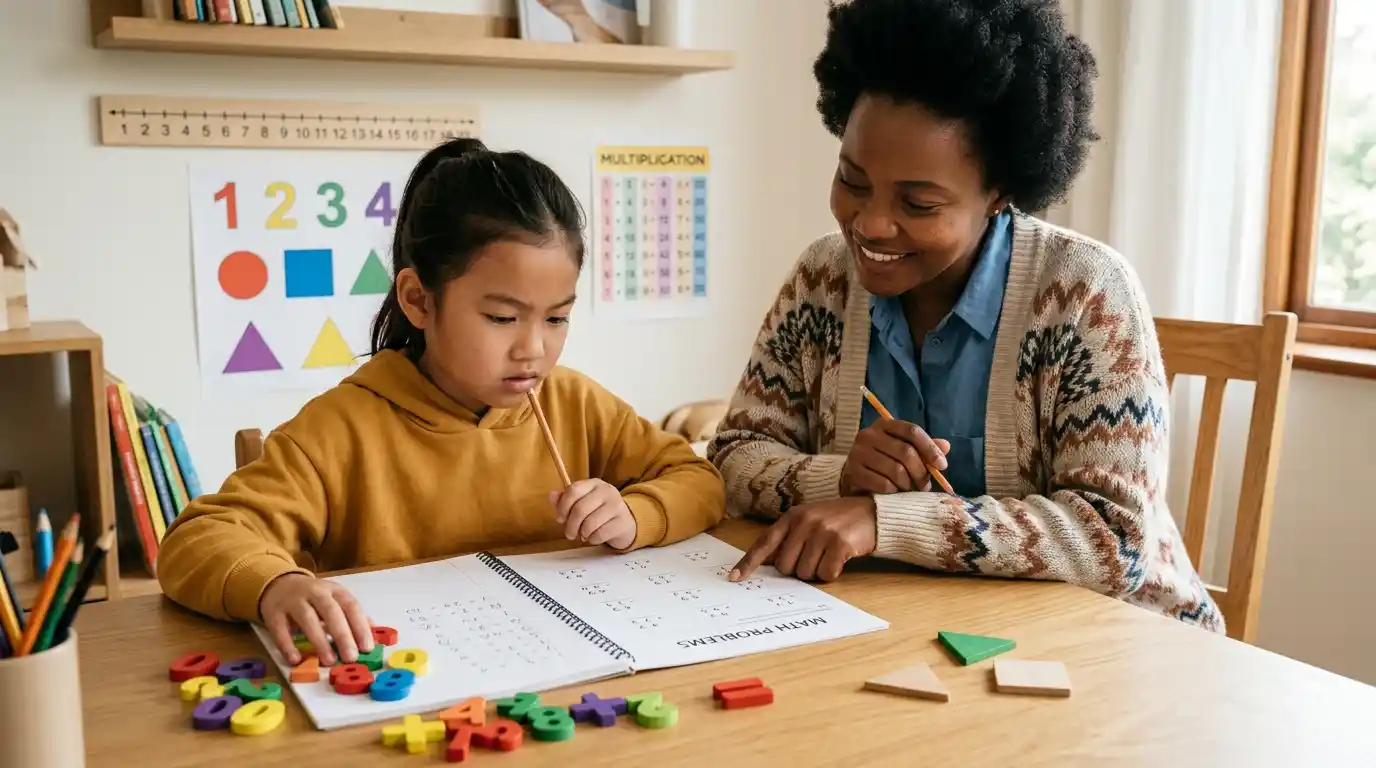
Does your child find mathematics difficult while other subjects seem easier? You may notice that they forget basic math facts, struggle with word problems, take longer to complete calculations, or become frustrated whenever numbers appear.
If this sounds familiar, remember that struggling with mathematics does not automatically mean your child is not capable of learning math. Children develop mathematical skills at different rates, and there can be several reasons why a child finds numbers challenging.
Understanding the reason behind the difficulty is often the first step toward finding the right support.
Why Does My Child Struggle With Mathematics?
Children can struggle with mathematics for many different reasons. Some may have gaps in their foundational skills, while others may have difficulty understanding mathematical concepts, remembering number facts, following multiple steps, or applying math to everyday situations.
Learning style, classroom experiences, confidence, attention, language skills, and previous learning experiences can also influence how comfortable a child feels with mathematics.
Quick Answer
A child may struggle with mathematics because of gaps in foundational math skills, difficulty understanding numbers and mathematical concepts, challenges with working memory or attention, math anxiety, language-related difficulties, or a specific learning difficulty such as dyscalculia.
Identifying the underlying challenge can help parents and teachers provide more effective support.
What Are Math Learning Difficulties?
Math learning difficulties refer to persistent challenges with understanding or using mathematical concepts and skills. These difficulties can appear in different ways and may affect children differently.
For example, one child may understand addition but struggle with subtraction and multiplication. Another may calculate correctly but have difficulty understanding mathematical word problems.
Some children simply need more practice and a different explanation, while others may need additional educational support.
The important thing is to look beyond the number on a worksheet. A child’s mistakes can sometimes provide clues about what they are finding difficult.
Common Signs Your Child May Be Struggling With Math
Every child makes mistakes in mathematics. However, repeated difficulties may be worth paying attention to, particularly when they continue despite regular practice.
Some common signs include:
Difficulty recognizing or understanding numbers
Frequently forgetting basic addition or subtraction facts
Struggling to understand place value
Difficulty remembering multiplication tables
Confusing mathematical symbols such as +, −, ×, and ÷
Taking significantly longer than expected to complete simple calculations
Difficulty following multi-step math problems
Struggling with mathematical word problems
Difficulty understanding fractions, decimals, or percentages
Problems estimating quantities or comparing numbers
Difficulty understanding time, money, measurements, or distances
Avoiding homework or activities involving mathematics
Becoming unusually frustrated or anxious during math activities
One or two of these signs do not necessarily indicate a learning disorder. A child’s age, grade level, learning environment, and overall development should also be considered.
1. Gaps in Basic Math Skills
Sometimes the problem is not with a child’s ability to learn mathematics but with a missing piece of foundational knowledge.
Mathematics is cumulative. Children often need to understand earlier concepts before they can confidently learn more advanced ones.
For example, a child who has not fully understood place value may later struggle with addition, subtraction, multiplication, division, decimals, and fractions.
Parent Tip
Instead of immediately moving to harder questions, go back and identify the specific concept your child is finding difficult. Strengthening that foundation can make later topics much easier.
2. Difficulty Understanding Number Concepts
Some children find it difficult to develop a strong sense of numbers. They may know that 8 is a number but struggle to understand what the quantity actually represents.
This can affect skills such as:
Comparing numbers
Counting accurately
Understanding greater than and less than
Estimating quantities
Understanding number relationships
Recognizing patterns
Developing number sense is an important part of early mathematics learning because it helps children understand why mathematical operations work instead of simply memorizing procedures.
3. Working Memory and Attention Challenges
Many mathematical problems require children to hold several pieces of information in their minds at the same time.
Consider a problem that requires a child to remember the numbers, choose the correct operation, follow several steps, and check the answer. This can place a significant demand on working memory.
A child may understand each individual step but lose track of the information when several steps are combined.
Breaking larger problems into smaller steps can make mathematical tasks easier to manage.
4. Math Anxiety Can Make Learning Harder
Sometimes a child’s difficulty with mathematics becomes connected to fear or anxiety.
If a child repeatedly hears that they are “bad at math,” they may begin to believe that mathematics is something they simply cannot learn. This can lead to avoidance, frustration, or fear of making mistakes.
When children feel anxious, they may also find it harder to concentrate and retrieve information they already know.
Replace “I’m Bad at Math” With “I’m Still Learning This”
Encouraging children to see mistakes as part of learning can help create a healthier attitude toward mathematics.
Focus on effort, strategies, and progress rather than describing a child as naturally “good” or “bad” at math.
5. Difficulty With Mathematical Language
Mathematics is not only about numbers. It also involves language.
Children need to understand words such as:
More and less
Greater and smaller
Difference
Equal
Before and after
Remaining
Altogether
Increase and decrease
A child may know how to calculate an answer but still struggle with a word problem because they do not fully understand what the question is asking.
This is particularly important when mathematics problems become more complex and require children to read, interpret, reason, and calculate.
6. Dyscalculia and Specific Math Learning Difficulties
Some children have persistent difficulties with mathematical learning that may be associated with a specific learning difficulty such as dyscalculia.
Dyscalculia is commonly described as a learning difficulty that affects the understanding and use of numbers and mathematical concepts. Children with dyscalculia may experience difficulties with number sense, arithmetic facts, calculations, or other mathematical tasks.
However, parents should avoid diagnosing their child based only on a few symptoms found online.
If mathematical difficulties are persistent, significant, and affecting school or everyday activities, discussing the situation with the child’s teacher and an appropriately qualified educational or learning professional can help determine what support may be appropriate.
7. Different Children Learn Math in Different Ways
Not every child understands a mathematical concept from the same explanation.
One child may understand addition after seeing written equations. Another may need objects they can physically count. Someone else may understand the concept through a drawing, game, story, or real-life example.
Using different approaches can make abstract mathematical concepts easier to understand.
How Can Parents Help a Child Who Struggles With Math?
Parents do not need to turn the home into another classroom. Small, positive activities can help children develop mathematical thinking without creating additional pressure.
1. Use Everyday Activities
Mathematics is everywhere. You can introduce simple math concepts while cooking, shopping, traveling, playing games, or organizing household items.
For example, ask your child to compare prices, count objects, measure ingredients, calculate change, read the time, or estimate how many items are in a group.
2. Make Math Visual
Use drawings, number lines, blocks, coins, counters, shapes, and other visual materials.
Visual representations can help children connect abstract numbers with quantities and real-world examples.
3. Break Problems Into Smaller Steps
If a child becomes overwhelmed by a large question, divide it into manageable parts.
Instead of asking them to solve the entire problem immediately, guide them through questions such as:
What information do we already have?
What does the question want us to find?
Which operation might we need?
What should we calculate first?
Does our answer make sense?
4. Practice Without Excessive Pressure
Regular practice can strengthen mathematical skills, but too much repetitive work can increase frustration.
Short, focused activities are often easier for children to manage than long sessions that leave them exhausted.
5. Celebrate Progress
Notice improvement, not just correct answers.
If your child previously struggled to solve a particular type of problem and can now complete it with less help, that is meaningful progress.
Math Games Can Make Learning More Engaging
Games can provide children with opportunities to practice mathematical thinking without making every activity feel like homework.
Depending on the child’s age, you can use:
Board games involving counting or money
Card games
Number puzzles
Pattern games
Dice activities
Measurement challenges
Shape-building activities
Simple mental-math competitions
The goal is not simply to make children calculate faster. It is to help them develop confidence, reasoning, problem-solving skills, and a stronger understanding of numbers.
When Should Parents Seek Additional Support?
Occasional mistakes are a normal part of learning mathematics. However, additional support may be useful when difficulties are persistent or significantly affect a child’s schoolwork and everyday activities.
Consider speaking with your child’s teacher or an appropriate educational professional if your child:
Continues to struggle with concepts they have been taught repeatedly
Has significant difficulty with basic number skills
Becomes extremely distressed whenever math is involved
Has difficulties that interfere with classroom learning
Finds everyday tasks involving money, time, counting, or measurement unusually difficult
Shows a persistent gap between their mathematical performance and classroom expectations
Early support can help identify specific areas of difficulty and provide strategies that match the child’s learning needs.
Math Learning Difficulties vs. Not Practicing Enough
It can be difficult for parents to know whether a child simply needs more practice or whether there is a deeper learning challenge.
| Possible Practice Gap | Possible Persistent Learning Difficulty |
|---|---|
| Difficulty improves with targeted practice | Difficulty continues despite appropriate practice |
| Child understands the concept after explanation | Child repeatedly struggles to understand the underlying concept |
| Problems may occur mainly with unfamiliar topics | Difficulties may appear across several mathematical areas |
| Confidence usually improves as skills improve | Frustration or avoidance may remain significant |
| Progress is noticeable with support | Progress may remain limited without specialized strategies |
This comparison is only a general guide. A qualified professional is better placed to understand an individual child’s learning profile.
How Schools and Parents Can Work Together
Children benefit when parents and teachers communicate about what they are experiencing.
Parents can share observations from home, while teachers can explain which mathematical concepts are causing difficulty in the classroom.
Together, they can identify questions such as:
Which math skills are most difficult?
Does the child struggle with concepts or calculations?
Does the difficulty appear during homework as well as classroom activities?
Which teaching methods seem to help?
What kind of practice produces the most progress?
This information can help create a more consistent learning experience for the child.
Building a Positive Relationship With Mathematics
Perhaps the most important thing parents can do is protect their child’s confidence.
A child who struggles with mathematics may quickly begin to associate numbers with failure. Constant correction or comparison with siblings and classmates can make this worse.
Instead, encourage curiosity.
Ask your child how they reached an answer. Let them explain their thinking. Give them opportunities to try different strategies. Most importantly, allow them to make mistakes without feeling embarrassed.
Final Thoughts
When a child struggles with mathematics, the answer is not always “they need to practice more.” There can be many reasons behind math difficulties, including gaps in foundational knowledge, number-sense challenges, working-memory demands, language difficulties, anxiety, different learning needs, or specific learning difficulties.
The good news is that struggling with math today does not define a child’s mathematical ability tomorrow.
With patient guidance, appropriate teaching strategies, regular practice, and encouragement, children can develop stronger mathematical skills and greater confidence.
The goal should not simply be to get every answer correct. It should be to help children understand how mathematics works and feel confident enough to keep trying when a problem is difficult.
Frequently Asked Questions
1. Why is my child struggling with math?
Children may struggle with math because of gaps in basic skills, difficulty understanding numbers, working-memory challenges, math anxiety, language difficulties, or specific learning needs.
2. How can I help my child improve in mathematics?
Use everyday math activities, visual examples, games, short practice sessions, and step-by-step explanations. Focus on understanding and progress rather than speed.
3. What are the signs of a math learning difficulty?
Common signs include persistent difficulty with number concepts, calculations, multiplication facts, word problems, time, money, measurement, and mathematical reasoning.
4. What is dyscalculia?
Dyscalculia is a learning difficulty associated with persistent challenges in understanding and using numbers and mathematical concepts. A qualified professional should assess individual concerns.
5. When should I seek help for my child’s math difficulties?
Consider seeking additional support when difficulties persist despite appropriate practice, affect schoolwork or daily activities, or cause significant frustration or avoidance.