
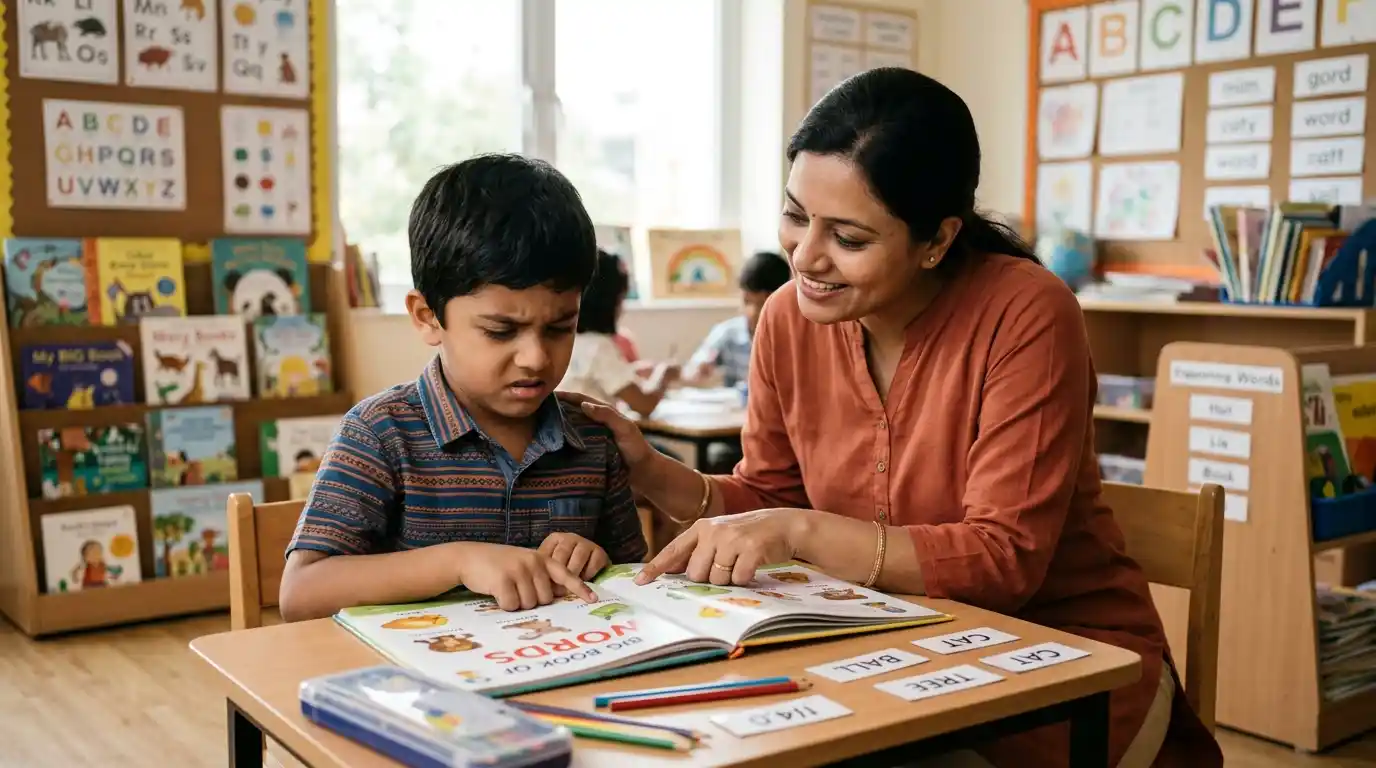
If you’ve found yourself watching your child stumble over the same word for the third time, or wincing every time reading homework comes up, you’re not alone and it doesn’t mean anything is “wrong” with your child.
Reading is actually a surprisingly complicated skill, built from several smaller ones working together: recognizing letters, connecting them to sounds, decoding words, building vocabulary, staying focused, and making sense of it all. A child can be completely fine in most of these areas and still get stuck in just one and that one sticking point can make reading feel like a daily struggle for the whole family.
Every child develops at their own pace, and that’s genuinely normal. But if the struggle keeps going day after day, it’s worth understanding why not writing it off as laziness or “just needing to try harder.”
So, Why Is My Child Struggling With Reading?
There are a lot of possible answers here, and honestly, more than one can be true at once. A child might be struggling with phonics, letter recognition, decoding unfamiliar words, reading smoothly, understanding vocabulary, comprehending what they’ve read, staying focused, or processing language more generally.
Some children have specific learning differences, like dyslexia. Others just haven’t had much exposure to books yet, missed a foundational building block somewhere along the way, or simply need to be taught in a different way than what’s worked for other kids their age.
The goal isn’t to slap a label on it right away. It’s to figure out which specific part of reading is actually hard for your child because that’s what tells you what kind of help will actually make a difference.
Signs Worth Paying Attention To
You might notice your child:
- Struggling to recognize letters or common, everyday words
- Having trouble connecting letters to the sounds they make
- Guessing at words instead of actually reading them
- Reading noticeably slowly for their age
- Skipping words, adding extra ones, or losing their place
- Mixing up or reversing letters and words
- Getting stuck sounding out anything unfamiliar
- Avoiding reading altogether, or finding excuses to skip it
- Getting visibly frustrated or upset when asked to read
- Forgetting what they just read moments later
- Struggling to answer basic questions about a story
- Having a hard time following written instructions
Seeing one or two of these every now and then isn’t a red flag on its own every child has an off day. But if you’re seeing several of these consistently, over weeks rather than days, that’s usually a sign it’s worth digging deeper.
Breaking Down the Most Common Reading Struggles
Reading isn’t one skill it’s several, stacked on top of each other. A child can be strong in one layer and genuinely stuck in another.
Trouble With Phonics
Phonics is basically the bridge between letters and sounds. A child who struggles here might know their individual letters just fine, but freeze when it’s time to blend those sounds together into a word like cat, ship, or train. Reading feels less like flowing and more like assembling a puzzle, one piece at a time.
Trouble Recognizing Words on Sight
Some kids just can’t seem to “bank” familiar words the way most readers do. Instead of instantly recognizing a word they’ve seen a hundred times, they have to sound it out from scratch every single time which makes reading exhausting long before it gets enjoyable.
Choppy, Effortful Reading (Poor Fluency)
Fluent reading is smooth, accurate, and paced naturally, almost like speaking. A child without it might read word-by-word, pause constantly, or sound flat and mechanical. And here’s the thing when so much brainpower goes into just decoding each word, there’s not much left over for actually understanding what the story’s about.
Reading the Words, Missing the Meaning
This one catches a lot of parents off guard, because the child can technically read the page out loud correctly they just can’t tell you what it was about afterward. They might struggle to pull out the main idea, remember key details, understand new vocabulary, connect ideas across the story, or answer simple questions about what happened. This is usually described as a comprehension difficulty, and it’s a completely different issue from not being able to sound out words.
Limited Vocabulary
Sometimes a child can technically decode a word perfectly and still have no idea what it means. A thinner vocabulary doesn’t just make reading harder it quietly affects performance across almost every subject in school, since so much learning happens through text.
Trouble Staying Focused
Reading takes sustained attention, and kids who struggle to hold that focus often lose their place, skip entire lines, or forget what they just read a paragraph ago. This doesn’t automatically mean there’s a specific reading disorder at play but it absolutely can slow down reading development if it’s not addressed.
Could It Be Dyslexia?
Maybe but not necessarily, and it’s worth being careful here.
Dyslexia is a specific learning difference that can affect reading, spelling, and the ability to recognize words accurately and fluently. Kids with dyslexia often have persistent, ongoing trouble connecting letters to sounds, decoding new words, reading smoothly, or spelling correctly even with plenty of practice.
But here’s the important part: not every child who struggles with reading has dyslexia. Plenty of the difficulties above have other causes entirely. If you suspect dyslexia, the right move is a proper assessment from a qualified professional not a guess based on a checklist, however tempting that shortcut is when you’re worried.
What Can You Actually Do to Help at Home?
The good news is that consistent, low-pressure practice really does make a difference over time.
Build reading into the daily routine. A short, regular reading window even just ten or fifteen minutes tends to help more than occasional long, forced sessions that leave everyone frustrated.
Read together, not just at them. Try taking turns you read a page, your child reads the next. It shares the load and keeps reading feeling collaborative instead of like a test.
Pick books at the right level. Something too far above their current ability tends to breed frustration fast. Look for books that stretch them a little without overwhelming them completely.
Talk about the story afterward. Simple questions go a long way: What happened? Who was your favorite character? What do you think happens next? Why do you think they did that? This builds comprehension skills in a way that feels like conversation, not homework.
Keep it pressure-free. Try not to let mistakes turn into a moment of embarrassment. Correct gently, encourage another try, and keep the overall tone warm. Kids who feel safe making mistakes tend to take more risks with reading — and that’s exactly what builds confidence.
When Is It Time to Get Outside Help?
If reading struggles are sticking around despite regular practice, or if you’re noticing your child’s confidence, schoolwork, or general willingness to read starting to slip, it’s a reasonable time to loop in a professional.
A proper evaluation can help pinpoint whether the root issue is phonics, language development, comprehension, attention, dyslexia, or something else entirely. And the earlier that’s identified, the easier it usually is to put the right support in place before frustration has a chance to snowball into avoidance.
One Thing Worth Remembering
Struggling with reading doesn’t mean your child isn’t smart, capable, or a strong learner. It really doesn’t.
Kids learn in different ways some grasp things instantly when they hear them out loud, see them visually, or get to try them hands-on, but hit a wall the moment the same information shows up as plain text on a page. That’s not a lack of intelligence. It’s just a different learning shape.
With the right support, consistent practice, and a patient environment, most kids genuinely do build stronger reading skills and just as importantly, they build back the confidence that often takes the biggest hit along the way.
Frequently Asked Questions
Why is my child suddenly struggling with reading? A sudden shift can come from several places harder material at school, changes in attention or focus, gaps in earlier foundational skills, language difficulties, or even emotional and environmental factors going on outside of reading itself. If it doesn’t ease up, it’s worth mentioning to your child’s teacher or a learning professional to help narrow down the cause.
What are the early signs of reading difficulties? Trouble learning letter sounds, recognizing common words, sounding out new words, remembering letters, rhyming, or connecting spoken sounds to written letters are all early signals worth watching for.
Is struggling with reading always a sign of dyslexia? Not necessarily it can be one possible sign, but reading struggles have many different causes. A proper assessment is the only reliable way to know what’s actually going on, rather than assuming based on symptoms alone.
Can a child actually overcome reading difficulties? Yes, very often. Many children make real, meaningful progress with the right instruction, consistent practice, and support tailored to their specific difficulty. What works depends heavily on which part of reading is the actual sticking point.
How can I help improve my child’s reading at home? Read together regularly, choose books that match their current level, practice sounding out unfamiliar words, talk through stories afterward, work on vocabulary, and keep the whole experience positive rather than pressured.
When should I get my child assessed for reading difficulties? If the struggles persist over time, are affecting school performance, are causing real frustration or avoidance, or simply aren’t improving with regular home and classroom support, it’s a reasonable point to seek a proper evaluation.
The Bottom Line
A child who’s struggling with reading usually just needs the right kind of support, not more pressure. Figuring out whether the issue sits in phonics, decoding, fluency, vocabulary, comprehension, attention, or somewhere else entirely is the real first step toward helping them.
Instead of asking “why won’t they just try harder?” a more useful question is usually “which part of reading is actually hard for them right now, and what would genuinely help?”
With early attention, patient support, and an environment where mistakes feel safe rather than shameful, most kids grow into confident, capable readers even if the road there looks a little different than it does for other children their age.